

Visit to a Jewish Community in Chile
| by Shayah Kosak ’27
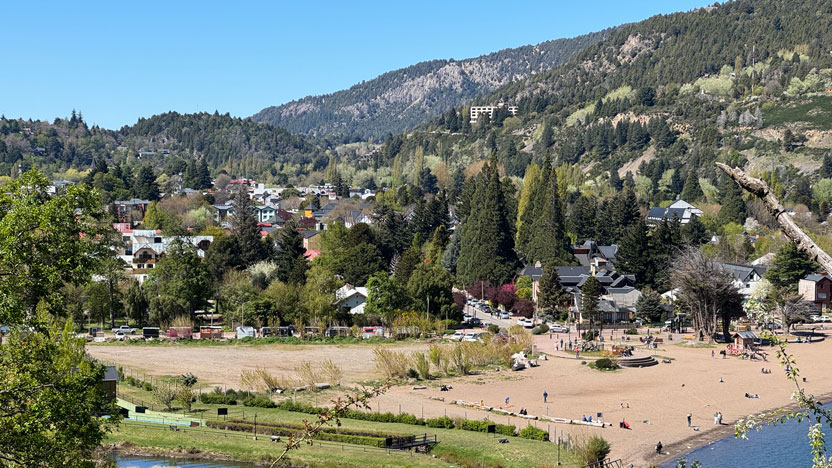
Growing up as a rabbi’s son, I’d never been too far away from a Jewish community. From attending Jewish day school to teaching at my synagogue’s Sunday school, I have always participated in Jewish activities as a core part of my life.
While the Jewish community in Middlebury is smaller than that in Portland, Oregon, my hometown, it is nonetheless a tight-knit group that has supported me significantly throughout my time in Vermont, and one that I have missed while studying abroad in southern Chile.
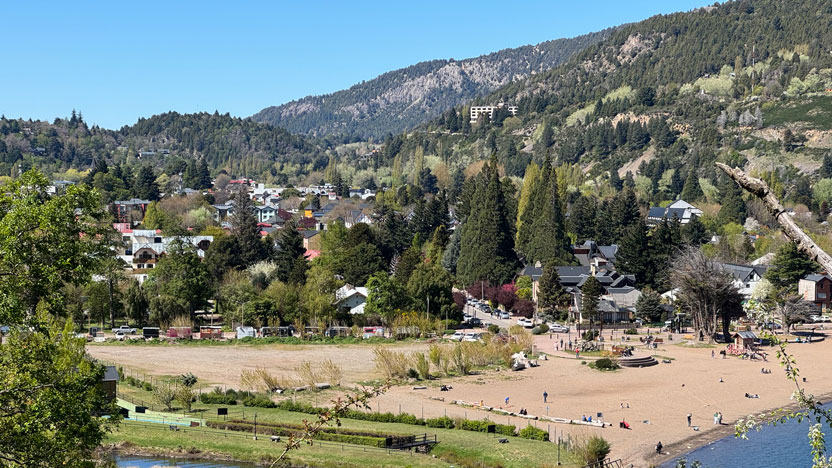
Valdivia, Chile’s “Pearl of the South,” is a small port city that I’ve called home since July. Here, I am usually the first Jew that anyone has ever met, and I often end up becoming an ambassador for the religion, explaining our traditions and culture to my host family and Chilean friends. While I greatly appreciate the genuine curiosity and respect shown regarding my background, it is a far cry from what I’ve experienced in the rest of my life. Of course, while deciding to spend a year in Valdivia, I knew that this would be the case. Chile is not particularly known for its Jewish community, with the vast majority of its roughly 20,000 Jews residing 500 miles north of Valdivia, in the nation’s capital of Santiago. Nevertheless, I felt it was important for me to spend time away from the Jewish community to better understand what my needs are and plan for my post-Middlebury life.
While I do not regret coming to Valdivia whatsoever, the lack of a Jewish community has been more challenging than I anticipated. It took me three months to run into another Jew, an Orthodox rabbi from Santiago who was passing through Valdivia. He was kind enough to give me his contact information and even managed to get a machzor (High Holiday prayer book) sent to me so I could celebrate the High Holidays. Still, even with the machzor, praying and fasting alone did not make for the most meaningful Yom Kippur. As Sukkotapproached, I knew I wanted to do something different. My Chilean university’s spring break (the seasons are flipped because of being in the southern hemisphere) was fast approaching, and it overlapped with the holiday. Going to Santiago was not in the cards, so I looked across the Andes to find a solution.
Argentina is home to the world’s sixth-largest Jewish community, with Jewish presence in the nation dating back to the 16th century with the arrival of the conversos, or Spanish and Portuguese Jews who converted to Christianity but practiced Judaism in secret. In the late 1800s, large waves of European Jews began arriving in the country, fleeing from increasing persecution and hoping to find a better life in the vast and largely undeveloped lands of Argentina. At this time, the German Jewish industrialist Maurice de Hirsch bought nearly 200,000 acres of agricultural land and sponsored Jewish migration to his property, intending to establish agricultural colonies where Jews could farm peacefully. While initially tenuous, his plan worked, giving rise to the oft-overlooked Jewish gaucho, or cowboy, a fleeting moment in our history. In time, however, the agricultural experiment gave way to urban consolidation. By the early 20th century, many of the settlers’ children left the colonies of Santa Fe and Entre Ríos for Buenos Aires, Rosario, and Córdoba, drawn by education, commerce, and the cultural vitality of city life. The rural dream had been real, but it was also transitional. What endured was not the gaucho on horseback, but the institutions built in his wake. Buenos Aires, in particular, became one of the great Jewish capitals of the Diaspora.
The neighborhood of Once was filled with Yiddish bookstores, Hebrew schools, labor unions, Zionist clubs, Bundist circles, kosher butchers, and cafés thick with political argument. By the interwar period, Argentina had one of the most vibrant Yiddish presses in the world, alongside a thriving theatrical scene that connected it culturally to Warsaw, Vilna, and New York. Although Buenos Aires became the center of Jewish Argentina, the country’s far south remained largely outside that story for most of its history. Patagonia, remote, sparsely populated, and economically marginal until the late 20th century, did not attract significant Jewish settlement in the early waves of immigration. The agricultural colonies were in the Pampas, the lowland plains; the cultural institutions were in the cities. The deep south was something else.
Only in recent years has this changed. In San Martín de los Andes, a group of local Jews inaugurated the first new synagogue in Patagonia in decades, opening a permanent space for prayer and community life that had previously taken place in homes and temporary gatherings.
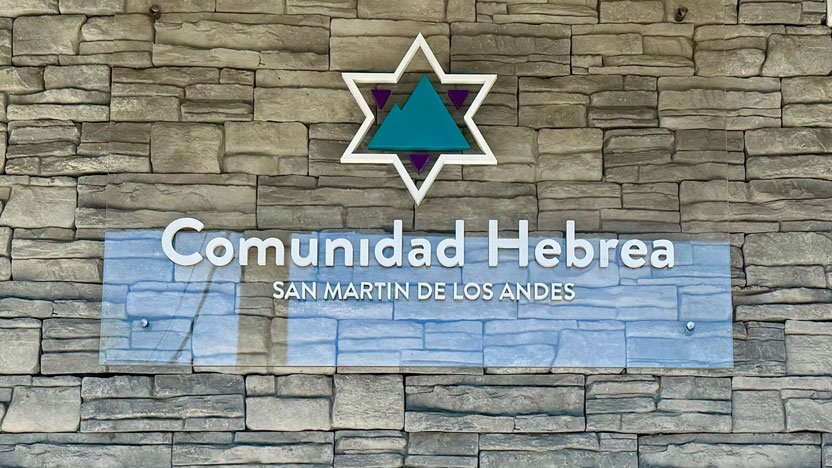
The synagogue is only the second Jewish institution in the entire Patagonian region, and unlike other new synagogues in Argentina, it is affiliated with the Conservative movement rather than Chabad-Lubavitch.
As a Conservative Jew myself, I thought there would be no better way than to join this small community for Sukkot. It would be particularly interesting to see what traditions we shared and learn the history of this Kehilla (community),such an oddity, not just in Argentina, but in the declining world of Conservative Judaism as a whole. So, I reached out to the community and asked about joining them for Shabbatand the holiday. Unsurprisingly, they responded with enthusiasm, and a couple of weeks later, with funding from the Scott Center, I made my way to San Martín, arriving just in time for Kabbalat Shabbat. I remember being hit with a wave of emotion during the recital of Mizmor Shir, Psalm 92, whose words reflected the gratitude I felt for being reunited with the larger Jewish community.
Moreover, because San Martín’s Kehilla is Conservative, much of their Nusach was extremely similar to that of my synagogue back in the U.S. It is an incredibly unique and profound experience to feel like you are at home when you are physically distant from your family and country. After the service, I chatted with the members of the synagogue, who were overjoyed to have a guest and surprised to learn that I spoke Spanish. They had assumed I was using a translator in my communication with them. Sharing a language in addition to the aforementioned religious similarities strengthened our connection even more. Despite just having met each other, it felt more like being with family than being with strangers. It is in moments such as this one where I am most grateful for and proud of my Jewish identity and its remarkable power to connect me with my brethren wherever they may be.
On Shabbat day, I was given a walking tour of the town by Judi, a day-school teacher from Buenos Aires who comes down to San Martín to chant Torahfor the community during major holidays. We discussed Jewish life in Argentina, and she told me the story of how her family migrated from Syria generations ago. Aside from the U.S. and Israel, Argentina has the largest Jewish population of any country I’ve visited, and I was struck by how similar many things felt to the United States. Being Jewish or interacting with Jewish culture is nearly as prevalent in Argentina as in the U.S. It doesn’t come across as odd or unique as it may in other countries like Chile. I’ve spoken with many non-Jewish Argentinians from around the country and have been shocked by how knowledgeable they are on Judaism. I find it refreshing to be reminded that something like this exists beyond the United States and Israel. While antisemitism exists everywhere, I was told by the community in San Martín that it isn’t something they ever really have to think about.
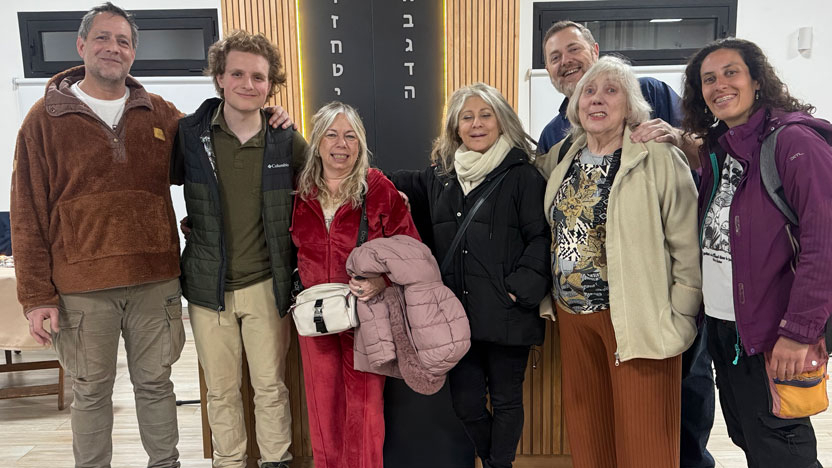
Nonetheless, being a small community in Patagonia does pose certain challenges. There was no place for a communal sukkah, nor were we able to read from the Torah for Sukkot, given the lack of a minyan, or quorum of 10 Jews.Yet despite this, I felt satisfied with my Sukkot in Argentina. I was able to spend the holiday with my newfound family, all while learning about a community that has only formally existed since 2022. Visiting San Martín’s Kehilla for Sukkot reminded me of the sukkah itself: not the shelter I’m used to, but another temporary dwelling along the same long journey—different in its beams and branches yet held together by the same story.