
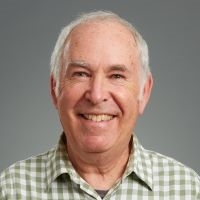
Pete Schumer
John C. Baldwin Professor Emeritus of Mathematics and Natural Philosophy
- schumer@middlebury.edu
- Office Hours
- Office hours by appointment via email
Peter Schumer is a Professor of Mathematics and is currently the John C. Baldwin Professor of Mathematics and Natural Philosophy. He has been at Middlebury College since 1983 after receiving his B.S. and M.S. degrees from Rensselaer Polytechnic Institute and a Ph.D. from University of Maryland at College Park.
He is the author of two books, Introduction to Number Theory (PWS) and Mathematical Journeys (Wiley) in addition to many articles in the fields of number theory and the history of mathematics. He has been the recipient of the Trevor Evans Award of the Mathematical Association of America for his article, “The Magician of Budapest” as well as having received the North American Teacher of the Year award from the American Go Federation.
Pete has had sabbaticals at University of California San Diego, San Jose State University, Stanford, and at Keio University, Doshisha University, and International Christian University in Japan. Hobbies include playing go, juggling, seeing the latest films, travel, and hiking trails around Middlebury.
Courses Taught
MATH 0122
Calculus II
Course Description
Calculus II
A continuation of MATH 0121, may be elected by first-year students who have had an introduction to analytic geometry and calculus in secondary school. Topics include a brief review of natural logarithm and exponential functions, calculus of the elementary transcendental functions, techniques of integration, improper integrals, applications of integrals including problems of finding volumes, infinite series and Taylor's theorem, polar coordinates, ordinary differential equations. MATH 0121 or equivalent, or by placement) 4 hrs. lect/disc.
Terms Taught
Requirements
MATH 0500
Advanced Study
Course Description
Advanced Study
Individual study for qualified students in more advanced topics in algebra, number theory, real or complex analysis, topology. Particularly suited for those who enter with advanced standing. (Approval required) 3 hrs. lect./disc.
Terms Taught
MATH 0741
Advanced Number Theory
Course Description
Advanced Number Theory
A senior tutorial on some topics in advanced elementary number theory and an introduction to analytic number theory. In this course we will review key areas of elementary number theory and abstract algebra followed by the study of integer partitions, continued fractions, rational approximations of irrationals, primes and primality testing, the average order of magnitude of several number theoretic functions, the Basel problem, Bernoulli numbers, and the Riemann zeta function. (MATH 0241 or MATH 0302) 3 hrs. sem.
Terms Taught
Requirements
MATH 1001
The Game of Go
Course Description
The Game of Go
Go is the most ancient of all East Asian board games and the most challenging in play. It combines the logic of mathematics with the aesthetic appeal of music and art. Despite this, it is a simple game to learn and is enjoyed by approximately 40 million enthusiasts the world over including over 1000 dedicated professionals. The course will involve playing, recording, analyzing, and critiquing our games and learning about its history and the cultures in which it flourishes. We will also read and write about various related Japanese arts and traditions including the latest AI developments.
Terms Taught
Requirements
MATH 1011
Math Circus
Course Description
Math Circus
Each class will entail small group work solving various logic and puzzle problems, mathematical conundrums, and devising winning strategies for various games and challenges. Students will present their solutions to the class and work on their own puzzles and games pamphlet to be completed by the end of the term. Elementary mathematical, logical, game theoretic, and probability concepts will be introduced as needed with the goal of increasing everyone's problem solving and analytical thinking skills. The class will meet four days a week (2 hours per class).
Terms Taught
Requirements
Academic Degrees
B.S. and M.S. degrees from Rensselaer Polytechnic Institute and a Ph.D. from University of Maryland at College Park
Publications
Introduction to Number Theory (PWS) and Mathematical Journeys (Wiley)