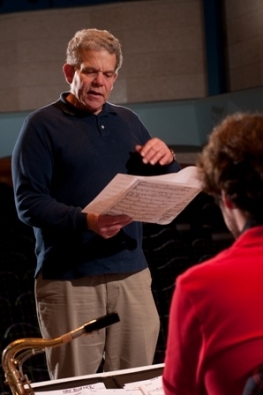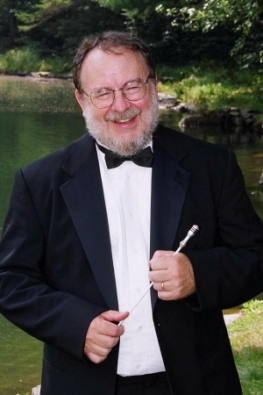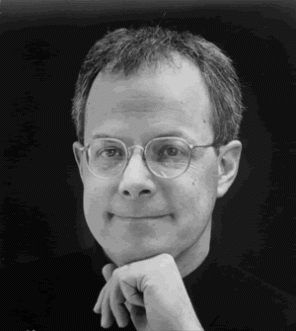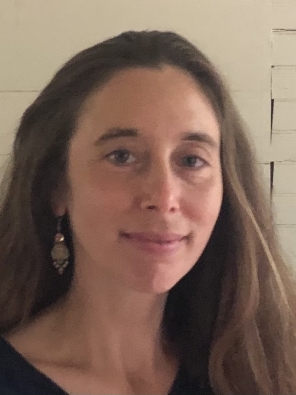
Greg Vitercik
Professor of Music
Email: vitercik@middlebury.edu
Phone: work802.443.5071
Download Contact Information
Greg Vitercik received his BA from Columbia University. He spent two years in Paris studying theory and composition with Nadia Boulanger. He has a Master's and PhD in critical musicology from the State University of New York at Stony Brook. He has been on the faculty at Middlebury College since 1986, teaching music history, theory, analysis, and performance.
Courses
Courses offered in the past four years.
▲ indicates offered in the current term
▹ indicates offered in the upcoming term[s]
FYSE 1132 - Shakespeare and Music ▲
Sounds and Sweet Airs: Shakespeare and Music
Shakespeare's plays are the stories we tell ourselves to explain to ourselves who we are. We have told them over and over, and they have proven to be infinitely adaptable to our needs. Composers, too, have been drawn to them from the beginning, adding their music to the music of Shakespeare's language. In this seminar we will study a number of plays, among them Romeo and Juliet, Hamlet, Othello, Macbeth, and A Midsummer Night's Dream, and the operas, ballets, film scores, and symphonic works they have inspired from the 17th century to the present.
Fall 2013
FYSE 1315 - Wagner's Ring
Wagner's Ring: The Twilight of the Gods and the Invention of the Twentieth Century
The four operas of Wagner's Ring des Niebelungen represent one of the most imposing documents of modern Western civilization. This monumental work sums up central strands of 19th century philosophical, political, social, and musical thought and in all those realms it has served as a foundation for key thinkers, ideologies, and cultural productions that shaped the 20th century, from Freud and Jung to Nazism and film scores. We will explore the operas and their sources in depth through listening, reading, and regular viewing sessions, as well as consider the way Wagner’s art has shaped rather than simply mirrored European history. (No previous musical experience is required or expected.)
Fall 2010
HIST 0256 / MUSC 0256 - Topics in Eur Cult and Hist
Topics in European Culture and History: Paris-Vienna-Moscow: The Birth of Modernism
The years between 1890 and 1920 represent one of the most creative periods in European history: the incubation of a new artistic culture which we call Modernism. In this course we will explore the cultural ferment in France, Austria and Russia during these crucial decades through the political, artistic, and musical history of the period. Readings will include Dostoevsky, Bely, Huysmans and duGard,. The Russian Realists, Suprematists, and Constructivists, as well as the Impressionists, Post-Impressionists, and Cubists and Viennese Secession will be discussed. The music of Mussorgsky, Rimskii-Korsakov, Stravinsky, Debussy, Satie and Mahler among others will be considered.
Spring 2010
MUSC 0101 - Introduction to Western Music
Introduction to Western Music
This course is designed to introduce students to the music created by the men and women of Western civilization. The styles and genres of art music from the Middle Ages to the present will be a focus for the course. The relationship of music to society, historical context, and the other arts will also be examined. Music reading skills are not required. 3 hrs. lect./disc.
Spring 2010, Spring 2011
MUSC 0102 - Concert Experience
The Concert Experience
Music exists primarily in performance. In this course we will attend various performances and use them as a vehicle for studying the history, form, and social role of the music. While western classical music will be at the center of class activities, we will also explore other musical styles for comparison and try to understand how concert presentation reflects the cultural context and musical meaning of a particular musical style. Attendance at the concerts involved is mandatory. 3 hrs lect.
Spring 2012
MUSC 0130 - Topics in Music
Topic is determined by the instructor - refer to section for the course description.
ARTSpring 2012, Spring 2013
MUSC 0160 - Music Theory I: Fundamentals
Music Theory I: Fundamentals
This course is an introduction to the basic elements and theoretical concepts of Western music. We will focus on such topics as basic keyboard skills, sight singing, musical notation, rhythm, and harmony. Theoretical work and drills will be combined with compositional and performance projects. The goal of the course is to expand students’ musical intuition and skill and to provide the technical basis for further music study. No prior musical experience is required. (Students who wish to take upper-level composition or music theory courses must either complete this course or pass a theory and musicianship test administered by the department to demonstrate equivalent experience.) (Formerly MUSC 0109). 2 hrs. lect./1 hr. lab.
Fall 2011
MUSC 0220 - Music History I ▲
Music History I: Music to 1800
In this course we will survey Western art music from the earliest notated Medieval music through the Renaissance, Baroque, and Classical periods. Beginning with Gregorian chant and troubadour song, we will explore Renaissance vocal polyphony, the development of opera and instrumental music in the 17th century, the late Baroque music of Bach and Handel, and the Viennese classicism of Haydn and Mozart. Analysis of the music is supplemented by consideration of the ways in which music relates to the other arts and reflects the history and culture of its time. (Assumes ability to read music.) 3 hrs. lect.
Fall 2009, Fall 2011, Fall 2013
MUSC 0221 - Music History II
Music History II: Music Since 1800
This course is a survey of the principle genres and forms of Western art music from Beethoven to the present day. The approach of the course is historical, analytical, and cultural; we will try to understand the music both as music and as it reflects its times and the concerns of composers and their audience. (Assumes ability to read music.) 3 hrs. lect.
Spring 2010, Spring 2011, Spring 2013
MUSC 0240 - Performing Chamber Music
Performing Chamber Music
In this course for intermediate to advanced performers we will explore the art of collaborative music making in the classical tradition. Students will form small vocal and instrumental ensembles (2–6 players) at the beginning of the semester or may enroll in the course as an established ensemble. Repertoire will be determined in collaboration with instructor. Weekly coaching sessions for each group and master classes for all groups will culminate in at least one end-of-semester performance and writing assignment. In addition to technical performance issues, master classes and readings will consider group dynamics, rehearsal techniques, and interpersonal aspects of musical collaboration. Although previous chamber music experience is not required, students should be experienced performers of notation-based music. 3 hrs. lect/disc.
Fall 2009, Fall 2010
MUSC 0500 - Independent Study ▲ ▹
Independent Study
Admission by approval. Please consult published departmental guidelines and paragraph below.
Project and budget proposals for Independent Study and Senior Work should be submitted by the previous April 1 for fall and winter term projects, and the previous October 15 for spring term projects. Budget proposals will not be considered after those dates. Project proposals will be considered after the deadline but are more likely not to be approved due to previous commitments of faculty advisors or other scheduling reasons.
Fall 2009, Winter 2010, Spring 2010, Fall 2010, Winter 2011, Spring 2011, Fall 2011, Winter 2012, Spring 2012, Fall 2012, Winter 2013, Spring 2013, Fall 2013, Spring 2014
MUSC 0704 - Senior Work ▲ ▹
Senior Work
Senior work is not required of all music majors and joint majors. However, students interested in and eligible for departmental honors (see guideline above, in "Departmental Honors" section) may propose one or two-semester Senior Work projects. Projects may be in history, composition, theory, ethnomusicology, performance, or electronic music, and should culminate in a written presentation, a public performance, or a combination of the two. MUSC0704 does not count as a course toward fulfillment of the music major.
Project and budget proposals for Independent Study and Senior Work should be submitted by the previous April 1 for fall and winter term projects, and the previous October 15 for spring term projects. Budget proposals will not be considered after those dates. Project proposals will be considered after the deadline but are more likely not to be approved due to previous commitments of faculty advisors or other scheduling reasons.
Fall 2009, Winter 2010, Spring 2010, Fall 2010, Winter 2011, Spring 2011, Fall 2011, Winter 2012, Spring 2012, Fall 2012, Winter 2013, Spring 2013, Fall 2013, Spring 2014
MUSC 1006 - Who's Afraid of Guiseppe Verde
Who's Afraid of Giuseppe Verdi?
Can't tell a cabaletta from a cannoli? Do you ever have the uncomfortable feeling that "Kill da wabbit, kill da wabbit" might NOT be the real words to that song? This course will set you straight. We will explore the grandeur, passion, subtlety, humor, human insight, and astonishing beauty of opera, from its beginnings in the aristocratic courts of 17th-century Italy to the masterpieces of Handel and Mozart, the larger-than-life canvasses of Verdi and Wagner, the expressionist horrors of Strauss and Berg, and on to the present day.
Winter 2010
MUSC 1013 - American Musical/Performance
The American Musical in Performance
A survey of the American Musical will lay the groundwork for a fully-mounted production of a significant work. The production, staged at Middlebury’s Town Hall Theater, will be a collaboration of college faculty, student actors, musicians and designers, and area residents. The production also involves collaboration with the Department of Theater. A theater major gets advanced credit for designing and building costumes for the show. (Approval required; please contact Doug Anderson at danders@middlebury.edu">middlebury.edu or Carol Christensen at christen@middlebury.edu)
Winter 2011
MUSC 1020 - Introduction to Opera
Introduction to Opera
Opera takes place in a strange world where everyone sings. All the time. That world resonates with passions that cannot be expressed in words alone; its inhabitants cannot help but burst into song. When we visit a world where no feeling or thought is left unsung, the barriers between us are broken down, empathy becomes beguiling, and the human condition is exposed in all its beauty and terror. In this course we will explore in depth through readings, discussion, and screenings some of the most powerful statements about that condition in operas by Mozart, Verdi, Wagner, and Alban Berg. This course counts as a performance elective or as an elective for courses at the 0200-level and above.
Winter 2012