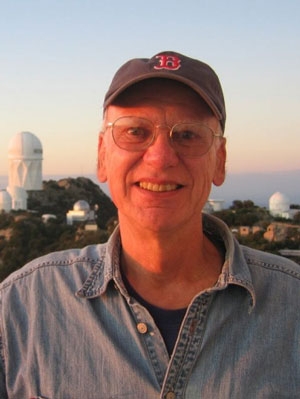
P. Frank Winkler
Gamaliel Painter Bicentennial Professor of Physics
Email: winkler@middlebury.edu
Phone: work802.443.5426
Office Hours: Associate Status, by appointment only
Download Contact Information
B.S. California Institute of Technology
Ph.D. Harvard University
Joined the Middlebury College faculty in 1969
I am a professor in the Department of Physics at Middlebury College, where I have been a member of the faculty since 1969. My current research centers around supernovae, supernova remnants, and the interstellar medium. Simply put, I am interested in how stars blow up, what is left after they do, and how they enrich the cosmos in heavy elements like oxygen, carbon, silicon, iron, etc.—the elements that play a crucial role in the development of planets and life on them.
I have taught most of the courses in the Physics Curriculum at Middlebury at one time or another, but I am now on Associate Status, teaching only in the Fall Term, when I teach two somewhat different versions of our introductory astronomy course.
A more-or-less complete CV can be found here.
Research
My research is based on observations carried out across the electromagnetic spectrum, primarily optical (using facilities such as Kitt Peak National Observatory, Cerro Tololo Inter-American Observatory, Gemini and the Hubble Space Telescope), and X-rays (primarily using the Chandra X-ray Observatory).
I am particularly interested in young supernova remnants—ones where we can still find clues about the nature of supernova explosions, the stars that led to them, and the debris that results.
Recent Publications
The Chandra ACIS Survey of M33: X-ray, Optical and Radio Properties of the Supernova Remnants (Long et al. 2010)
Non-Maxwellian Hα Profiles in Tycho's Supernova Remnant
Chandra ACIS Survey of M33 (ChASeM33): The Enigmatic X-Ray Emission from IC131 (Tüllmann et al. 2009)
Spitzer Spectroscopy of the Galactic Supernova Remnant G292.0+1.8: Structure and Composition of the Oxygen-Rich Ejecta (Ghavamian et al. 2009)
The First X-Ray Proper-Motion Measurements of the Forward Shock in the Northeastern Limb of SN 1006 (Katsuda et al. 2009)
Expanding Ejecta in the Oxygen-Rich Supernova Remnant G292.0+1.8: Direct Measurement Through Proper Motions (Winkler et al. 2009)
Teaching
Every Fall Term, I teach two versions of introductory astronomy:
Physics 0155, "Introduction to the Universe" is open to all students, regardless of background. For more details ab
Physics 0165, "Physics in the Universe" is a more analytical version, and is open to students who have taken Phys0109 (Newtonian Physics) or another college-level physics course (e.g., AP physics), and a semester of calculus (e.g., Math0112).
For more information about the Fall 2011 versions of these courses, see: PHYS0155, Fall 2011 or PHYS0165, Fall 2011
Courses
Courses offered in the past four years.
▲ indicates offered in the current term
▹ indicates offered in the upcoming term[s]
PHYS 0111 - Thermo, Fluids, Waves & Optics
Thermodynamics, Fluids, Wave Motion, and Optics
This lecture and laboratory course covers concepts from classical physics that are not included in PHYS 0109 and PHYS 0110, and that serve as a bridge between those two courses. Topics include thermal properties of matter, thermodynamics, fluid mechanics, wave motion, sound, and geometrical and physical optics. This course is strongly recommended for all students otherwise required to take PHYS 0109 and PHYS 0110 as part of a major or a premedical program, and is required for physics majors. (PHYS 0109 or equivalent)
Winter 2010, Winter 2011
PHYS 0155 / PHYS 0165 - Introduction to the Universe
An Introduction to the Universe
Our universe comprises billions of galaxies in a rapidly expanding fabric. How did it begin? Will it expand forever, or how may it end? How do the stars that compose the galaxies evolve from their births in clouds of gas, through the tranquility of middle age, to their often violent deaths? How can scientists even hope to answer such cosmic questions from our vantage point on a small planet, orbiting a very ordinary star? Are there other planets, orbiting other stars, where intelligent beings may be pondering similar issues? This introductory astronomy course, designed for nonscience majors, will explore these and other questions. Students will also become familiar with the night sky, both as part of our natural environment and as a scientific resource, through independent observations and sessions at the College Observatory. The approach requires no college-level mathematics, but students should expect to do quantitative calculations using scientific notation and occasionally to use elementary high-school algebra. (Students may not receive credit for both PHYS 0155 and PHYS 0165.) 3 hrs. lect., 2 hrs. lab./disc.
Fall 2009, Fall 2010, Fall 2011, Fall 2012
PHYS 0500 - Ind. Study & Special Topic ▹
Independent Study and Special Topics
(Approval required)
Fall 2009, Fall 2010, Fall 2011, Fall 2012, Winter 2013, Spring 2013, Spring 2014
PHYS 0704 - Senior Project
Senior Project
Independent research project culminating in both written and oral presentations.
Fall 2011, Fall 2012
PHYS 0705 - Senior Research & Thesis ▹
Senior Research and Thesis
Independent research in the fall, winter, and spring terms culminating in a written thesis (two units total). (Approval required)
Spring 2009, Fall 2009, Fall 2010, Fall 2011, Fall 2012, Winter 2013, Spring 2013, Spring 2014