
Robert Greeley
Faculty
Email: rgreeley@middlebury.edu
Phone: work802.443.2006
Download Contact Information
Robert Greeley obtained his B.A. in Arabic from the University of Utah and his M.A. in Arabic literature from UC Berkeley. He was then a lecturer at Emory University and is currently working on his doctorate in Human Geography at the University of South Carolina. Bob has spent a number of years living in various parts of the Middle East.
Courses
Courses offered in the past four years.
▲ indicates offered in the current term
▹ indicates offered in the upcoming term[s]
ARBC 3201 - Intermediate Arabic
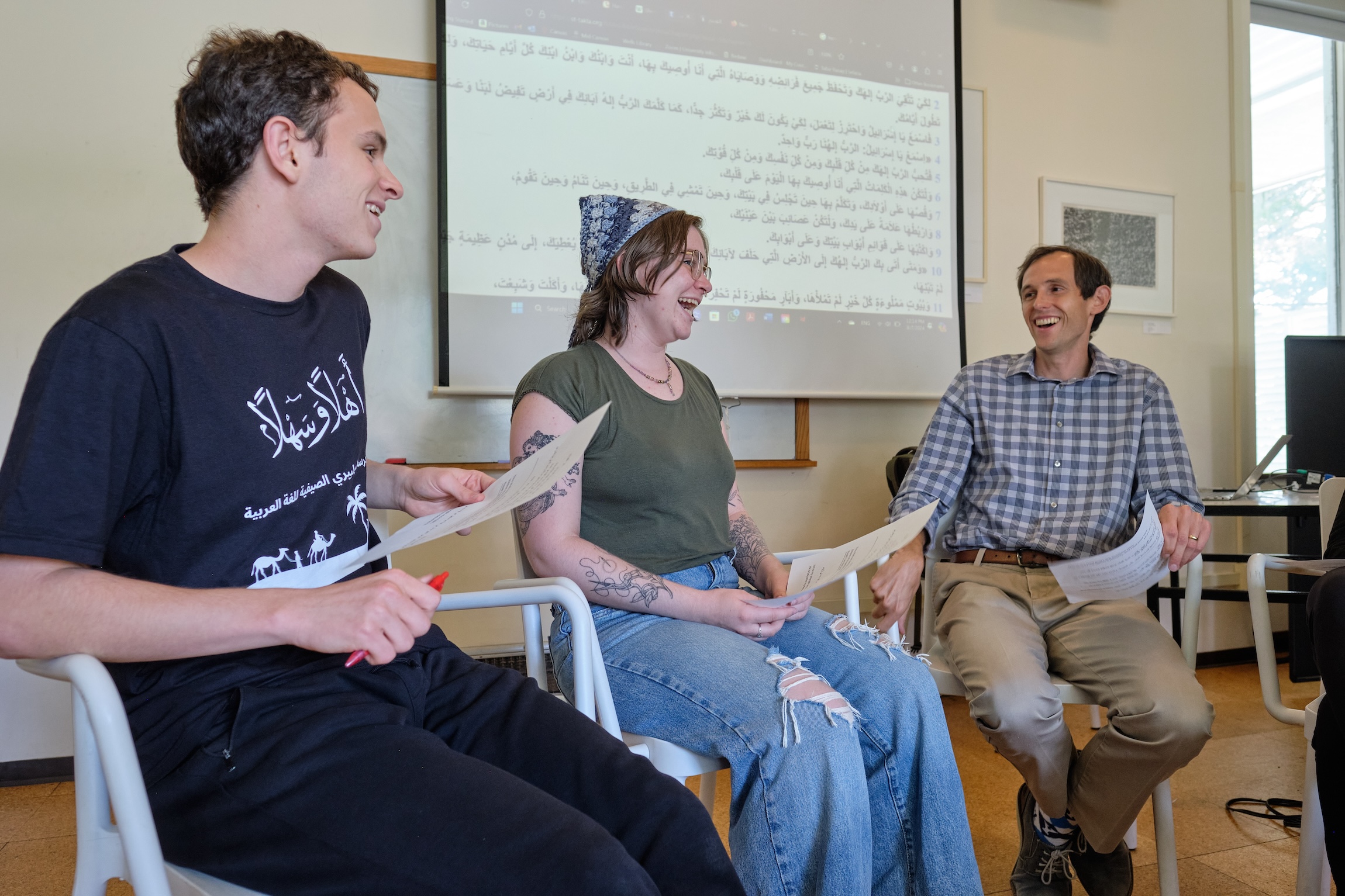
Students placed in Level 2 normally have taken two or three semesters of Arabic in an academic setting and have knowledge of the basic grammatical and lexical features of Arabic. Sometimes a "lower intermediate" class is created to accommodate those students whose proficiency and language skills require that they go at a slower speed than regular intermediate students. Typically, students in the lower intermediate class have finished only two semesters of college Arabic, or more than two semesters but have been away from the language for some time. The objectives of Intermediate Arabic are, in general, to solidify knowledge of the basic rules of Arabic grammar, to expand vocabulary in terms of complexity, and to increase the acquisition of words for active use in a wide variety of topics and settings. Emphasis is placed on the use of authentic reading and listening materials, and on communicative writing and speaking tasks. Students at the intermediate level are required to go to all Arabic lectures and movies. Usually, there are homework assignments designed to enhance each student's benefit from the cultural activities. At the end of the course, students at the intermediate level are expected to write a long composition of at least 1,200 words. Oral presentations of 15 to 20 minutes are regular activities at this level. In addition, work outside of class requires an average of four to five hours a day. (1 unit)
Required Texts:
1) Al-Kitaab fii Tacallum al-cArabiyya: A Textbook for Beginning Arabic, Part I, Second Edition, by Brustad, Al-Batal and Al-Tonsi, Georgetown University Press, 2004.
2) Al-Kitaab fii Tacallum al-cArabiyya, Part II, Second Edition, by Brustad, Al-Batal, and Al-Tonsi, Georgetown University Press, 2006.
3) The Hans Wehr Dictionary of Modern Written Arabic, Spoken Languages Services.
Summer 2010, Summer 2011
ARBC 3202 - Intermediate Arabic
Students placed in Level 2 normally have taken two or three semesters of Arabic in an academic setting and have knowledge of the basic grammatical and lexical features of Arabic. Sometimes a "lower intermediate" class is created to accommodate those students whose proficiency and language skills require that they go at a slower speed than regular intermediate students. Typically, students in the lower intermediate class have finished only two semesters of college Arabic, or more than two semesters but have been away from the language for some time. The objectives of Intermediate Arabic are, in general, to solidify knowledge of the basic rules of Arabic grammar, to expand vocabulary in terms of complexity, and to increase the acquisition of words for active use in a wide variety of topics and settings. Emphasis is placed on the use of authentic reading and listening materials, and on communicative writing and speaking tasks. Students at the intermediate level are required to go to all Arabic lectures and movies. Usually, there are homework assignments designed to enhance each student's benefit from the cultural activities. At the end of the course, students at the intermediate level are expected to write a long composition of at least 1,200 words. Oral presentations of 15 to 20 minutes are regular activities at this level. In addition, work outside of class requires an average of four to five hours a day. (1 unit)
Required Texts:
1) Al-Kitaab fii Tacallum al-cArabiyya: A Textbook for Beginning Arabic, Part I, Second Edition, by Brustad, Al-Batal and Al-Tonsi, Georgetown University Press, 2004.
2) Al-Kitaab fii Tacallum al-cArabiyya, Part II, Second Edition, by Brustad, Al-Batal, and Al-Tonsi, Georgetown University Press, 2006.
3) The Hans Wehr Dictionary of Modern Written Arabic, Spoken Languages Services.
Summer 2010, Summer 2011
ARBC 3203 - Intermediate Arabic
Students placed in Level 2 normally have taken two or three semesters of Arabic in an academic setting and have knowledge of the basic grammatical and lexical features of Arabic. Sometimes a "lower intermediate" class is created to accommodate those students whose proficiency and language skills require that they go at a slower speed than regular intermediate students. Typically, students in the lower intermediate class have finished only two semesters of college Arabic, or more than two semesters but have been away from the language for some time. The objectives of Intermediate Arabic are, in general, to solidify knowledge of the basic rules of Arabic grammar, to expand vocabulary in terms of complexity, and to increase the acquisition of words for active use in a wide variety of topics and settings. Emphasis is placed on the use of authentic reading and listening materials, and on communicative writing and speaking tasks. Students at the intermediate level are required to go to all Arabic lectures and movies. Usually, there are homework assignments designed to enhance each student's benefit from the cultural activities. At the end of the course, students at the intermediate level are expected to write a long composition of at least 1,200 words. Oral presentations of 15 to 20 minutes are regular activities at this level. In addition, work outside of class requires an average of four to five hours a day. (1 unit)
Required Texts:
1) Al-Kitaab fii Tacallum al-cArabiyya: A Textbook for Beginning Arabic, Part I, Second Edition, by Brustad, Al-Batal and Al-Tonsi, Georgetown University Press, 2004.
2) Al-Kitaab fii Tacallum al-cArabiyya, Part II, Second Edition, by Brustad, Al-Batal, and Al-Tonsi, Georgetown University Press, 2006.
3) The Hans Wehr Dictionary of Modern Written Arabic, Spoken Languages Services.
Summer 2010, Summer 2011
ARBC 3204 - Intermediate Arabic
Students placed in Level 2 normally have taken two or three semesters of Arabic in an academic setting and have knowledge of the basic grammatical and lexical features of Arabic. Sometimes a "lower intermediate" class is created to accommodate those students whose proficiency and language skills require that they go at a slower speed than regular intermediate students. Typically, students in the lower intermediate class have finished only two semesters of college Arabic, or more than two semesters but have been away from the language for some time. The objectives of Intermediate Arabic are, in general, to solidify knowledge of the basic rules of Arabic grammar, to expand vocabulary in terms of complexity, and to increase the acquisition of words for active use in a wide variety of topics and settings. Emphasis is placed on the use of authentic reading and listening materials, and on communicative writing and speaking tasks. Students at the intermediate level are required to go to all Arabic lectures and movies. Usually, there are homework assignments designed to enhance each student's benefit from the cultural activities. At the end of the course, students at the intermediate level are expected to write a long composition of at least 1,200 words. Oral presentations of 15 to 20 minutes are regular activities at this level. In addition, work outside of class requires an average of four to five hours a day. (1 unit)
Required Texts:
1) Al-Kitaab fii Tacallum al-cArabiyya: A Textbook for Beginning Arabic, Part I, Second Edition, by Brustad, Al-Batal and Al-Tonsi, Georgetown University Press, 2004.
2) Al-Kitaab fii Tacallum al-cArabiyya, Part II, Second Edition, by Brustad, Al-Batal, and Al-Tonsi, Georgetown University Press, 2006.
3) The Hans Wehr Dictionary of Modern Written Arabic, Spoken Languages Services.
Summer 2010, Summer 2011