

Psychology Students Connect with Community and Purpose
When Associate Professor of Psychology Gina Thomas arrived at Middlebury College in 2020, she brought with her an idea for teaching child development that extended beyond the classroom. Professor Thomas has long believed that students better understand children’s development when they can apply what they are learning in a real-world setting, whether that is by working directly with children or on their behalf. At the time, this experiential learning approach was new territory for Professor Thomas, but she felt certain that with guidance she could build a course that would make the theories and concepts behind child psychology feel alive and relevant to her students.
Thomas found that guidance at the Center for Community Engagement (CCE). With the support of CCE staff and a trained Community Engagement Project Assistant, she used a research-based framework and strategies to design and launch her community-connected learning course with confidence. That first version of the course was much smaller in scope than what the class is today. “I had only a few community partners […] Every semester I would do something else to refine it or add something else to deepen it.” That steady process of growth helped make the course both effective and sustainable.
Today, Psych0225 is a fully realized immersive learning experience built around a semester-long cycle that begins with outreach to community partners. Thomas works with these local partners to identify projects that are useful to the organizations, meaningful for students, and manageable within the course timeline. Projects might include volunteering for storytime at the Isley Library, working in the afterschool program at Mary Hogan Elementary School, or with a local child care center. For students with schedule or transportation constraints, a remote option is always available that is often centered on policy or advocacy work with organizations such as United Way, Let’s Grow Kids, or Hunger Free Vermont. Once all the project options are finalized, students rank their preferences and Professor Thomas assigns groups of four to six students to each project, knowing that a good match is essential to success.
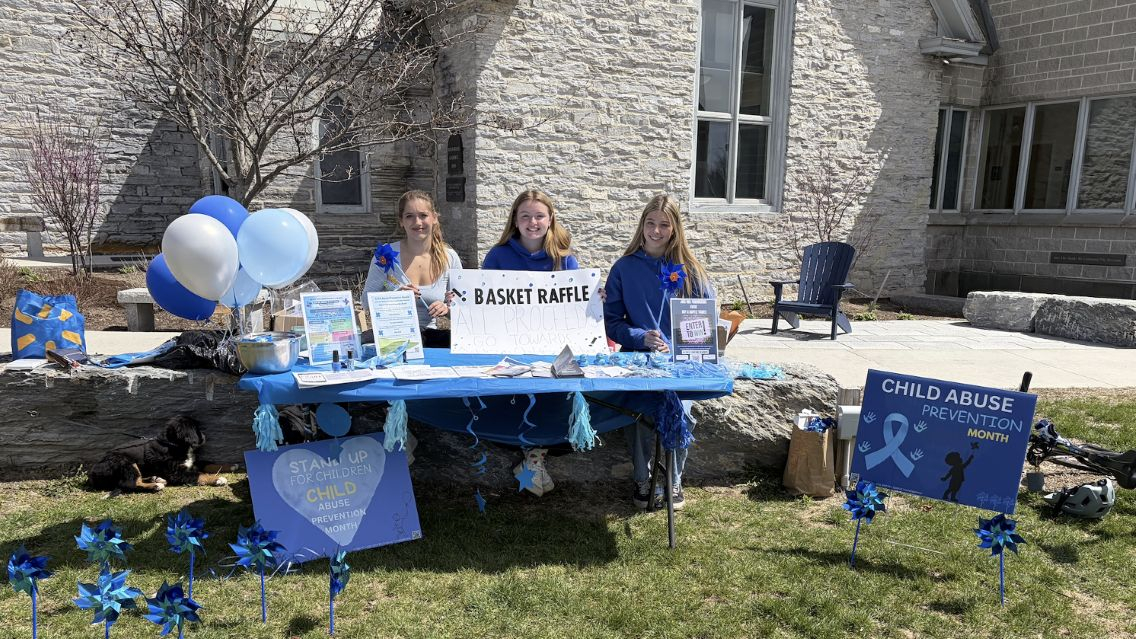
After five years of teaching Psych0225, Thomas has refined the course into a clear structure with four distinct phases. The course begins with students researching their organization project and meeting with their community partner for an orientation. They then write a short paper about the anticipated project, including their hopes, concerns, and any assumptions they might have about the issues they will be engaging with, whether it’s child care or child-abuse prevention. In the second phase, which makes up most of the course, students spend three to five hours a week for seven weeks completing the project. During this time, they volunteer in classrooms or at daycare centers, plan fundraisers, interview community members or conduct research. Every week, they submit activity logs and field notes to Professor Thomas, a practice borrowed from anthropology. The combination helps students engage with the research and theories they are studying in a lasting and meaningful way. The course concludes with student presentations, a paper that links theory to their observations, a final assessment, and a personal reflection.
Thomas says student reflections reveal the powerful impacts of the course. “I find that students often realize that they underestimate children […] I think it gives them a greater respect for all the things kids are having to process on a daily basis, and how complex their learning is.” For some students, Psych0225 confirms a career path they already hoped to pursue. For others, it introduces a field or profession they had not known about before. In both cases, the course gives students a chance to explore possible futures in a tangible way. Caroline Byrne ’28, a psychology major who completed the Spring 2026 course and plans to pursue a master’s degree in child psychology, described the experience this way:
“This project was one of the most formative academic experiences I have ever had. It has given me new insight into a future career tied to child development and allowed me to make the next steps in my career path. This class has allowed me to find the thing that makes me feel excited to do schoolwork, and I am so appreciative of the opportunity and the community connections to make the experience more tangible.”
Other students who have worked on advocacy or policy have witnessed how their applied skills and knowledge can affect change on a broader scale. For example, in 2023, Vermont lawmakers passed H.165, a bill that established permanent universal free lunch for every child in the public school system. Psych0225 students were on the very team that presented the brief to legislators who went on to vote the bill into law.
Looking back, Thomas believes the course succeeded because it started small and she built it up mindfully over time, while using frameworks for project-based and community-based learning. Her advice to other faculty interested in adding this kind of work to a course is simple: “Don’t underestimate how much students will love it. I’ve done this four or five times now … it’s probably a 99% rate of students saying, I loved this project. I loved doing this.” Although the course requires extra time, effort, and some courage from students, it clearly gives them a meaningful way to apply knowledge, build life skills, and create lasting memories. As Thomas puts it, “They will not remember me lecturing to them. They will remember their interactions with those community partners and with those kids, and that will stick.”