Philosophy PHIL

PHIL 0710 Project Presentations

Sponsored by:
Philosophy
Please join us for philosophical discussions of these works in progress, including independent research, on a wide range of fascinating topics.

Chris Branch: “Ancient Insights into Modern Mathematical Anxiety: Why We Should Welcome Being Stumped by the Math We Study”
Christopher Echeveste: “A More Just Way: Re-examining Justice and Punishment”
Finn Helgesen: “Philosophy of Researching Human Sexuality”

Davis Family Library 201- Watson Lecture Hall

Open to the Public

PHIL 0710 Project Presentations

Sponsored by:
Philosophy
Please join us for philosophical discussions of these works in progress, including independent research, on a wide range of fascinating topics.

Cheryl Liu: “Regulating the Emerging Organ Market in the Era of Transhumanism and Medical Advancements”
Alex Maldjian: “On Stoicism and its Practicality Today”

Davis Family Library 201- Watson Lecture Hall

Open to the Public

PHIL 0710 Project Presentations

Sponsored by:
Philosophy
Please join us for philosophical discussions of these works in progress, including independent research, on a wide range of fascinating topics.

Lea Hohenlohe: “The Duties and Limitations of Citizenship: Creating and Applying a Set of Criteria for Civil Disobedience”
Olivia Reposa: “#MeToo: The Recognition of Epistemic Injustice in Cases of Sexual Assault”
Alex Stimpson: “Inside Jokes: A Cognitive Model of Humor and its Applications”

Davis Family Library 201- Watson Lecture Hall

Open to the Public

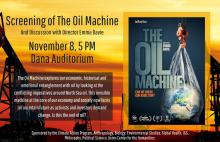
The Oil Machine: Film Screening and Director Chat

Join us for a screening of the much-buzzed about film, “The Oil Machine,” followed by a Q&A with Director, Emma Davie. Facilitated by James Sanchez.

Oil has been an invisible machine at the core of our economy and society. It now faces an uncertain future as activists and investors demand change. Is this the end of oil?

Dana Auditorium (Sunderland Language Center)

Open to the Public

Reflection and Discussion Dinner with Peter Dixon

Sponsored by:
Philosophy
Following Peter Dixon’s presentation on “Everyday Peace Around the World”, join us for an opportunity to discuss and reflect on the contents of his talk with Dixon over dinner. Guests will have the ability to ask questions and exchange conversation about conflict transformation, peace, and justice. Peter Dixon ’02 is lead research scientist for Everyday Peace Indicators and researcher at Brandeis’ Program in Conflict Resolution and Coexistence, and has worked for the United Nations, the International Criminal Court. Dixon also has a PhD in Sociology from UC Berkeley.

26 Blinn Lane, CCE

Open to the Public

Philosophy 0710 Presentations

Sponsored by:
Philosophy
7:30 PM Ben Awtrey, “A philosophical framework for understanding and addressing the problem of physician burnout”
This analysis examines the current literature and makes the argument that there are similarities and links between empirical medical research and philosophical theories. These associations translate into interdisciplinary, evidence-based solutions which could bring effective change to the industry.

8:00 PM Sean Lovett, “Artificial Consciousness: Could Machines Have a Capacity for Phenomenal Consciousness?”

Davis Family Library 201- Watson Lecture Hall

Open to the Public

Philosophy 0710 Presentations

Sponsored by:
Philosophy
Julia Fairbank, “An Analysis on Personhood and Neuroethics Regarding Artificial Intelligence and Neural Enhancement Technologies”
Given the rapid rise of AI, consider a future where humans have the ability to augment and enhance their brains and bodies. Apply a philosophical lense to examine how personal identity and sense of self either support or refute the future of neural enhancement technology.

8:00 PM Greg Livingstone, “Surviving Progress—The Paradoxical Relationship Between Technological Advancement and Human Flourishing”

Davis Family Library 201- Watson Lecture Hall

Open to the Public

Philosophy 0710 Presentations

Sponsored by:
Philosophy
7:30 PM Maggie Connolly, “Aristotle’s Civic Friendship in Modern-day Polarized America”
The United States finds itself in one of the most heightened periods of political animosity in the country’s history. In addressing many of the same questions we continue to grapple with today, Aristotle proposed his theory of civic friendship as a key element to a functioning society. In this paper, I argue that Aristotle’s civic friendship can help us navigate polarization today by shedding light on timeless aspects of human nature that we must learn to work with rather than against.

Davis Family Library 201- Watson Lecture Hall

Open to the Public