
Courses
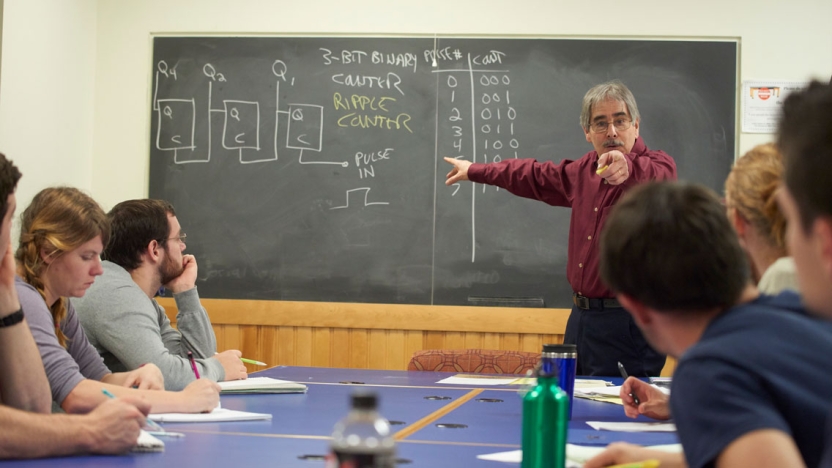
Courses offered in the past four years. Courses offered currently are as noted.
PHYS 0102
An Exploration of Time Keeping
Course Description
On Time - An Exploration of Time Keeping
Time is at once familiar and confounding. After eighteen years (568 million seconds) of existence, you know it intimately. But what is time, really? The truth is, we don’t know; the fundamental laws of physics are essentially indifferent to the arrow of time. In this course we will use lectures, discussions, homework exercises, papers, and presentations to explore the history of time keeping, from astronomical observations to atomic clocks, learning how data collection and analysis spur advancements in science. Along the way we will explore Einstein’s theory of relativity, where pure logic and deductive reasoning lead to perplexing conclusions about time.(Not open to students who have already completed FYSE 1035 or FYSE 1112.)
Terms Taught
Requirements
PHYS 0105
Upcoming
Energy Technology
Course Description
Fundamentals of Energy Technology
The world is rapidly changing, and the way that humans produce and consume energy in the coming years will profoundly impact our global environment. In this course students will investigate the technologies at play in this energy transition. Using fundamental physical principles, we will explore the limits inherent in harvesting energy from decarbonized sources like the sun, wind, and nuclear materials along with ways to more efficiently transport and expend that energy. Course assignments will include weekly homework with quantitative questions requiring a knowledge of high school algebra. Students will research contemporary energy technologies, presenting them both orally and through shorter responses and a longer paper. Core content knowledge will be assessed through quizzes and exams. 3 hrs. lect.
Terms Taught
Requirements
PHYS 0108
Current
Upcoming
The Physics of Motion
Course Description
The Physics of Motion
This calculus-based course examines fundamental topics in motion and mechanics, including inertia, force, Newton's laws of motion, work, energy, linear momentum, collisions, gravitation, rotational motion, torque, and angular momentum, emphasizing applications in physics, engineering, the life sciences, and everyday life. Laboratory explorations of topics covered in lecture will build students’ physical intuition and problem-solving skills. Students who have taken a high-school course in physics should consider enrolling in PHYS 0109. (MATH 0121 concurrent or APAB 4 or APBC 3 or MATH 0122 concurrent or M1DP 30. Students may not receive credit for both PHYS 0108 and PHYS 0109) 3 hrs. lect/3 hrs. lab.
Terms Taught
Requirements
PHYS 0109
Current
Introductory Mechanics
Course Description
Introductory Mechanics
This calculus-based course examines fundamental topics in motion and mechanics, including inertia, force, Newton's laws of motion, work, energy, linear momentum, collisions, gravitation, rotational motion, torque, angular momentum, and oscillatory motion, emphasizing applications in physics and engineering. Laboratory explorations of topics covered in lecture will build students’ physical intuition and problem-solving skills. (MATH 0121; students may not receive credit for both PHYS 0108 and PHYS 0109) 3 hrs. lect/3 hrs. lab.
Terms Taught
Requirements
PHYS 0110
Electricity & Magnetism
Course Description
Electricity and Magnetism
The physical principles of electricity and magnetism are developed with calculus and applied to the electrical structure of matter and the electromagnetic nature of light. Practical topics from electricity and magnetism include voltage, current, resistance, capacitance, inductance, and AC and DC circuits. Laboratory work includes an introduction to electronics and to important instruments such as the oscilloscope. (PHYS 0109, MATH 0122) 3 hrs. lect./3 hrs. lab.
Terms Taught
Requirements
PHYS 0111
Current
Upcoming
Waves, Optics & Thermodynamics
Course Description
Oscillatory Motion, Waves, Optics, and Thermodynamics
This calculus-based course covers oscillations, wave motion, sound, geometrical optics, physical optics, and thermodynamics. Other physics topics may be added at the discretion of the instructor. Lab experiments will explore these topics and develop skills in experimentation and data analysis. (PHYS 0108 or 0109 and MATH 0121) 3 hrs. lect./3 hrs. lab.
Terms Taught
Requirements
PHYS 0114
Current
Upcoming
Electricity & Magnetism
Course Description
Electricity and Magnetism
The physical principles of electricity and magnetism are developed with calculus and applied to the electrical structure of matter and the electromagnetic nature of light. Practical topics from electricity and magnetism include voltage, current, resistance, capacitance, inductance, and AC and DC circuits. Laboratory work includes an introduction to electronics and to important instruments such as the oscilloscope. (PHYS 0108 or 0109 and MATH 0122) Students may not receive credit for both PHYS 0110 and PHYS 0114. 3 hrs. lect./3 hrs. lab.
Terms Taught
Requirements
PHYS 0155
Current
Introduction to the Universe
Course Description
An Introduction to the Universe
Our universe comprises billions of galaxies in a rapidly expanding fabric. How did it begin? Will it expand forever, or how may it end? How do the stars that compose the galaxies evolve from their births in clouds of gas, through the tranquility of middle age, to their often violent deaths? How can scientists even hope to answer such cosmic questions from our vantage point on a small planet, orbiting a very ordinary star? Are there other planets, orbiting other stars, where intelligent beings may be pondering similar issues? This introductory astronomy course, designed for nonscience majors, will explore these and other questions. Students will also become familiar with the night sky, both as part of our natural environment and as a scientific resource, through independent observations and sessions at the College Observatory. The approach requires no college-level mathematics, but students should expect to do quantitative calculations using scientific notation and occasionally to use elementary high-school algebra. 3 hrs. lect./1 hrs.lab.
Terms Taught
Requirements
PHYS 0201
Relativity And Quantum Physics
Course Description
Relativity and Quantum Physics
This course probes a number of areas for which classical physics has provided no adequate explanations. Topics covered include Einstein's special relativity, quantization of atomic energy levels and photons, the atomic models of Rutherford and Bohr, and wave-particle duality. (PHYS 0109; PHYS 0110 concurrent or prior; MATH 0122) 3 hrs. lect.
Terms Taught
Requirements
PHYS 0202
Quantum Physics Applications
Course Description
Quantum Physics and Applications
This course introduces quantum theory and statistical mechanics, and explores the Heisenberg uncertainty principle, the Schrödinger wave equation, and wave mechanics. These techniques are then applied to atomic, molecular, nuclear, and elementary particle systems. (PHYS 0201; PHYS 0212 concurrent or prior) 3 hrs. lect.
Terms Taught
Requirements
PHYS 0212
Applied Math For Phys. Science
Course Description
Applied Mathematics for the Physical Sciences
This course concentrates on the methods of applied mathematics used for treating the partial differential equations that commonly arise in physics, chemistry, and engineering. Topics include differential vector calculus, Fourier series, and other orthogonal function sets. Emphasis will be given to physical applications of the mathematics. This course is a prerequisite for all 0300- and 0400-level physics courses. (MATH 0122; PHYS 0110 concurrent or prior) 4.5 hrs. lect.
Terms Taught
Requirements
PHYS 0214
Current
Relativity & Electromagnetism
Course Description
Relativity and Electromagnetism
This course develops a unified description of electromagnetism and Einstein’s theory of special relativity, based upon the postulate that the laws of physics are the same in all inertial reference frames. Topics include relativistic phenomena, relativistic energy and momentum, Lorentz transformations, four-vectors in spacetime, differential operators and integral theorems of vector calculus, Maxwell’s equations in differential form, electromagnetic waves, and the electromagnetic vector potential. (PHYS 0114 and PHYS 0216 concurrent or prior; students may not receive credit for both PHYS 0214 and PHYS 0201) 3 hrs. lect.
Terms Taught
Requirements
PHYS 0216
Current
Waves and Fourier Analysis
Course Description
Waves and Fourier Analysis
Wave mechanics provides our most fundamental description of all known forms of matter, radiation, and their interactions. In this course we will develop the physics of oscillations and waves and the associated mathematics of Fourier series and transforms, orthogonal functions, and solutions of ordinary and partial differential equations, focusing especially on solutions of initial and boundary value problems by separation of variables in Cartesian, cylindrical and spherical coordinates. (PHYS 0109 or PHYS 0108 and PHYS 0111 or PHYS 0114 and MATH 0122) Students may not receive credit for both PHYS 0212 and PHYS 0216. 4.5 hrs. lect.
Terms Taught
Requirements
PHYS 0218
Upcoming
Quantum Physics
Course Description
Quantum Physics
Classical theories of physics fail to adequately explain the behavior of the smallest and most fundamental objects in nature. In this course we introduce quantum theory, which makes accurate predictions by describing fundamental particles as wave-like and measurements as inherently probabilistic. Students will utilize prior knowledge of wave behavior to explore the foundational principles of quantum theory, including the Heisenberg uncertainty principle, the Schrödinger wave equation and wave-particle duality. These principles and techniques are then applied to explain the properties of elementary particles, atoms, molecules, and nuclei. (PHYS 0216) Students cannot receive credit for both PHYS 0218 and PHYS 0202. 3 hrs. lect.
Terms Taught
PHYS 0221
Electronics For Scientists
Course Description
Electronics for Scientists
An introduction to modern electronic circuits and devices, emphasizing both physical operation and practical use. Transistors and integrated circuits are considered in both analog and digital applications. Examples and laboratory experiments stress measurement and control applications in the physical and biological sciences. Students will gain hands-on familiarity with the design, use, and troubleshooting of electronic instrumentation. (PHYS 0110 or PHYS 0114) 3 hrs. lect./3 hrs. lab.
Terms Taught
Requirements
PHYS 0222
Upcoming
Experimental Physics I
Course Description
Experimental Techniques in Physics I
In this lab course, we will learn the design and execution of experiments, the modeling of physical systems, and the analysis and presentation of data, at an intermediate level. Laboratory experiments will examine topics in classical mechanics, optics, quantum mechanics, and electricity and magnetism, each with an emphasis on the acquisition of data and computer-aided analysis of data. Students will also gain experience keeping a lab notebook and writing a lab report. (PHYS 0111 OR PHYS 0216) AND (PHYS 0114 concurrent or PHYS 0110) 3 hrs. lect./3 hrs. lab
Terms Taught
Requirements
PHYS 0225
Computational Physics
Course Description
Computational Physics
The laws of physics provide a beautiful mathematical framework for describing the universe. Yet it’s rare that exact solutions to the resulting equations can be found with pen and paper. In this course we will explore a range of powerful computational methods that allow us to solve physical problems, primarily using the Python programming language. Applications of these methods will include problems in Newtonian mechanics, electricity and magnetism, statistical and thermal physics, quantum mechanics, and relativity. No prior experience with programming is required. Students who meet the prerequisites for PHYS 0325 must register for that course instead. (Not open to students who have taken PHYS 0230 or PHYS 0202, or CSCI 0145 or CSCI 0150) (PHYS 0109; MATH 0122)
Terms Taught
Requirements
PHYS 0241
Upcoming
Biomedical Imaging
Course Description
Biomedical Imaging
Why do we use microscopes for thin tissue slices but x-rays for imaging through the entire body? In this course we will explore the physics of light and life through various biomedical imaging techniques. We will apply the fundamental imaging concepts of resolution, aberration, diffraction, scattering, the Fourier transform, and deconvolution. Most of the course will focus on biomedical optics, including standard optical microscopes, fluorescence imaging, spectroscopy, fiber-optic endoscopes, and laser-scanning microscopes. The latter part of the course will cover non-optical imaging, such as ultrasound, x-ray, and magnetic resonance imaging (MRI). Students will gain hands-on experience through in-class experiments and field trips, e.g., to the cell imaging and nuclear magnetic resonance facilities in McCardell Bicentennial Hall. (PHYS 0216 or (PHYS 0111 and MATH 0122)) 3 hrs. lect.
Terms Taught
Requirements
PHYS 0255
Current
Intro to Astrophysics
Course Description
An Introduction to Astrophysics
In this course students will learn the fundamental concepts and techniques used by astronomers to understand the universe and its contents. These include the physics of light (which conveys the properties of astrophysical phenomena) and gravity (the fundamental force that drives orbits). We will apply these techniques to learn about the physics of stars including stellar interiors and stellar atmospheres as well as their nuclear energy generation processes. We will use real astrophysical data to explore the wide-ranging properties of stars and stellar evolution from birth to death. Students will engage with the literature and learn to use data analysis tools, including Python programming, to analyze real data. No prior experience with programming is required. (PHYS 0111 OR PHYS 0114) AND (PHYS 0214 OR PHYS 0216 OR MATH 0223) 3 hrs. lect. 1 hour discussion.
Terms Taught
Requirements
PHYS 0301
Intermediate Electromagnetism
Course Description
Intermediate Electromagnetism
The unified description of electricity and magnetism is one of the greatest triumphs of physics. This course provides a thorough grounding in the nature of electric and magnetic fields and their interaction with matter. Mathematical techniques appropriate to the solution of problems in electromagnetism are also introduced. The primary emphasis is on static fields, with the full time-dependent Maxwell equations and electromagnetic waves introduced in the final part of the course. (PHYS 0114 and PHYS 0214 and PHYS 0216) 3 hrs. lect./1 hr. disc.
Terms Taught
PHYS 0302
Electromagnetic Theory
Course Description
Electromagnetic Waves
Maxwell's theory of the electromagnetic field provides the basis of our understanding of the nature of light, radio waves, infrared radiation, X-rays, and other forms of electromagnetic radiation. This course examines the behavior of electromagnetic waves starting from Maxwell's equations, the fundamental laws of electromagnetism. Topics include wave propagation in different materials; reflection and refraction at interfaces; applications in space communications, optics, and other fields; and relativistic electrodynamics. (PHYS 0301) 3 hr. lect.
Terms Taught
Requirements
PHYS 0314
Current
Electromagnetic Theory
Course Description
Electromagnetic Theory
The unified description of electromagnetic fields is one of the most profound theories in physics and provides the basis for our understanding of the nature of light and other forms of electromagnetic radiation. In this course we will investigate the theory of electromagnetic waves starting from an understanding of Maxwell’s equations in differential vector form, applied both in empty space and materials. We will see how fundamental properties of light, such as polarization, energy, and momentum, emerge from these equations. Other topics may include boundary value problems in electrostatics; the multipole expansion; wave propagation in materials; principles of optics including reflection and refraction; radio-based communications; and electrodynamics in astrophysics. (PHYS 0214 and PHYS 0216) (Not open to students who have successfully completed PHYS 0301.) 3 hrs. Lect.
Terms Taught
Requirements
PHYS 0318
Upcoming
Quantum Mechanics
Course Description
Quantum Mechanics (formerly PHYS 0401)
A fundamental course in quantum mechanics aimed at understanding the mathematical structure of the theory and its application to physical phenomena at the atomic level. Topics include the basic postulates of quantum mechanics, operator formalism, Schrödinger equation, one-dimensional and central potentials, and angular momentum and spin. (PHYS 0216 and PHYS 218 and MATH 0200) 3 hrs. lect.1 hr. disc.
Terms Taught
PHYS 0321
Current
Experimental Physics II
Course Description
Experimental Techniques in Physics
*Experimental Techniques in Physics*
This course will cover the design and execution of experiments, and the analysis and presentation of data, at an advanced level. Laboratory experiments will be chosen to illustrate the use of electronic, mechanical, and optical instruments to investigate fundamental physical phenomena, such as the properties of atoms and nuclei and the nature of radiation. Skills in computer-based data analysis and presentation will be developed and emphasized. This course satisfies the College writing requirement. (PHYS 0214 AND PHYS 0218 AND PHYS 0222) 3 hrs. lect./3 hrs. lab. (Approval required)
Terms Taught
Requirements
PHYS 0325
Upcoming
Computational Physics
Course Description
Computational Physics
The laws of physics provide a beautiful mathematical framework for describing the universe. Yet it’s rare that exact solutions to the resulting equations can be found with pen and paper. In this course we will explore a range of powerful computational methods that allow us to solve physical problems, primarily using the Python programming language. Applications of these methods will include problems in Newtonian mechanics, electricity and magnetism, statistical and thermal physics, quantum mechanics, and relativity. Prior programming experience or physics coursework at 200 level is required to enroll in this course; students without this background may be eligible to enroll in PHYS 0225 (not open to students who have taken PHYS 0230). (PHYS 0109 and MATH 0122 and PHYS 0202 or CSCI 0145 or CSCI 0150 or equivalent).
Terms Taught
Requirements
PHYS 0330
Analytical Mechanics
Course Description
Analytical Mechanics
An intermediate-level course in the kinematics and dynamics of particles and rigid body motion. The topics will include: analysis and application of Newton's law of mechanics; the concepts of work, energy, and power; energy conservation; momentum and momentum conservation; torque, angular momentum, and angular momentum conservation; oscillatory motion; and central-force motion. Lagrange's and Hamilton's formulations of classical mechanics will be introduced with emphasis placed on developing problem-solving strategies and techniques. (PHYS 212 or PHYS 0216) 3 hrs. lect.
Terms Taught
PHYS 0340
Upcoming
Solid State Physics
Course Description
Introduction to Solid State Physics
In this course, the properties of solids are shown to arise naturally from their atomic composition and their structure. Elementary quantum mechanics, electromagnetism, and statistical mechanics are invoked to explore fundamental properties of crystalline solids, including their classification as metals, insulators, semiconductors, and semimetals. Topics covered include crystal structure and diffraction; crystal vibrations; electrical and thermal conduction; and the response of solids to external electric and magnetic fields. (PHYS 0202 or PHYS 0218) 3 hrs. lect.
Terms Taught
PHYS 0345
Upcoming
High Energy Astrophysics
Course Description
High Energy Astrophysics
The study of high energy astrophysics offers insights into some of the most extreme environments and phenomena found in the Universe, from ultra-strong magnetic fields to the event horizons of black holes. In this course we will explore an introduction to the physics of high energy emission and absorption processes in the context of white dwarfs, neutron stars, black holes, supernovae, and more. We will link the theory of these emission mechanisms to data through X-ray data analysis projects that will introduce students to the spectroscopic and timing analyses used by high energy astrophysicists. (PHYS 0214).
Terms Taught
PHYS 0350
Current
Statistical Mechanics
Course Description
Statistical Mechanics
This course is a study of statistical mechanics and its applications to a variety of classical and quantum systems. It includes a discussion of microstates, macrostates, and entropy, and systematically introduces the microcanonical, canonical, grand canonical, and isobaric ensembles. This underlying theory is applied to topics including classical thermodynamics, the equipartition theorem, electromagnetic blackbody radiation, heat capacities of solids, and ideal classical and quantum gases, with a focus on Bose-Einstein condensation and degenerate Fermi systems. (PHYS 0202 or PHYS 0218) 3 hrs. lect./1 hr. disc.
Terms Taught
PHYS 0355
Upcoming
Observational Astrophysics
Course Description
Observational Astrophysics
This is a lecture and laboratory course covering techniques in modern observational astrophysics, at an advanced level. Students will be trained to operate the telescope in the Mittelman observatory on campus and will gain expertise in the acquisition and analysis of digital images. Students will design and conduct a variety of observational projects from canonical experiments that illuminate the nature of stars and galaxies to originally conceived projects such as photometric studies in the time domain. Skills in computer-based data reduction, analysis, and presentation will be developed and emphasized. The course may also include theoretical modeling techniques that would make use of advanced computation and data mining methods. Students will write up their observing projects and results in comprehensive reports to satisfy the College writing requirement. Nighttime attendance at the observatory outside of formal class meeting time will be required. (PHYS 0255 And PHYS 0222) 3 hr. lect./3 hr. lab Approval required.
Terms Taught
Requirements
PHYS 0370
Cosmological Physics
Course Description
Cosmology
Cosmology is the study of the Universe as a whole entity, including the origin, evolution, and ultimate fate of the entire Universe. In this course we will study the Big Bang, inflation, primordial nucleosynthesis, the cosmic microwave background, the formation of galaxies, and large-scale structure. The course will link observations to theory in order to address some of the current open questions in cosmology such as: what are the forms of matter and energy distributed in the Universe? What is the expansion rate of the Universe and how has it changed with time? What is the age of the Universe? What is the shape of the Universe? (PHYS 0214 AND PHYS 0216 AND PHYS 0218 OR PHYS 0111) 3 hrs. lect.
Terms Taught
Requirements
PHYS 0380
Upcoming
General Relativity
Course Description
General Relativity
Among the forces of nature, gravity is both the most familiar and the least well-understood. A hundred years after it was formulated by Einstein, General Relativity remains our best fundamental theory of gravity. In this course we will see how gravity emerges from the geometry of curved spacetime and how this picture leads to phenomena such as black holes, gravitational waves, and the expansion of the universe. (MATH 0200 and PHYS 0214 and PHYS 0216) 3 hrs. lect.
Terms Taught
Requirements
PHYS 0401
Quantum Mechanics
Course Description
Quantum Mechanics
A fundamental course in quantum mechanics aimed at understanding the mathematical structure of the theory and its application to physical phenomena at the atomic and nuclear levels. Topics include the basic postulates of quantum mechanics, operator formalism, Schrödinger equation, one-dimensional and central potentials, angular momentum and spin, perturbation theory, and systems of identical particles. (PHYS 0202 and PHYS 0212; MATH 0200 recommended) 3 hrs. lect.
Terms Taught
PHYS 0500
Current
Upcoming
Ind. Study & Special Topic
Course Description
Independent Study and Special Topics
(Approval required)
Terms Taught
PHYS 0704
Current
Upcoming
Senior Project
Course Description
Senior Project
Independent research project incorporating both written and oral presentations.
Terms Taught
PHYS 0705
Current
Upcoming
Senior Thesis
Course Description
Senior Thesis
For a student who has completed PHYS 0704 and, by agreement with his or her advisor, is continuing the senior project as a senior thesis. (PHYS 0704 and approval required)
Terms Taught
PHYS 1010
Cosmic Beginnings and Endings
Course Description
Cosmic Beginnings and Endings
The study of astronomy is driven by questions about the origins and ultimate fate of objects in the cosmos. Astronomical time scales often far exceed human ones, meaning that we rarely get to watch astronomy happen in the same way that we can watch experiments in a traditional physics laboratory. Astronomers can only observe objects as they are and must develop theories and models about how they came to be and how they might cease to be. In this course, we will explore scientific models about the cosmic beginnings and endings of some of the most fundamental objects in the Universe (and of the Universe itself). Topics will include the Big Bang, the ultimate fate of the Universe, the formation of the first stars and galaxies, the births and deaths of stars, and the search for life in the Universe. The course has no prerequisites, but students should expect to solve quantitative problems using algebra and trigonometry and to read scientific articles regarding recent astronomical discoveries.
Terms Taught
Requirements
PHYS 1103
Picture a Physicist
Course Description
Picture a Physicist
Picture a physicist. Whom do you see? In this course we will learn about the pioneering physics research done by women, African Americans, and members of other groups that are underrepresented in physics. Through in-class demonstrations and simulations, students will understand the many physics questions that would never have been answered without a diverse group of physicists working to solve them. Students will read about the lives and struggles of these physicists and will examine the hidden and overt obstacles that can hinder their persistence in the field. No prior knowledge of physics is necessary nor expected. (FYSE 1548 students require permission of the instructor.)
Terms Taught
Requirements
PHYS 1105
Ancient Astronomy
Course Description
Ancient Astronomy
In this course we will learn about astronomy through the lens of ancient civilizations. By studying the civilizations of the Babylonians and Greeks, as well as selected civilizations around the world, we will learn how ancient astronomers determined the sizes of the Earth and Moon as well as distances to bodies in the solar system and how celestial phenomena motivated religious and cultural practice. We will employ hands-on, lab-like activities, and naked-eye observations of the sky along with moderate use of mathematics to learn how our ancestors understood our place in the cosmos.
Terms Taught
Requirements