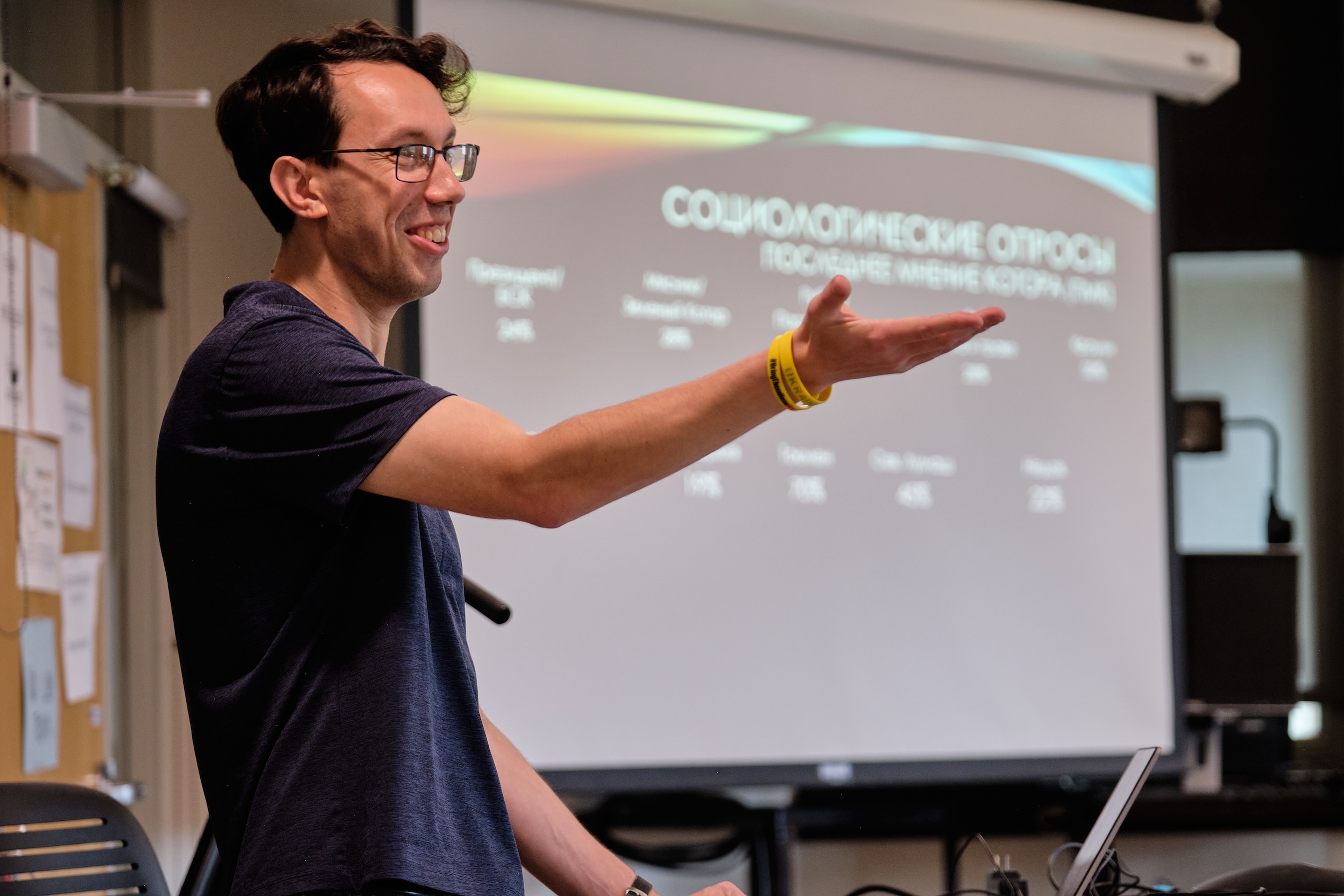
Marina Rojavin
Email: mrojavin@middlebury.edu
Phone: work802.443.5230
Download Contact Information
I was born in Ukraine. A journalist by college education, I worked as an editor in the USSR. I received my Ph.D. in Russian Linguistics at the O. Potebnia Institute for Linguistics, National Academy of Sciences, Ukraine. My dissertation focused on The Gender Category in Modern Russian. I taught Russian language and literature at Temple University and at Swarthmore College.
Some of my professional interests are: semantic gender category in modern Russian and Ukrainian and the Russian grammatical gender as a source of metaphorical thinking; origin, development, and transformation of the Russian literary and historical anecdote; Russian philosophers and intellectuals in Imperial Russia.
I love grammar and try to convince my students that grammar is an appealing thing, sharing funny stories about punctuation marks and parts of sentences with them. I like tongue-twisters, proverbs, and sayings– we practice them in class with students who usually pronounce tongue-twisters better than I do. I like hard rock and classical music. When work overwhelms me, I go to the kitchen and cook. I enjoy food in restaurants as well.
I enjoy trips: hiking or traveling by car through Alaska or the Apennine Mountains or the Alps.
My Home Page
http://www.swarthmore.edu/Humanities/mrojavi1/home.html
VOYAGES a students’ literary journal where I’m an editor
http://www.swarthmore.edu/Humanities/voyages/home.html
Courses
Courses offered in the past four years.
▲ indicates offered in the current term
▹ indicates offered in the upcoming term[s]
RUSS 6506 - Advanced Grammar
This course will focus on the study of advanced Russian grammar. Daily homework assignments and in-class exercises. Written tests and quizzes.
Linguistics Language & StylisticsSummer 2009
RUSS 6507 - Advanced Syntax
This course will focus on the use of various syntactical constructions and their meanings; it will also illuminate different functional styles. Students will gain a higher level of proficiency by developing their skills in structuring sentences, word order, and the use of punctuation marks and connective words. They will learn a variety of word combinations, the way word connections function, how word combinations are used in a sentence, and how certain structures are used in discourse. The course will help students to develop their skills in the formation of complex sentences. Students will be given 3 written exams; they will prepare oral and written assignments, 3 essays and presentations based on the texts.
Required text: Ivanova, I.S., Karamysheva, L.M., Kupriianova, T.F., Miroshnikova, M.G. Sintaksis. Prakticheskoe posobie po russkomu iazyku kak inostrannomu. St. Petersburg: Zlatoust.
Linguistics Language & StylisticsSummer 2009, Summer 2010
RUSS 6515 - Adv Composition & Stylistics
Advanced Composition & Stylistics
The course is designed to develop students' understanding of the grammatical and lexical norms and peculiarities of the functional styles of the modern Russian language. Students will be taught to stylistically evaluate language variant and to classify language mistakes; to distinguish stylistic features of various texts through analysis; they will also acquire skills to produce texts of different styles and genres.
Summer 2010, Summer 2011
RUSS 6517 - Advanced Russian Composition ▹
In this course, we focus on different types of texts, e.g. personal diary, essay, non-fiction forms, fictional short stories, literary critics, etc. We explore the relationships between fact and writing, work on various texts, and read different kinds of texts, etc. We read diaries of Dostoyevsky and Gogol, essays of Shklovsky and Merezhkovsky, short stories by Babel, Chekhov, and Tolstaya, scholarly articles by Gumilev, Soloviov, and Rozanov.
Every week is devoted to certain literary genres. During class meetings students participate in improvisation and write their texts on a randomly chosen topic. They prepare written assignments and produce written works in different genres.
Once a week students are invited to practice their skills in a certain genre by participating in a literary salon and in a forum where they discuss and criticize fictional, scholarly and their own writings.
Language & StylisticsSummer 2011, Summer 2012
RUSS 6676 - Intelligentsia in Russ Cinema ▹
Russian Intelligentsia in Soviet Cinema
This course is designed as a study of the concept of the Russian Intelligentsia in Soviet cinema. Films will be examined in the cultural context from a historical, ideological, and an aesthetic perspective to present the main images regarding this subject in the Soviet cinema. The films will show the ways and the transformations of the Russian intelligentsia from the Decembrists, nihilists, and Chekhov’s nobles in the 19th century to the Soviet intelligentsia after the Revolution up to the Khrushchev and Brezhnev eras. Students will investigate the role of cinema as a mechanism of the construction of the national collective consciousness.
By the end of the course, students will be able to use methods of textual and contextual film analysis. The course incorporates readings of the literary works and detailed analyses of the cinematic works—students will read excerpts from literary works by Turgenev, Goncharov, Chekhov, Bulgakov, Aksenov and critical essays by Gasparov, Firsov, and others. The course includes two film screenings weekly, five essays and a final paper.
Summer 2012