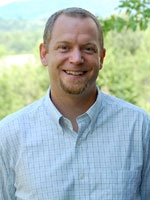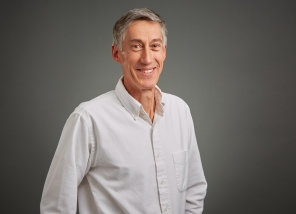
Steve Sontum
Professor of Chemistry & Biochemistry
Email: sontum@middlebury.edu
Office Hours: Fall 2011: Mon, Wed, Fri 10:00-11:00AM, Mon 4:00-5:00PM; and by appointment
Download Contact Information
Education:
B.A. Physics 1971 California Lutheran College ( CLU )
Ph.D. Biophysics 1979 University of California Davis ( UCDAVIS )
Post-Doctoral. Chemistry 1980 University of California Davis ( DA Case's Group )
Interests:
My research and teaching interest lie in the fields of computational biology, physical biochemistry, and quantum chemistry. I view myself as a teacher in both my course work and in my research, where I try to give my students an understanding of the marvels of nature from the point of view of a physical biochemist. I teach introductory chemistry courses and advanced-level courses in bioinformatics (CHEM 324) and physical biochemistry (CHEM 353), as well as, a general college courses on the history of molecular biology (What is Life?). My laboratory group studies the structure, function and informational content of biological macromolecules. We use bioinformatics and computational techniques to associate genes with the function of their protein products. See the Sontum Lab site for more information on student research projects and my classes. Away from work, I like to read science fiction, sail, ski, and play the banjo.
Click here for Steve Sontum's CV.
Courses
Courses offered in the past four years.
▲ indicates offered in the current term
▹ indicates offered in the upcoming term[s]
CHEM 0103 - General Chemistry I
General Chemistry I
Major topics will include atomic theory and atomic structure; chemical bonding; stoichiometry; introduction to chemical thermodynamics. States of matter; solutions and nuclear chemistry. Laboratory work deals with testing of theories by various quantitative methods. Students with strong secondary school preparation are encouraged to consult the department chair for permission to elect CHEM 0104 or CHEM 0107 in place of this course. CHEM 0103 is also an appropriate course for a student with little or no prior preparation in chemistry who would like to learn about basic chemical principles while fulfilling the SCI or DED distribution requirement. 3 hrs. lect., 3 hrs. lab, 1 hr. disc.
Fall 2011
CHEM 0104 - General Chemistry II
General Chemistry II
Major topics include chemical kinetics, chemical equilibrium, acid-base equilibria, chemical thermodynamics, electrochemistry, descriptive inorganic chemistry, and coordination chemistry. Lab work includes inorganic synthesis, qualitative analysis, and quantitative analysis in kinetics, acid-base and redox chemistry. (CHEM 0103 or by waiver) 3 hrs. lect., 3 hrs. lab, 1 hr. disc.
Fall 2009, Spring 2010
CHEM 0351 - Quantum Chemistry/Spectroscopy
Quantum Chemistry and Spectroscopy
Quantum theory is developed and applied to atomic structure and molecular bonding. Spectroscopy is examined as an application of quantum theory. (CHEM 0241 co-requisite, MATH 0122 and PHYS 0110, or by waiver) 3 hrs. lect., 1 hr. disc.
Fall 2011
CHEM 0353 - Physical Biochemistry
Physical Biochemistry
This is a basic course in physical biochemistry intended for majors in chemistry and the life sciences. The course presents an introductory development of thermodynamics and kinetics as applied to the structure and function of biochemical systems. Special emphasis is given to biological energetics, the forces that stabilize the conformation of biological macromolecules, enzyme kinetics, and membrane transport, as well as physical methods used to isolate and characterize proteins and nucleic acids. (PHYS 0109, MATH 0122, CHEM 0242) 3 hrs lect., 1 hr. disc.
Spring 2009, Spring 2010, Spring 2011
CHEM 0400 - Seminar In Chemical Research
Seminar in Chemical Research
This seminar provides students with experiences to support the preparation of a senior thesis. As the course involves participation in a mentored laboratory project and the intent to complete a senior thesis, students must make arrangements to work with a faculty advisor prior to gaining approval for course registration. The classroom portion of this seminar focuses on reading the scientific literature, giving effective oral presentations, and writing the thesis introduction. Particular emphasis will be given to computer and technology issues related to oral and written presentations. Participation will normally be followed by registration for CHEM 0500 or CHEM 0700 (winter term and spring). (Senior standing; 0300-level CHEM co-requisite; Approval only) 2 hrs. sem., 12 hrs. lab.
Fall 2009
CHEM 0500 - Independent Study
Independent Study Project
Individual study for qualified students. (Approval required)
Spring 2009, Fall 2009, Winter 2010, Spring 2010, Fall 2010, Winter 2011, Spring 2011, Fall 2011
CHEM 0700 - Senior Research
Senior Research
In this course students complete individual projects involving laboratory research on a topic chosen by the student and a faculty advisor. Prior to registering for CHEM 0700, a student must have discussed and agreed upon a project topic with a faculty member in the Chemistry and Biochemistry Department. Attendance at all Chemistry and Biochemistry Department seminars is expected. (Approval required; open only to seniors)
Spring 2009, Fall 2009, Winter 2010, Spring 2010, Fall 2010, Winter 2011, Spring 2011, Fall 2011
MBBC 0324 / CHEM 0324 - Bioinformatics and Genomics
Genomics, Bioinformatics and Systems Biology
The human Genome is both the chef and the chef's recipe for building a human body. Three interrelated fields of study help understand this recipe. Genomics is the study of all of the genes of organisms. Bioinformatics is the interdisciplinary field that uses the techniques of statistics and computer science to interpret this genetic recipe and its protein products. And finally, Systems Biology looks at how the dynamic network interaction of genes and proteins give rise to the behavior of the system as a whole. Students will utilize online resources to understand how genome-scale information (e.g., DNA sequences, genome variations, microarrays, proteomics, and clinical studies) can provide a systems biology perspective. This course is aimed at making biological inferences from national repositories of biology information. Students will use the Perl programming language, cutting-edge databases, and open-source bioinformatics tools to visualize data and post their analyses online. This course also counts toward the biology major and the biochemistry major. (CHEM 0104 or CHEM 0107 and BIOL 0145 or by waiver) 3 hrs. lect., 3 hrs. lab.
Spring 2009, Spring 2011
MBBC 0700 - Senior Research
Senior Thesis
Seniors conducting independent study in Molecular Biology and Biochemistry should register for MBBC 0700 unless they are completing a thesis project in which case they should register for MBBC 0701. (Approval required).
Spring 2009, Winter 2010, Spring 2010, Winter 2011, Spring 2011, Winter 2012, Winter 2013
Recent Publications
"Radical Reactions Mediated by Cyclobutadieneiron Tricarbonyl" Byers, J. H.; Sontum, S. F.; Dimitrova, T. S.*; Huque, S.*; Zhang, Y.*; Zegarelli, B. M.*; Jasinski, J. P; Butcher, R. P. Organometallics 2006, 25, 3787.
Case, D. A.; Sontum, S. F.; Noodleman, L. "Electronic Structure in Broken-Symmetry and Spin-Symmetry Applications to Fe-S Proteins and Clusters", J.Chim. Phys. Physicochim.Biol. 1989,86, 743.
Pitha, R.; King, M.; Sontum, S. F. "A Laser Refraction Method for Measuring Liquid Diffusion Coefficients", J.Chem.Ed. 1989, 66, 787.
Sontum, S.F.; Noodleman, L.; Case, D.A. "Spin Coupling and Electron Delocalization in Mixed Valence Iron Sulfur Clusters", American Chemical Society Symposium Series 1989,394; "The Challenge of d and f Electrons Theory and Computation" D.R. Salahub and M.C. Zerner, eds; p 366.