Information Session: Graduate Opportunities at the Falk School of Sustainability & Environment
Franklin Environmental Center, The Orchard-Hillcrest 103
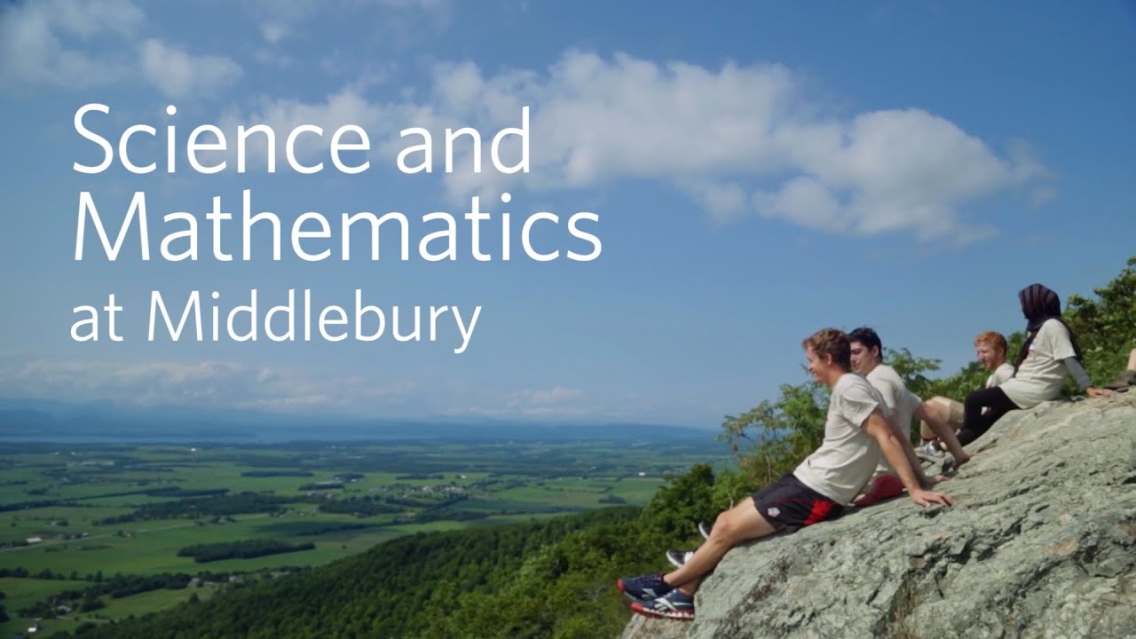
Science and mathematics are a vital and dynamic part of Middlebury’s liberal arts curriculum.
Coming soon.
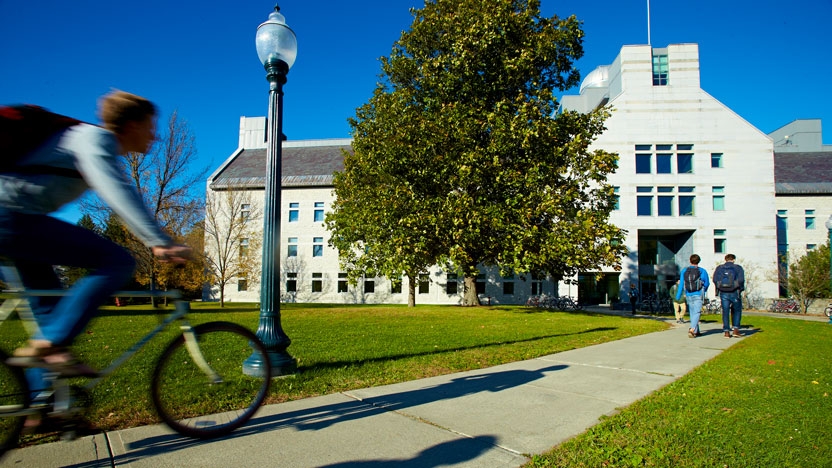
Students who want the best in STEM education will find it here, as well as a holistic education that fosters a deep and integrative approach to any field of study they choose. Middlebury’s science and math departments blend the high-tech facilities and cutting-edge research typically associated with larger universities with the collaborative learning atmosphere of a liberal arts college. With 11 departments and programs focused on math and both the physical and life sciences, Middlebury not only has a broad range of ways to study the sciences, it gives students the freedom to explore them all.
Recent Middlebury College STEM Annual Report
Franklin Environmental Center, The Orchard-Hillcrest 103
Hold the Salt: Salinity Influences Structure and Function of Streams Across North America
Most inland waters are defined by their low salinity relative to the oceans. However, both geological and anthropogenic processes can lead to freshwater salinization. This talk will summarize work done by Eric Moody and his research students at Middlebury College using ecological stoichiometry as a framework to study the causes and consequences of freshwater salinization in streams and rivers across North America.
McCardell Bicentennial Hall 220
Open to the Public
speaker series
McCardell Bicentennial Hall 104
“Animal Farming Should Be Environmentalists’ Central Focus” a Howard E. Woodin Environmental Studies Colloquium Series talk by Kevin Kuruc, Assistant Professor of Economics at Middlebury College.
Animal agriculture destroys more habitat than any other human activity and ranks among the most water intensive. The industry produces enough greenhouse gases to push warming close to two degrees on its own. And it causes tremendous suffering to the farmed animals themselves. No human activity is more at odds with our shared goals and values.
Franklin Environmental Center, The Orchard-Hillcrest 103
Open to the Public
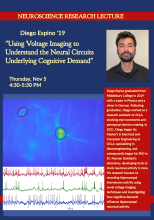
Specifics of the lecture will be added when available, please check back or check the Biology department events page.
McCardell Bicentennial Hall 220
Open to the Public
McCardell Bicentennial Hall 104
“Consilience, Ecology, and Public Education: A Look at The Walden Project and Perennial Learning” a Howard E. Woodin Environmental Studies Colloquium Series talk by Matthew Schlein, M.A., M.S.W. and Founder/Director of The Willowell Foundation.
Franklin Environmental Center, The Orchard-Hillcrest 103
Open to the Public
McCardell Bicentennial Hall 104
Environmental Studies Core Conversations: Truth in Environmentalism
Mez Baker-Medard, Associate Professor of Environmental Studies
Dan Brayton, Julian W. Abernethy Professor of Literature and member of the Environmental Studies Program
Molly Costanza-Robinson, Professor of Chemistry and Environmental Studies
Joseph Holler, Associate Professor of Geography
Franklin Environmental Center, The Orchard-Hillcrest 103

Open to the Public
The Scott A. Margolin ’99 Lecture in Environmental Affairs takes an interdisciplinary approach to the natural environment and human interaction with it.
In 1998, the Environmental Affairs Lecture was named in honor of Scott A. Margolin, of the Middlebury College Class of 1999. In his one year here, Scott established himself as a dedicated student of Environmental Studies, a leader in Environmental Quality and other student affairs, and an outstanding writer. He lives in our memory.
Franklin Environmental Center, The Orchard-Hillcrest 103
Open to the Public