

Chapel Carillon
About Our Carillon
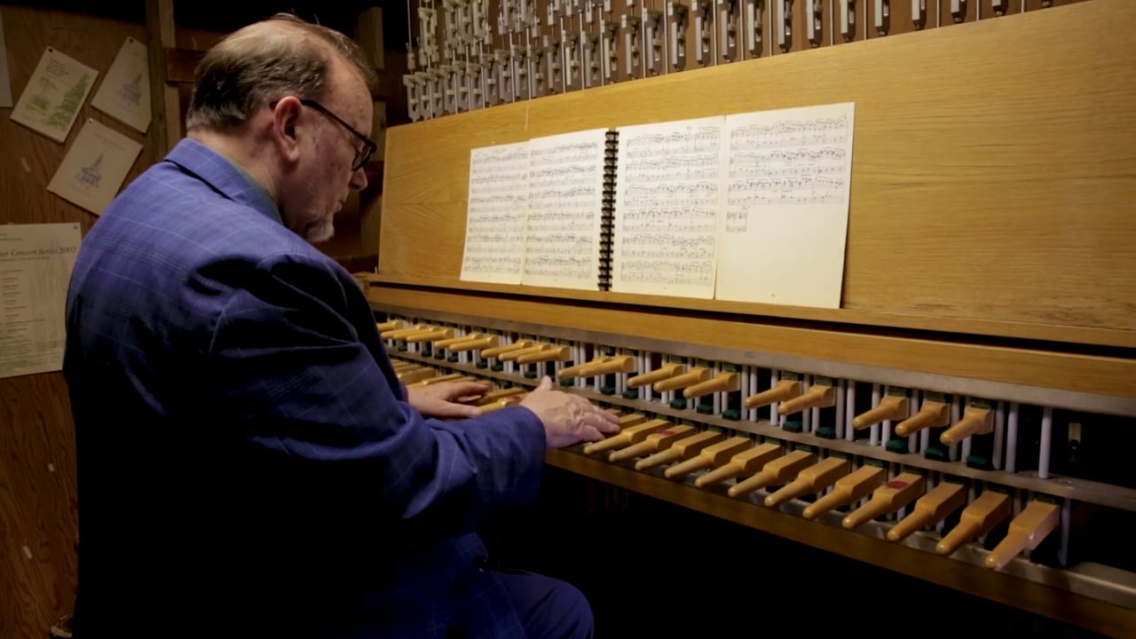
A carillon is set up like a keyboard, with black and white keys and foot pedals that can help produce different kinds of sound. Each key is connected by wire to a bell clapper so different bells are rung depending on which key is struck. It is a 75-step climb up to Middlebury’s bell tower, atop Middlebury Chapel. The Middlebury Carillon is considered a traditional carillon of 48 bells. The pitch of Middlebury’s heaviest bell is E in the middle octave. It is a 2,300-pound bell; roughly the same weight as the Liberty Bell. In 1915, the instrument was begun with eleven bells by the Meneely bellfoundry in Watervliet, New York. Nine bells remain from that work. In 1986, the instrument was enlarged to its present size with bells made by Paccard-Fonderie des Cloches in Annecy, France. The enhanced carillon was presented as a gift from then Chairman of the Board of Trustees Allen Dragone ‘50 (and his wife Jane) in 1986. 27 bells remain from that work. In 2001, 12 bells were recast or replaced in 2001 by Meeks & Watson of Georgetown, Ohio.
In 1918, the family of former governor John Mead gave Mead Chapel a chime of 11 bells made by the Meneely Company of West Troy, New York (a chime is defined as six to 22 bells. A carillon comprises 23 or more bells.) A note about the chapel name. The Meneely family of that time was the 8th or 9th generation descendants of Paul Revere (a bell cast by Paul Revere is in the tower of St. Stephen’s Episcopal Church, Middlebury). In 1985, through the kindness of donor Allen Dragone, then President of the Board of Trustees of the College, the chime was expanded to a full carillon of 48 bells by the firm Paccard et Fils of Annecy le-Vieux of France. Middlebury’s carillon is one of 183 carillons in the United States (71 of them in colleges or universities) and about 750 in the world.
George Matthew, Jr., has been the College Carillonneur since 1985, and teaches Middlebury College students the art of this unique musical form.
Daily Carillon Schedule
All programs will be at 12:30 to 1:30 pm unless otherwise announced.
George Matthew Jr., college carillonneur
Thursday, October 1 (Sukkot)
Friday, October 2 (Shabbat)
Saturday, October 3 (Simchas Torah)
Part 1. Traditional Melodies from the Reform Union Prayer Book
Part 2. Selected Traditional Succot and Simchas Torah melodies from Europe, the Mideast and Calcutta
Part 3. Night in Sukka - Mathieu Daniel Polak
The Schul Dance - Mathieu Daniel Polak
Part 4. Kievan Bulgar – Klezmer tune
Klangspiel in Klezmer style – Nancy 3. Hoffmann
Lecha dodi (Spanish Portuguese)
Lecha dodi – Traditional
Yigdal – Traditional
Sunday, October 4 - Works of Bach
Prelude & Fugue in g minor
Partita III
Adagio from Prelude, Adagio and Fugue
Sarabande from Cello Concerto
Adagio from Italian Concerto
Traditional Ukrainian Melodies
Traditional Afghanistan Melodies
Traditional Hispanic Folksongs
Monday, October 5
Violin Suite – Liesbeth Janssens
Variations on a German folksong – Edmund de Vos
Sonerie Mariale – Edmund de Vos
Lietuva – Edmund de Vos
Fantasia on a Swiss folksong – Gijsbert Kok
National Anthems of our Students – Afghanistan, Argentina, Armenia, Australia, Bangladesh and Bhutan
Tuesday, October 6, Wednesday 7 and Thursday, October 8
Programs to be announced.
Friday, October 9
Six Swiss folksongs – arr. Leen’T Hart
Legend and Allegro – Samuel Barber
Mini Shabbat:
Eight settings of Adom Olam: Dagastan, East European, 19th century German, two Jerusalem tunes, four Mizrahi tunes
National Anthems of our Students: Bosnia, Herzegovina, Brazil, Bulgaria, Cambodia, Canada and Chile.
Traditional Ukrainian Melodies
Traditional Afghanistan Melodies
Traditional Hispanic Folksongs
Saturday, October 10
- Canadian Songs: Four songs from New Brunswick, three songs from Labrador, two English songs arranged by Ronald Barnes, three Irish songs arranged by Adrian Patrick Gebruers, three Scottish songs from Prince Edward Island.
- Gavotte by Edward B. Manning, Canadian composer.
Traditional Ukrainian Melodies
Traditional Afghanistan Melodies
Traditional Hispanic Folksongs
Sunday, October 11 – Works of Bach
Lute Suite III
Concerto for Organ I
Traditional Ukrainian Melodies
Traditional Afghanistan Melodies
Traditional Hispanic Folksongs
Monday, October 12 and Tuesday, October 13 – Indigenous People’s Days, US and Canada
- Music of the Calumet – H. W. Loomis
(Calumet = “Peace Pipe” in Omaha) -
Four songs for Native American flute – R. Carlos Nakai
11/11/82 song, 11/20/82 song, Whirlwind Dancing, Rainy Night in Taos, NM
- Indian Medicine Song “Yo Ke” – arranged by Leen’T Hart
- Two melodies for Kinyaa’aanii - Connor Chee
- Two Navajo preludes – Connor Chee
-
Haudenosaunee Song – arranged, Andrea McCrady
Watsiwe Weneta (Huron Dance) – arranged, Andrea McCrady
Iroquois Dance – Charles Semowich
- Medley of Penobscot, Passamaquoddy and Maliseet songs
- Four Inuit Songs
National Anthems of our Students:
Monday: China, Cambodia, Dominican Republic, Ecuador, El Salvador, Estonia
Tuesday: France, Germany, Greece, Grenada, Guatemala, Hong Kong
Traditional Ukrainian Melodies
Traditional Afghanistan Melodies
Traditional Hispanic Folksongs
Wednesday, October 14
Prelude IV – Mathias van den Gheyn
Tacoma Sketches – Carl Bangs
Hallelujah! – Hilton J. Rufty
Andante Largo – Fernando Sor
Partita I – Percival Price
Weeping Willow Rag – Scott Joplin
National Anthems of our Students – Hungary, India, Iran, Japan, Kenya, Kuwait
Traditional Ukrainian Melodies
Traditional Afghanistan Melodies
Traditional Hispanic Folksongs
Thursday, October 15
The Alfred University Suite – Kamiel Lefevre
Sinfonia for the Carillons (from “Saul”) – G. F. Handel
Carillon – G. F. Handel
Allegro from Harp Sonata – Alan Hovhaness
National Anthems of our Students – Lebanon, Macedonia, Mexico, Moldovia, Mongolia, Morocco
Traditional Ukrainian Melodies
Traditional Afghanistan Melodies
Traditional Hispanic Folksongs
Friday, October 16
Paraphrase on a French folksong – Addie de Jong
Five Australian folksongs – arranged by Leen’T Hart
Mini Shabbat:
Rad Halaida, Hafingan, Frailach
Mizmor L’David (Psalm 23)
National Anthems of our Students – Namibia, Nepal, Netherlands, New Zealand, Nigeria, Norway
Traditional Ukrainian Melodies
Traditional Afghanistan Melodies
Traditional Hispanic Folksongs
Saturday, October 17 - Folksongs
Alferetan (Basque), The Steam Engine (Finnish), Cow Herd song (Norwegian)
Oberweissenfelder Glocken Schottish (German)
The Yets of Muckert – Prince Edward Island
The High Road to Linton - PEI
Fairwell to Whiskey – PEI
Impromptu de la Cordernez – Granados ( Spain)
Mia Bella Biondina (Italian) – arranged by G. M.
Traditional Ukrainian Melodies
Traditional Afghanistan Melodies
Traditional Hispanic Folksongs
Sunday, October 18 – Works of Bach
Lute Suite III
Prelude for Cello
Traditional Ukrainian Melodies
Traditional Afghanistan Melodies
Traditional Hispanic Folksongs
Monday, October 19
Passacaglia – J. K. Fischer
Concerto in C – Giolio Taglietti
L’empora Sardina – Eric Moura
Sonata #2 – F. J. Haydn
National Anthems of our Students: Pakistan, Palestine, Panama, Paraguay, Peru, Philippines
Traditional Ukrainian Melodies
Traditional Afghanistan Melodies
Traditional Hispanic Folksongs
Tuesday, October 20
Six folksongs from Rotterdam – traditional
Emergenza – Addie de Jong
National Anthems of our Students: Poland, Portugal, Georgia, Korea, Romania, Russia
Traditional Ukrainian Melodies
Traditional Afghanistan Melodies
Traditional Hispanic Folksongs
Wednesday, October 21
When the Peace Bells Ring – Clarence Lyndon
Three short preludes for Carillon – Jean Miller
Three preludes for Carillon – Theodore Rusterholz
Variations on the song “Snow White Birdie” – Kees van Eersel
The Tower by the Sea – Gerard Boedijne
Jazz Divertimento – Eugene Uten
National Anthems of our Students – Rwanda, Senegal, Sierra Leone, Slovakia, Somalia, South Africa
Traditional Ukrainian Melodies
Traditional Afghanistan Melodies
Traditional Hispanic Folksongs
Thursday, October 22
Toccata – B. Marcello
Prelude I (guitar) – Villa Lobos
Tarde una novem rosa (Portuguese) – Villa Lobos
The Jovial Clarinet – Karel L. Borghuis
Reine de Musette – J. Peyronnin
Lily Queen – Scott Joplin
National Anthems of our Students: South Sudan, Spain, Sri Lanka, Sudan, Sweden, Syria
Traditional Ukrainian Melodies
Traditional Afghanistan Melodies
Traditional Hispanic Folksongs
Friday, October 23
Six Maori Songs – arranged by Leen’T Hart
Rippling Waters – Herman Dreher
Mini Shabbat:
Tzur ya El (Syrian Jewish, popular in Brooklyn, NYC)
Lecha Dodi – Hazan Abraham Beer
Ten songs from the Calcutta Synagogue
National Anthems of our Students: Tajikistan, Tanzania, Thailand, Turkey, Uganda
Traditional Ukrainian Melodies
Traditional Afghanistan Melodies
Traditional Hispanic Folksongs
Saturday, October 24
Works of Canadian composer Edward B. Manning (1870 – 1951):
Scherzo, Leibeslied, Gigue
Romance, Rondelay, Gavotte, Red Jacket
(Red Jacket was a sailing vessel said to have made the fastest crossing of the Atlantic by a sailing ship.)
Traditional Ukrainian Melodies
Traditional Afghanistan Melodies
Traditional Hispanic Folksongs
Sunday, October 25 – Works of Bach
Passacaglia and Fugue in c minor
Sonatina, Siciliano and Partita III
Traditional Ukrainian Melodies
Traditional Afghanistan Melodies
Traditional Hispanic Folksongs
Monday, October 26 – Student Program
Tuesday, October 27 – Works of G. F. Handel
Andante from Organ Concerto
Fantasia #5
Largo opus #13
Fantasia in C
Air and Variations
National Anthems of our Students: United Kingdom, Uruguay, Venezuela, Vietnam, Zambia, Zimbabwe
Traditional Ukrainian Melodies
Traditional Afghanistan Melodies
Traditional Hispanic Folksongs
Wednesday, October 28 – Works of G. F. Handel
Fantasia in C
Allegro in D
Sarabande and Gigue in d minor
“Where e’er you walk”
Selections from the Royal Fireworks music
Chaconne and March
National Anthems of our Students: Afghanistan, Argentina, Armenia, Australia, Bangladesh, Bhutan
Traditional Ukrainian Melodies
Traditional Afghanistan Melodies
Traditional Hispanic Folksongs
Thursday, October 29
Etudes for Carillon by:
Karel Borghuis, Bernard Winsemius, Jenke Kaldenberg, Kees van Eersel, Addie de Jong
Suite in D minor – Robert De Visé
National Anthems of our Students: Bosnia, Herzegovina, Brazil, Bulgaria, Cambodia, Canada, Chile
Traditional Ukrainian Melodies
Traditional Afghanistan Melodies
Traditional Hispanic Folksongs
Friday, October 30 – Let’s have some fun!
The Good-Natured Man (Irish)
The Tenderfoot (Alberta)
When the Ice Worms Nest Again (Alberta)
The Sally Gardens (English)
Capriccio Catalan (Spanish)
Alborado (Portuguese)
Les Jamapes (France)
Two Danish emigrant dances
Mayflower Waltz (Canadian)
The Cascades Rag – Scott Joplin
Red Peppers Rag – Imogene Giles
Three Klezmer Dances – Nancy 3. Hoffmann
Kiev Klezmer – traditional
Saturday, October 31
Some transcriptions of Edward B. Manning’s (Canadian composer) piano works:
Mayflower Waltz
Elf Dance
English Dance
Dutch Dance
Marinka Waltz
Eccossaise
Arbutus Waltz
Country Dance
Gigue
Minuet
Scherzo
Romance
Gavotte
Red Jacket