

Library Instruction
Library workshops help students gain research skills and thoughtfully evaluate sources. Our classes are designed in collaboration with faculty to support course objectives and specific assignments.
What will we do in a workshop?
Faculty report that students who receive instruction from a librarian produce higher-quality research and develop the skills needed to effectively find, evaluate, and engage with existing knowledge. If you are interested in learning more about our teaching standards and student outcomes, please see our information literacy page.
Our workshops are interactive and customized for your course. Talk to your liaison team! We’re happy to brainstorm research projects that will complement your learning goals. Some suggested workshops by course level are listed below.
Suggested Workshops
Which workshops do you recommend for first-year students?
|
Explore, Search, Discover: Library Orientation for New Students 30, 50, or 75 minutes |
This workshop introduces students to the library’s spaces, physical and digital collections, and interlibrary loan services. Incoming students are introduced to librarians who can help them track down what they need. Often this session incorporates a library scavenger hunt which can be completed remotely on Canvas, or be part of a hand-ons introduction. Learning Outcomes:
|
|
Navigating Authority: Making Sense of your Sources 30, 50, or 75 minutes |
This workshop equips students with the skills to identify and differentiate scholarly articles, books, websites, newspaper, and AI generated content appropriate for college level research. Emphasis is placed on critically evaluating source authority, empowering students to make informed decisions about credibility and reliability in their academic work. Learning Outcomes:
|
|
Research Ready: Bootcamp for Scholarly Research 50 or 75 minutes |
Designed for students across the disciplines, this bootcamp provides a foundation in library research, scholarly sources, and effective search strategies. Students leave with an overview of using and evaluating evidence-based research. This workshop can be tailored to focus on discipline specific resources relevant to course work. Learning Outcomes:
|
|
Citations, footnotes, & bibliographies, oh my! 30 minute short lesson |
Students are often intimidated by formatting in-text citations, footnotes, and annotated bibliographies. This quick workshop covers the fundamentals that students often lack, such as identifying the parts of a citation, and the bigger picture of why we have citation rules. Basic lessons on citation rules for one citation style (MLA, Chicago, or APA) and annotated bibliographies can also be included. Learning Outcomes:
|
|
How to Lie With Graphs 50 or 75 minutes |
This workshop introduces students to subjective aspects of the visual representation of information by experimenting with basic data visualization in Google sheets. Through trial and error we will explore best practices for visual design, and see how design choices can unintentionally warp the results we want to convey. Learning Outcomes :
|
|
Digital Privacy 101 50 or 75 minutes |
This workshop introduces students to the concept of personal data and digital privacy as a human right. In our hyperconnected digital world, we often give up private information without being aware of it. This workshop explores what data our phones and computers collect about us, and empower students to make informed decisions about the products and services they engage with online. Learning Outcomes:
|
Which workshops do your recommend for intermediate students?
|
Citation Management: Introduction to Zotero 30 to 50 minutes |
This hands-on workshop introduces Zotero, a free tool that helps collect, organize, and cite research sources. Students learn how to save a variety of sources directly from their browser, organize references into folders, and generate accurate in-text citations and bibliographies. No prior experience is needed, but it is recommended that participants install and work from their own laptop. Learning Outcomes:
|
|
Synthesizing Sources for a Literature Review 50- 75 Minutes |
This workshop introduces the concept of an academic literature review and focuses on the difference between synthesis and summary of sources. Students are introduced to the research synthesis matrix as a tool for organizing research and facilitating synthesis of sources. Learning Outcomes:
|
|
AI Tools for Research 50- 75 minutes |
This library workshop helps students develop research skills, discover academic resources, and learn strategies for finding reliable information using AI Tools. Participants explore AI tools in databases and techniques to support research projects. Learning Outcomes:
|
|
TidyData 50 minutes |
Students learn the basics of TidyData by exploring how rows, columns, and observations work together to organize data. Students practice identifying common data problems and cleaning a dataset by fixing issues such as inconsistent entries, missing values, duplicate records, and messy data frames. Learning Outcomes:
|
|
Finding Data Through Literature 50-75 minutes |
Students practice searching for data sets that suit their research topic in related studies and literature. Non-linear reading techniques and which sections of an academic article tend to contain information on the underlying dataset and methodology are discussed. Students gain an introduction to the concepts of reproducibility and replicability, and how making (well documented) research data accessible to others furthers open science principles. Learning Outcomes:
|
Which workshops do you recommend for senior/thesis students?
|
Entering the Scholarly Conversation 50+ Minutes |
Designed for students beginning work on a senior thesis, this workshop asks students to think more deeply about what it means to participate in a scholarly conversation, including seeking accuracy and reliability, respecting intellectual property, and interrogating the limits of peer-review. Practical skills in advanced search techniques & tools and in search result evaluation and management will also be covered. Learning outcomes:
|
|
Intro to APIs 50-75 minutes |
Students are introduced to the concept of Application Programming Interfaces (APIs) and how they can assist users with extracting data from complex databases. We will cover basic protocols for making API calls, types of APIs, and example data structures to expect in their outputs (JSON, HTML). The workshop is taught in Python- some prior coding experience is ideal but not required. Learning Outcomes:
|
How can I request a workshop?
Please contact your library liaison team directly. In order to get the time, location and customized content that you want, contact us as early as possible.
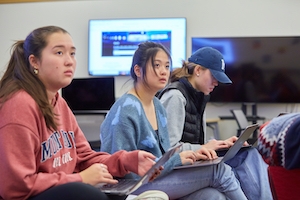
Students who receive instruction from a librarian do better research.