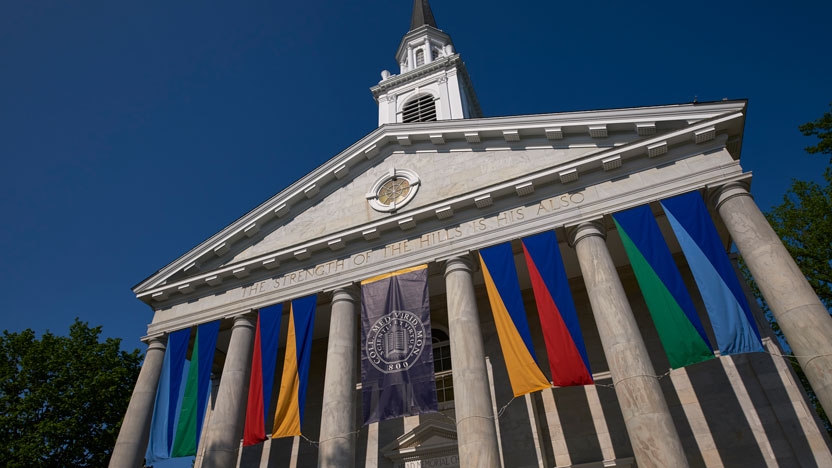
As has been the case since 2001, a committee of seniors selects a member of their class to deliver an address as part of this ceremony. This year the class chose Scott Guenther of Bozeman, MT.
Thank you and good morning.
Still at home in what ought to have been the fall semester of my freshman year of college, I was listening to NPR like any good Middkid while driving to my interim construction job. It was then that a locally syndicated program called Chrysti the Wordsmith, a program that provides the etymology of words old and strange, introduced to me a word that I think uniquely characterizes Middlebury students, and especially Febs: masochism. You are probably correct in thinking that this speech is only downhill from here, but before everyone in this building takes arms against this seemingly ludicrous assertion let me try and justify my observation.
You see the origins of the word masochism date back to a 19th century German fellow by the name of Leopold von Sacher-Masoch, who, by the age of 19 had received a doctorate in law from the University of Prague. This was a man who was clearly intelligent. He excelled in both his formal studies and academic positions before becoming a novelist of considerable notoriety. However, during this period of academic achievement and literary success, our protagonist exhibited some awfully peculiar behaviors. Herr Sacher-Masoch engaged frequently in extramarital affairs, where he desired to be dominated both physically and psychologically in the relationship. Masoch went so far as to pay his friends to steal away his mistresses from him so he could experience and revel in the despair of unrequited love. Once a local psychiatrist caught wind of Masoch’s odd behavior he granted our troubled protagonist a category all his own: masochism. Now, in fear of stating the obvious, I should make clear that the central message of this speech in not: “go and make a name for yourself.” As Masoch has shown us making a name for oneself does not necessarily distinguish between famous and infamous
Masoch was an abnormal man, and the parallels between his story and ours are not clear. But if we look past the sexually charged common definition of masochism and toward the often overlooked ancillary meaning we find that masochism is more clearly defined as “a taste for suffering.” A taste for suffering? As members of Club Midd I know it is not readily apparent that we could possibly suffer, let alone know whether we even have an affinity for it. For four years we have been awash in chocolate fountains and chicken parmesan, Free Friday Films and 5 dollar concerts, college-funded skiing and sprawling athletic facilities, newly constructed senior housing and dining halls, a Starship Library, and the largest pane of glass in all of Vermont, that is of course if one can actually be awash in such things. In the grand scheme of things we’ve been fortunate, and we know it. Moms, Dads, benefactors of the financial program, and whoever else may be responsible for footing the tuition bill, thank you.
But the problem with painting college in this light is that it masks the reality that Middlebury is a place of preeminent academics. If the reports provided by our friends at “peer-institutions” are correct, this education is far more rigorous and time-consuming that just about anywhere else in the country. Although I suppose that begs the question of whether it is Middlebury the institution or we the students that need to reevaluate with whom we associate. Regardless, it would seem as though suffering is the unnamed prerequisite to wield one’s very own Gamaliel Painter cane. My point is that we’ve worked much harder than needed, and though suffering may be too strong of word to legitimately call it—those pains of sleep deprivation, efforts toward comprehension, and struggles at writing with clarity and profundity—the past four years have not come easily.
And oddly enough we are still here. Indeed, we—Febs—are still here. Together we have suffered through the social purgatory of our super-senior fall, which alone must make Febs the supreme academic-masochists of campus. The majority of us unwittingly chose this by opting to wait a semester to go to college and did so at a time—high school—when college was seen as some sort of panacea. The rest, an equally disturbed bunch, managed to milk another semester of suffering out of college. But what most shows our taste for suffering is that when we walk across this stage to shake hands, receive a cane, and officially commemorate our time at Middlebury College we will not even receive a diploma. That, my friends, is suffering and maybe, just maybe, we’ve started to enjoy it.
However unlike the suffering in this world that leaves scars and haunting memories, our suffering may actually leave us as better individuals. Suffering while at Middlebury is a sign of willingness to open oneself to knowledge. Knowledge, after all, is why we are here today and why we came here four years ago. We have been taught to think and to know, but more importantly we have been asked to understand, for understanding expresses a receptiveness to knowing and thinking. To understand embodies something much deeper than knowing fact. To understand carries with it a sense of honesty, an awareness of the boundaries of our knowledge. In this respect—this desire to understand—Middlebury has taught us a great deal more than bookish ideas; it has taught us well. We have become brighter minds and better people than when we first arrived because we have suffered for our willingness to understand, and we have chosen to understand nevertheless.
The pioneering conservationist Aldo Leopold captures this idea of understanding in his book A Sand County Almanac. He writes, “Behind these obvious and immediate hopes and fears there lies a deeper meaning, known only to the mountain itself. Only the mountain has lived long enough to listen objectively. . . .” It seems as though Leopold merely asks that we listen objectively, and alone that is no easy task for the headstrong and confident college graduate like ourselves. But more pointedly he is also speaking to the limits of human objectivity, which makes our struggle for understanding futile. Understanding is to think like a mountain, to contemplate deeply, to recognize our limits, and when necessary allow for deference. Choose the metaphor that works for you. Choose something big that reminds you to be humble.
In the parking lot behind the service building, during normal working hours there is parked a nondescript car with a bumper sticker. I’ve never given much value to the messages our society puts on stickers, but this one isn’t so bad. It reads: “The most important things in life aren’t things.” The message is simple, direct and effective. Indeed, it is so simple that it probably does not warrant attention at an engagement such as this. But behind this message, I think there is a stronger point about community. Although Middlebury is home to some of the most brilliant minds in the country, professors, administrators and students alike, it does not mean that ideas of great value exist only within the classroom. Our degrees are educations by committee, by community. Live within that community, engage that community, extend that community to others. Smile and don’t forget to occasionally say hello.
So here we are (finally) celebrating a rite of passage that has had over two hundred years to ferment, on the grounds of a college that rests on a hill in a marble chapel atop that hill, where on some nights a light shines from the steeple. A little frightened? Excited? Finding yourself a little more masochistic than you had before? Hungover? As I have looked backward to look forward I have often wondered what Chrysti the Wordsmith might say if she were to analyze the word that brings us here today: Febs. Surely, she would inform her audience that Febs are February graduates of Middlebury College and that they (that we) tend to come later and/or last longer than traditional students. But I cannot help to think that there would be an additional definition, as we have found with masochism. Might it read: Febs: though they come and leave Middlebury by roads less traveled, it is their pursuit of understanding while at Middlebury, that irresistible desire to know and to accept, to suffer and be happy, which makes them truly unique. And so to my fellow Febs, my friends of the class of 2006.5, wherever you may go in life and whatever you may do, it is with this understanding that you will live to remember these times well, but also at times remember to live well. Thank you.