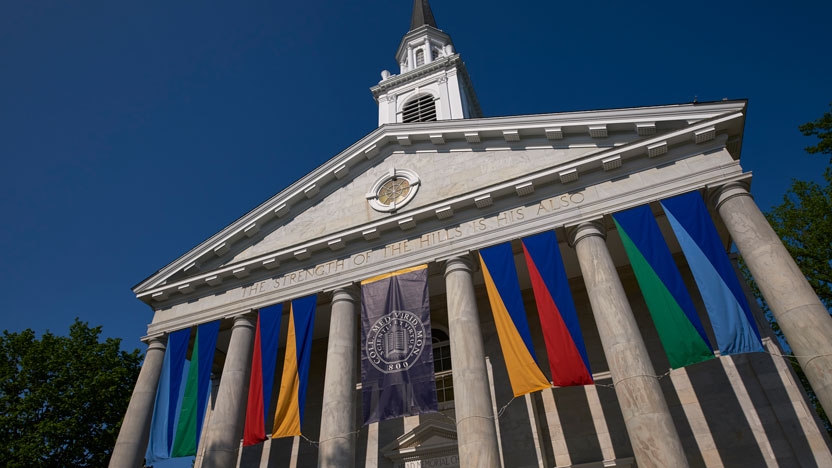
Each year the midyear graduates select a speaker to help them celebrate the completion of their studies. This year the class chose John M. McCardell, Jr., professor of history and President Emeritus.
The following remarks were delivered on February, 1, 2008.
“The Soldier’s Faith in Modern Times”
Many thanks for that generous introduction, Ron, and special thanks to those of you gathered here this weekend to mark the completion of your undergraduate studies. Many of you entered Middlebury in February 2004 and were thus the last new students to be welcomed by me as President. I remember that evening fondly, even wistfully, and am deeply grateful that you have been so considerate as to incorporate ritualistic symmetry into your ceremonial leave-taking.
This occasion, of course, is also a reminder, as if we needed such reminders, of our own mortality. For example, this is probably the last time I will ever address a class of seniors. All of us are four years older now than we were then, wiser also, let us hope, but ever more mindful in any case of the realities that regularly intrude into lives that we try to make orderly and pleasurable but that, much too frequently, are interrupted, distracted, redirected. Or, as the old Proverb puts it, “If you want to make God laugh, tell Him your plans.” How else explain snow and sleet on a February celebration? Or for that matter a 58 year-old ex-President and lapsed historian taking on the drinking age? But so it goes. And perhaps this weekend, as well as in years to come, even as you hear God laughing, you will seek and pursue lives of direction, service, and purpose.
And that is what I would like to think with you about for a few minutes this afternoon. As some of you know, for many years, beginning when I was President, I have taught a seminar on the Civil War and American Historical Memory. In that class we study not the war itself but rather how the war has been remembered across the generations. We come to understand that memory matters. It is selective, often personal, not entirely reliable. As a result, memory also involves forgetting, subjectivity, limits and, as time passes, nostalgia. It is not, it cannot be, inclusive. And thus memory is also competitive: historians surely know that there are as many versions of events as there are witnesses of the event. And so memory requires ordering, if you will prioritization. In its collective form it gives a culture shape and direction and coherence. In its individual manifestations it imparts meaning.
In our seminar we have always read what to me is an excellent example of the problems, as well as the possibilities, of historical memory: “The Soldier’s Faith,” which is the title of a Commencement address delivered to the Harvard Class of 1895 by Oliver Wendell Holmes.
Holmes graduated from Harvard in 1861 and immediately enlisted in the Union Army. He fought in numerous battles, was wounded three times (at Balls Bluff, Fredericksburg, and, most seriously, at Antietam), and left the Army with the rank of Lieutenant-Colonel. In 1882 he became both a Professor at Harvard Law School and a Justice of the Massachusetts Supreme Court. Twenty years later President Theodore Roosevelt appointed Holmes to the United States Supreme Court, where he served for thirty years.
By 1895 the Civil War participant generation had begun to pass from the scene. It is not surprising that not until the 1890s do we see the erection of Civil War monuments in the town squares of communities north and south; the proliferation of accounts, whether fiction or memoirs, of the war experience; of veterans’ organizations; and of speeches like “The Soldier’s Faith.” This passing generation had experienced something important, indeed unique, and felt increasingly compelled to communicate to those coming along behind them what that experience meant, and why it mattered. “The Soldier’s Faith,” in other words, is a striking example of one generation speaking to another. In one sense, that is a routine convention at Commencement time, and the words thus spoken are usually eminently forgettable. But this particular speech was out of the ordinary. Indeed, I always ask my class how they would react, sitting in an audience of graduates and hearing Holmes’s stern words. The reaction is decidedly mixed.
So what did Holmes say? The full address was remarkably brief, occupying not quite six pages in the collected speeches of Holmes. It can be read aloud in its entirety in under 30 minutes. Happily for you, I will neither read nor recite it, but I do want to give you some of its flavor, since it speaks to an emerging theme.
“The society for which many philanthropists, labor reformers, and men of fashion unite in longing is one for which they may be comfortable and may shone without much trouble or any danger.” These words, early in the address, give a clue about what is to follow.
“We express in numberless ways,” Holmes continues, “the notion that suffering is a wrong which can be and ought to be prevented, and a whole literature of sympathy has sprung into being which points out in story and in verse how hard it is to be wounded in the battle of life, how terrible, how unjust it is that anyone should fail.”
Sound at all familiar? It does if you have been following the current presidential primary campaigns. But Holmes goes on:
“But who among us could endure a world, although cut up into five-acre lots and having no man upon it who was not well fed and well housed, without the divine folly of honor, without the senseless passion for knowledge out-reaching the flaming bounds of the possible, without ideals the essence of which is that they can never be achieved?” Who indeed?
And so the “soldier’s faith:” “that faith is true and adorable which leads a soldier to throw away his life in obedience to a blindly accepted duty, in a cause which he little understands, in a plan of campaign of which he has no notion, under tactics of which he does not see the use.” Could there be a clearer definition of “faith?”
Holmes then describes the source of his own: “if you have advanced in line and have seen ahead of you the spot which you must pass where the rifle bullets are striking; if you have ridden by night at a walk toward the blue line of fire at the dead angle of Spotsylvania, where for twenty-four hours the soldiers were fighting … and in the morning the dead and dying lay piled in a row six deep … you know that there is such a thing as the faith I spoke of. You know your own weakness and are modest; but you know that man has in him that unspeakable somewhat which makes him capable of a miracle, able to lift himself by the might of his own soul, unaided, able to face annihilation for a blind belief.”
And then he concludes: “perhaps it is not vain for us to tell the new generation what we learned in our day, and still believe. That the joy of life is living, is to put out all one’s powers as far as they will go; that the measure of power is obstacles overcome, to ride boldly at what is in front of you …; to pray, not for comfort but for combat; to keep the soldier’s faith against the doubts of civil life, more besetting and harder to overcome than the misgivings of the battle-field.”
Pretty heavy stuff. And perhaps, to many of you, off-putting. Yet what Holmes is essentially expressing is the innate human need for risk and purpose and achievement and even the possibility of failure that resides in the soul of every individual in this room.
Let me put this a different way with a very different reference. There was a Greek poet and physician named Nicander who lived around 200 BC. Nicander left behind a recipe, for pickles, that explains, I think, what Holmes is trying to get at.
To make a pickle, writes Nicander, there are two steps. The first is to dip the object very quickly into boiling water. This is simply a preparatory step, however, as the word used, in the Greek – bapto – suggests. It effects no change. The second step is to immerse the object in a vinegar solution – a different word is used here, baptizo – and the result of this second process is a permanent transformation. From this simple recipe theologians have developed and debated the various types and meanings of baptism. But that is not, strictly speaking, our subject today.
And yet there IS an application. For what Holmes is really describing is the permanently transforming experience that for him, in his life, was war, his baptism by fire. All that he may have accomplished or witnessed or experienced before that time was a mere bapto, or dipping. For him the war was baptizo, immersion, and his life would never be the same.
Holmes was not alone in thinking it vitally necessary for rising leaders to undergo their own baptizo experience. The philosopher William James wrote of the need to finds what he called some “moral equivalent of war,” and he claimed to find such equivalency in mandatory social service. College presidents, even President Theodore Roosevelt, were so absorbed by this challenge that they initiated and encouraged intercollegiate athletic competition, especially football. Harvard’s Soldiers Field was a memorial gift made to the University by Thomas Wentworth Higginson, a Union veteran. The first permanent college football stadium in the country (and the first reinforced concrete structure in the world) opened on the site in 1903. The fact that more than 60% of our own student body studies abroad and more than half of our students participate in some form of community service suggests that a yearning for baptizo persists in your own generation.
And yet, for many of you, that experience is yet to come. My wish for you this evening is that such an experience may some day be yours. That you will depart from this special place taking wing in the words of Tennyson’s Merlin and:
Call your companions,
Launch your vessel,
And crowd you canvas,
And, ere it vanishes
Over the margin,
After it, follow it,
Follow The Gleam
That you will never forget times spent here, teachers dwelling here, friends made here, and that those things will have both helped set your course and inspired you to greatness, to knowledge, yes, but also to wisdom, to accomplishment, for certain, but also to humility, and to what Holmes calls “the divine folly of honor, the senseless passion for knowledge outreaching the flaming bounds of the possible, [and] ideals the essence of which is that they can never be achieved.”
That is the wish of this old soldier as well, attempting to impart some of his own faith, a faith that has been deepened and inured over 32 years in the service of this great College. As we each this weekend let go of that last thread that has bound us to our College in a particular way, we know that new ties that bind lie ahead, if only we will grasp them.
And so, one last time: go softly yet confidently forth. Know that our thoughts and prayers go with you. Know too that you are always welcome here. May you seek to set your feet on lofty places. May your hearts find strength in life’s noontime, love in life’s evening, and peace at the end of the day. And finally, may you from time to time lift your eyes to these hills, from whose strength generations of Middlebury men and women have drawn confidence, and courage, and hope.
We shall follow the course of your lives with deep and genuine and abiding interest. We shall not forget you. And we wish you well, until we meet again.