
Student Resources
Center for Careers and Internships
The CCI’s Explore Education blog focuses on news and opportunities in the field. It’s also a great resources for funding. Tracy Himmel Isham is the education advisor at the Center for Careers and Internships. Use the scheduling tool in Handshake to set up an appointment.
Library Liaison
Douglas Black, head of collections management, is the library liaison for education studies. You can reach him at dblack@middlebury.edu or 802-443-3635, or visit him in Davis Family Library 135D.
Education Studies Library Guide
Student Teaching
Read more about the licensure track and its requirements and eligibility.
Vermont Teacher Scholarships
In an effort to share its language resources with as many teachers and students as possible, Middlebury offers the Vermont Language Teacher Scholarship. Education students who are planning to teach foreign languages are encouraged to apply.
Grants
Education studies offers many opportunities for education students beyond the (college) classroom.
Language in Motion is an educational collaboration that connects Middlebury’s international, study abroad, and upper-level language students with local high school and middle school teachers, students, and classrooms. Participating teachers may also apply for professional development grants and take part in educational workshops hosted by Middlebury College.
Professional Organizations
About Twilight
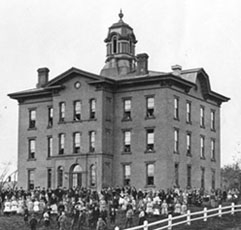
Built in 1867, Twilight Hall is made of brick, with brownstone details of Italianate style. The building had heavy, bracket-supported cornices, a gable on each facade, and a mansarded cupola. A fire in 1904 damaged it badly; it was rebuilt without the cupola, and with minor changes to the roofline.
Motivated by historic and community spirit, the College purchased the building from the Addison County School District in 1984 and undertook major renovations. On May 23, 1986, the restored building was rededicated and named Alexander Twilight Hall for the first Black American to earn a college degree, in 1823.
Education Studies is pleased to occupy a corner of a building with such a rich history. Since a charter in 1797, this location has been dedicated to education, as a grammar school, College classrooms, College dorms, back to a grammar school, and again as College classrooms. Long may Twilight Hall serve the educational needs of its students.