Middlebury Language School Graduate Programs


N.B. Course descriptions and required texts are subject to change.

Courses

Courses offered in the past four years.
indicates offered in the current term
indicates offered in the upcoming term[s]

ITAL 6506 - Creative Writing:Tools of Prof      

Creative Writing: the Tools of the Profession or first Read, then Write

A more accurate title for this course could be «Creative Reading». It implies, in fact, a strong interest in literature, in the pleasure of reading stories, poems, and essays – in a word, of reading books. A direct and close contact with some entertaining texts authored by the best contemporary Italian writers will lead the student to grow conscious of her/his voice and achieve a deeper understanding of it. We will read and comment the texts of the writers and also the texts produced by the students during the course. Our attention will be focused on the structure of Italian sentences, on the meanings of Italian words. We will examine many subtle features of the Italian written and spoken language. We will speak about Italian society, history and politics – all phenomena that give birth to new words. Together we will look for a style, in the pages we read and in the pages we write. Active participation in class is warmly required.

Required texts (to be read before the course starts)

Fruttero & Lucentini, I ferri del mestiere. Manuale involontario di scrittura con esercizi svolti, Tascabili Einaudi, n. 1279, Torino 2004.

Additional reading material will be provided by the instructor, possibly including short texts by Italo Calvino, Umberto Eco, Beppe Fenoglio, Carlo Emilio Gadda, Natalia Ginzburg, Tommaso Landolfi, Primo Levi, Leo Longanesi, Goffredo Parise, and others.

Language & Stylistics

Summer 2009

More Information »

ITAL 6515 - Politcs &Society Fascist Italy      

Politics, Culture and Society in Fascist Italy

This course will study how the totalitarian fascist program planned to reshape Italians and Italian Culture and the role played by literature, cinema, documentaries. The national program for youth development as well as the magazines aimed at young adults and children will also be examined. The course will present an overview of the “autarkical campaign,” imperialism, and the anti-Semitic campaign, as elements that contributed to construction of the totalitarian fascist model.

Required texts:Emilio Gentile, Il culto del littorio. La sacralizzazione della politica nell’Italia fascista, Roma-Bari, Laterza, 2009. ISBN - 88-420-6323-1
Ruth Ben-Ghiat, La cultura fascista, Bologna, Il Mulino, 2004.
ISBN - 88-15-09633-7

Mariolina Graziosi, La donna e la storia: identità di genere e identità collettiva
nell'Italia liberale e fascista
, Napoli, Liguori, 2000. ISBN - 88-207-3021-9
Vito Zagarrio, Cinema e fascismo. Film, modelli, immaginari, Venezia, Marsilio, 2004.
ISBN - 88-317-8063-8

Civ Cul & Soc

Summer 2010

More Information »

ITAL 6524 - Comic & Poetic Charm of Totò      

The Comic and Poetic Charm of Totò Bondì

The scope of this course is to study the various roles played by Italy’s greatest comedian: Totò, born Antonio Vincenzo Stefano Clemente on February 19, 1898 in a poor district of Naples, who went on to become a living legend. After many years on the stage Totò, in the late thirties made his debut in cinema and went on to make more than one hundred films. Unfortunately, for the most part, his earlier films were not well received by the critics who maintained that Totò’s real artistic dimension belonged only to the theater. Through a series of films made with Monicelli, Rossellini, Pier Paolo Pasolini and others, this course will bring to life Totò’s unsurpassable acting and his poetic cinematic interpretations.

Required texts: Totò, l'uomo e la maschera di Franca Faldini e Goffredo Fofi ed. L'ancora del Mediterraneo, 2000 Napoli ISBN 8884401151

Liliana de Curtis, Totò mio padre. Milano: Ed Rizzoli ISBN 88-04-33680-3.

Civ Cul & Soc

Summer 2009

More Information »

ITAL 6536 - New Verses Ital Contemp Lit      

Ten Poets: New Verses in Italian Contemporary Literature

Empty spaces are as important as written words when you engage yourself in reading a poem seriously. We will pay the same attention to the voices and to their silences while reading ten Italian poets from the twentieth century: Umberto Saba, Aldo Palazzeschi, Giuseppe Ungaretti, Eugenio Montale, Sandro Penna, Vittorio Sereni, Andrea Zanzotto, Elsa Morante, Patrizia Cavalli, Valerio Magrelli. We will read and comment in class two or three texts for each author for a total of ten poets.

Required texts:

Poeti italiani del Novecento, anthology edited by Pier Vincenzo Mengaldo, Oscar Mondadori, Milano 1990

A profile of Elsa Morante, Valerio Magrelli, and Patrizia Cavalli, who are not included in Mengaldo’s anthology, will be provided by the instructor, together with the texts to be read and commented.

Literature

Summer 2009

More Information »

ITAL 6538 - Exile & Migration Contemp Lit      

Borders, Exile, Migration and Exile in Contemporary Italian Literature

This class focuses on works written in Italian but that may not be classified as part of Italian literature according to the traditional national canon. The books included in the syllabus deal with multicultural experiences in and outside Italy. The goal of the class is that of reflecting upon literary categories that do not apply anymore (or have never applied) to specific sections of Italian literature that are better understood if de-nationalized and envisioned in a multicultural and multilingual context. Is it topics or languages that assimilate literary works to a specific tradition? Does a Hungarian-born author who writes in Italian belong to one of the two specific linguistic literary traditions? In what measure the acquired cultural tradition mingles or clashes with the original background in an author who lives most of his life abroad, but chooses to write in his/her native language? A Swiss Italian writer is Swiss or Italian? Both? Neither? What are the boundaries that define or expand the concept of border literature? We will study works that question the traditional lines of the Italian canon and suggest that rather than speaking of Italian literature, we should begin speaking of literature written in Italian.

Required texts: Fleur Jaeggy. La paura del cielo. Milano: Adelphi, 1994.
Giorgio Pressburger. La neve e la colpa. Torino: Einaudi, 1998. 88-06-14747-1
---. Di vento e di fuoco. Torino: Einaudi, 2000. 88-06-14748-X
Edith Bruck. Transit. Venezia: Marsilio, 1978. 88-317-6270-2
Claudio Magris. Danubio. Milano: Grazanti, 1985. 9-7888-11-674528
---. Un altro mare. Milano: Garzanti, 1991. 88-11-67752-1
Paolo Mauresing. La variante di Lüneburg. Milano: Adelphi, 1993. 88-459-0984-0

Summer 2010

More Information »

ITAL 6540 - History of Industrial Design      

Industrial Design Made in Italy

The objective of this course is to furnish the fundamental knowledge and critical
tools for understanding the phenomenon of Italian Industrial design. The development of the industrial system of production, the formation of the industrial model, and of the industrial and technological system in Italy will be examined to illustrate the historical lateness of Italy’s passage from applied art to industrial serial production and how this late transformation produced a specific evolution that has determined the success and the specificity of the Italian
system in the world market. The objective of this course is to identify the unique circumstances that have contributed to the success of “MADE IN ITALY.”

Required Texts:
Andrea Branzi, Introduzione al design italiano. Una modernità incompleta, Baldini Castoldi Dalai, 1999, Milano

Renato De Fusco, Made in Italy. Storia del design italiano, Laterza, 2007

Vittorio Gregotti, Il disegno del prodotto industriale. Italia (1860-1980), Mondadori, Electa, 1986, Milano

Civ Cul & Soc

Summer 2012

More Information »

ITAL 6545 - Italiana Identity Med Alterity      

Italina Identity and Mediterraneean Alterities

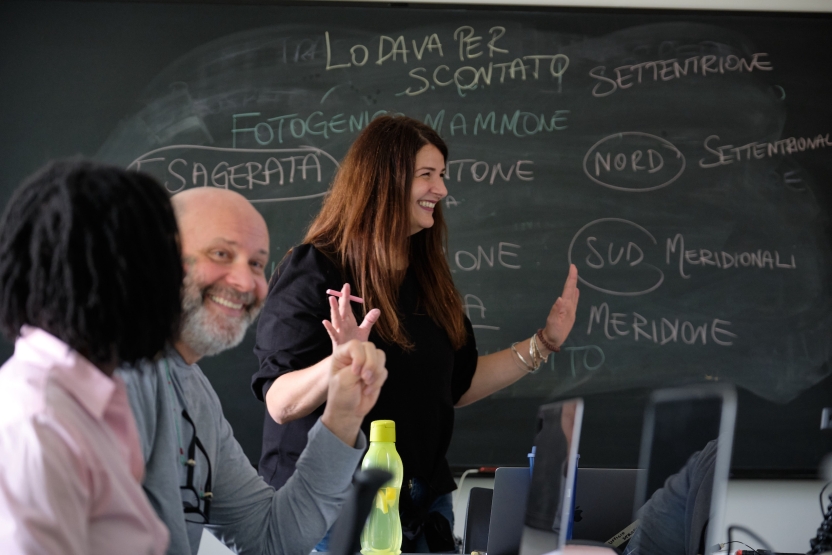
This course is divided in two parts, one on theory and the other on readings and textual analysis. The first part will be centered on the work of Edward Said and Franco Cassano, on a variety of work on immigration and on the formation of a multicultural social fabric in Southern Italy. Particular emphasis will be given to the presence of the Arab immigration that is now beginning to have its own literary voice in Italian. The second part will focus on the analysis of selected texts pertaining to these issues. Class discussions will examine the dichotomy of a mythological corrupted South versus an efficient, productive and industrial North which is at the base of Franco Cassano’s theory of the meridian thought. (This course can also count for the Master in Mediterranean Studies)

Required texts: Giuseppe Tomasi di Lampedura, Il Gattopardo, Feltrinelli, 2007. Leonardo Sciascia, Consiglio d’Egitto
Maria Attanasio, Di Concetta e le sue donne, Sellerio, 1999. Roberto Saviano, Gomorra. Viaggio nell'impero economico e nel sogno di dominio della camorra, Mondadori, 2006. Daniela Carmosino, Uccidiamo la luna a marechiaro. il Sud nella nuova narrativa italiana, Donzelli, 2009.
Franco Cassano, Il pensiero meridiano, Laterza, 2005 (1996).

Civ Cul & Soc

Summer 2010

More Information »

ITAL 6549 - Med Civ Cyclades to Modernity      

Mediterranean History, Arts, and Civilization from the Cyclades to Modernity *

This course will begin with the study of the mysterious civilization on the Cyclades Islands 2,000 years before Christ and will cover the classical period of ancient Greece, Imperial Rome, the fall of the Roman Empire, the birth of Christianity, the Middle ages in Europe, Byzantine art in Venice and in Ravenna, the religious schism between the Western and the Eastern churches, the Venetian Empire, the Renaissance in Tuscany, Luther’s Reformation and the crisis of the arts in Northern Europe. The course will conclude with a study of the Muslim World and the Mediterranean.

*(Besides regular credit this course may also count for one credit in the M.A. in Mediterranean Studies program)

*Mediterranean History, Arts, and Civilization from the Cyclades to Modernity

Civ Cul & Soc

Summer 2009

More Information »

ITAL 6564 - Sex Love Betrayal Ital Opera      

Sex, Love and Betrayal in the Italian Opera Tradition

This course will look at Italian Opera from Monteverdi to Puccini. Each opera will be analyzed from a purely musical aspect and within the historical context of its composition. Some of the topics discussed will be: opera seria, opera buffa, castrati, verismo, and the enormous contribution of non-Italian composers (such as Mozart) to the patrimony of Italian Opera. With the aid of a professional opera singer present at all lessons it will be possible to sing through selected arias and get a better feel for the music through live performance. Students will be encouraged to participate in the singing as much as possible. Reading and listening materials will be distributed by the professor.

Civ Cul & Soc

Summer 2009

More Information »

ITAL 6567 - Italian on Stage      

Italian on Stage: The Myth of Commedia dell'Arte

The course will study the Commedia dell'Arte focusing on figures ranging from the buffoons of the Middle Ages up to Goldoni's characters. As well, representative texts, scenarios, and acting techniques of the most celebrated Italian comic theatre tradition will be analyzed. All students in this workshop are expected to act in and/or to assist in the production of the play that will be performed prior to the end of the session.

Required texts: Siro Ferrone, Attori mercanti corsari, Einaudi Torino 1993 ISBN 8806131834

Roberto Alone, Goldoni dalla Commedia dell'Arte al dramma Borghese. Garzanti 2004, ISBN 8811600375

Carlo Goldoni, Il servitore di due padroni. Einaudi 2002 (Libro e DvD) ISBN 8806162853

Carlo Goldoni, Il teatro Comico - Memorie italiane. Mondadori 1983, ISBN 8804228927

Eduardo de Filippo, L'arte della Commedia. Einaudi Torino 1965 ISBN 8806065939

Civ Cul & Soc

Summer 2009

More Information »

ITAL 6603 - Italian Sociolinguistics      

The objective of the course is to present a profile of the sociolinguistic situation in Italy today, but with the necessary reference to the pre and post unification periods. The main theoretical notions relevant to linguistics and sociolinguistics (language, norms, language use and users, dialects, the different types of linguistic variations and so on) will be discussed. The final aim is to illustrate the characteristics of standard Italian, its regional variations and today’s dialects by considering their use by speakers in the different communicative situations. Other topics include jargon, contemporary adolescent talk, the Italian spoken by foreigners both in and outside of Italy, the Italian used in the mass media, in advertising, in politics and in other sectors. (1 unit)

Required Texts: Gaetano Berruto,Sociolinguistica dell’italiano contemporaneo.
Roma:Carocc,Edizione: 2012.
ISBN: 9788843063499
T. De Mauro, Linguistica elementare. Roma Bari: Laterza (1998),

Linguistics

Summer 2013

More Information »

ITAL 6604 - Italian Phonetics      

The course objective is to enable students to acquire the concepts and scientific instruments needed to understand the mechanisms that drive the production (phonetics) and organization (phonology) of the sounds of human language. To this end, a particular emphasis will be placed on the dialectal varieties of language. This preparation will allow students to put into practice the principles of the phonetic transcription of single words and enunciations (their concatenation) using the International Phonetic Alphabet (IPA). Students will also confront the study of the segmental system and some of the super-segmental characteristics of language (duration, accent and tone, for example), which go beyond the theories linked to the phonological structure of words and enunciation

Required texts: Maturi, Pietro. (2009). I suoni delle lingue, i suoni dell’italiano. Introduzione alla fonetica (seconda edizione). Bologna: Il Mulino. (pp. 9-113). ISBN: 978-88-15-13305-2.
Nespor, Marina & Bafile, Laura. (2008). I suoni del linguaggio. Bologna: Il Mulino. ISBN: 978-88-12678-8.

Linguistics

Summer 2013

More Information »

ITAL 6607 - Italian Language Pedagogy      

The course aims to provide the students with the principle notions of linguistics and sociolinguistic theories useful for the teaching of languages. Particular use will be made of notions relevant to applied linguistics and to the methodologies of language teaching. The objective is to outline the traits on an effective language pedagogy which places at the center of its concerns the communicative needs of the learner. Other topics include language acquisition, linguistics communication, the role of grammar in language teaching, the notion of” linguistic space”, the stratification of Italian lexicon, written language versus spoken language, regarding also the levels of Common European Framework of Reference for languages (CEFR).

Pedagogy

Summer 2013

More Information »

ITAL 6614 - Pirandello      

Pirandello: The Word, the Mise-en-scene and the Myth Santeramo

The course will offer an in-depth study of Luigi Pirandello's most important dramatic works, together with analyses of his theoretical essays on theatre. His three-year directorship of the Teatro d'Arte in Rome will also be examined. Pirandello's plays and theory will be studied in a European context. Particular attention will be paid to the following plays: Six Characters in Search of an Author, Each in his Own Way, Henry IV, The Feast of Our Lord of the Ships, The New Colony, Lazarus; I'm Dreaming, But Am I?; Tonight We Improvise and The Mountain Giants.

Required Texts: Donato Santeramo, Luigi Pirandello: la parola, la scena e il mito. Roma: Nuova Editrice Universitaria, 2007. ISBN: 978-88-95155-09-8

Additional reading materials will be provided by the instructor.

Pirandello's plays and essays can be found at: http://www.classicitaliani.it/index070.htm"

Literature

Summer 2011

More Information »

ITAL 6615 - Pier Paolo Pasolini      

Pier Paolo Pasolini’s Complex and Fascinating Creativity *

This course will focus on the entire body of Pier Paolo Pasolini’s creativeproduction: cinema, poetry, fiction, theater, and critical essays. Pasolini’s work stood out in Italian literature from the Fifties to the Seventies as a passionate attempt to conjugate Marxism, Christian spirituality, nostalgia for the lost values of agrarian society and fascination with the vitality of the sub-proletariat Roman world. His was a voice also noted for its explicit and pitiless accusation of the social structures of the industrialized West. Special attention will be given to certain works published during the last decade of his life, which are the most significant and representative of this original and controversial Italian intellectual. The memorable documents written after his 1966 and 1969 visits to USA will also be studied.

*Required Texts: P.P. PASOLINI, "Teatro", Milano: Garzanti, 2006, Euro 18.50. ISBN 88-11-66965-0
P.P. PASOLINI, "Empirismo eretico", Milano: Garzanti, 2007, Euro 13.50. ISBN 978-88-11-67544-0
P.P. PASOLINI, "Trasumanar e Organizzar", Milano: Garzanti, 2002, Euro 9.50. ISBN 978-88-11-67607-0
P.P. PASOLINI, "Pasolini rilegge Pasolini", Milano: Archinto, RCS Libri, 2005, Euro 20.00. ISBN 88-7768-448-8

Civ Cul & Soc

Summer 2009

More Information »

ITAL 6617 - Mediterrean Identity in Arts      

Mediterranean Identity through Literature-Cinema-Poetry-Theater

A fundamental approach to the exploration of the Mediterranean self/identity is to examine those figures that are different from the narrative self - among which the female figure is one of the most important and universal representations of otherness. One such multi-faceted character is Medea, arguably the most captivating female figure of all times who, since the dawn of Western literature, has inspired many artists in all fields. Euripides, Seneca, Corneille, Anouilh, Pasolini, Callas, Fo and Rame, NDiaye, Ba, are among the many who have breathed life into Medea’s various incarnations, on the stage and in cinematic productions, from ancient Greek drama to the present day. Unlike most mythic figures, whose defining attributes remain constant across the various versions of the myth, the essence of Medea is continually changing as her story is rethought by the various authors and new versions are created. The Medea myth often supplies the vocabulary for expressing modern political concern, such as the tensions within a mixed marriage in contemporary society. She illuminates the opposing concepts of self and other, and also suggests the disturbing possibility of otherness within the self. We shall investigate the figure of Medea in XX-century theater and film in the Mediterranean area, reconstructing its ancient meaning in literary tradition, as well as the philosophical, psychological, and cultural questions these portrayals give rise to.

(Besides regular credit this course may also count for one credit in the M.A. in Mediterranean Studies program)

Civ Cul & Soc

Summer 2009

More Information »

ITAL 6618 - Tavianis Brothers' Films      

The 150th Anniversary of Italy Unification seen through the Films of the Tavianis Brothers

The course will study and analyze 150 years of national history through
the Taviani Brothers' films. We will look at the agricultural society
of the South and the reality of migration studying A Man for Burning
and Good Morning Babylon. The Risorgimento as an unsuccessful
revolution will be analyzed from the standpoint of Saint Michael had a
Rooster and Allonsanfan. We will also study the subversion and the
utopias of the Sixties, the Resistance movement and the issue of the
South as portrayed in The Night of San Lorenzo, My Father, my Master
and Kaos , adapted from short stories by Sicilian writer par
excellence, Luigi Pirandello. Through an examination of so-called
"political cinema," we will study the disengagement and economic boom
that followed the Resistance through the comedies of Risi and
Monicelli, concluding with a look at the cinema of the last generation
(Vicari, Munzi, Garrone, Marra and Crialese) who experiment with new
narrative forms.

Civ Cul & Soc

Summer 2011

More Information »

ITAL 6626 - Topics History Ital Language      

Topics in the History of the Italian Language

This course will trace the origins of the Italian language, and provide an overview of the principal phases of its evolution, from the earliest documents and Medieval vernaculars through the codification of the literary standard during the Renaissance. The focus on the literary language will be complemented by the study of the varying relations between Italian and its dialects across time, space, and society, but particularly in regard to contemporary Italy. A look at the vicissitudes of Italian abroad will shed light on language use and structural changes in unstable contexts of contact situations.

Required Texts: Material in electronic form to be available for students upon arrival at Middlebury

Language & Stylistics

Summer 2011

More Information »

ITAL 6631 - Myth of Ulysses in Ital Lit      

The Mediterranean Myth of Ulysses in Italian Literature

This course looks to deepen the understanding of the figure of Ulysses, as legend in the foundation of Mediterranean culture. The course will examine the multifarious nature of the character of Ulysses, i.e., its ancient as well as modern aspects. The figure of Ulysses offers itself as a symbol of innumerable potentialities: a varying heroismk constantly reinterpreted with the passage of centuries. It stimulated expression from Homer to authors of the twentieth century, and inspired a plurality of protagonists very different from one another. After an analysis of the Ulysses in Homeric poetry (the Illiad and the Odyssey), the course will focus on the metamorphosis of the character in some classical authors of Italian literature: from Dante Alighieri to Ugo Foscolo, from Gabriele D’Annunzio to Giovanni Pascoli, and to Guido Gozzano; from Primo Levi to Umberto Saba.

Required Text:
G. Tellini, Letteratura italiana. Un metodo di studio. Firenze, le Monnier Università, 2011.

Additional reading materials will be provided by the instructor.

Civ Cul & Soc Literature

Summer 2012

More Information »

ITAL 6632 - Artist-Writer Ital Renaissance      

Artist-Writers of the Italian Renaissance

The course aims to deepen your knowledge regarding the rapport of artistic culture through the literary works of three grand artist-writers: Michelangelo Buonarroti, Benvenuto Cellini, and Giorgio Vasari. During the cultural height of the first half of the 1500s, these artist-writers shared presuppositions that restored reason to the fundamental experience of writing, occupying a prominent position also in the field of literary history through three diverse genres: lyric poetry, autobiographical prose, and artistic historiography.

Required texts: Gino Tellini, Letteratura italiana. Un metodo di studio, Firenze, Le Monnier, 2011, ISBN 978-88-00-74071-5.
Additional reading materials will be provided by the instructor.

Civ Cul & Soc Literature

Summer 2013

More Information »

ITAL 6634 - Humoristc Lit:I promessi sposi      

Beyond "Historia": /I promessi sposi/ as a Humorist Novel

Beyond "History": "I promessi sposi" as a Humorist Novel Ciccarelli In this course we will analyze Alessandro Manzoni's famous novel as a model of humoristic literature for the subsequent Italian narrative tradition. From Pirandello to Calvino, from Svevo to Gadda, most Italian writers who have been associated to the humoristic literary current have demonstrated a keen appreciation of Manzoni's novel and work, without judging it, mostly or exclusively, for its religious or moralistic goal.

To the contrary, they have identified the novel's strength in its irony and humor, which have been seen as powerful intellectual weapons of Manzoni's poetics. It is through these rhetorical weapons that Manzoni, in his novel, uncovers and denounces the harshness of reality, without ever losing contact with the paradoxical aspects that affect human life. Manzoni combines his strong belief in the historical truth with his strong religious belief to ridicule hypocrisy and falsity, and to offer an anthropological view of human conditions which embraces empathy as well as condemnation of humanity's inevitable flaws. In this class we will read the novel and its appendix, the 'Storia della colonna infame,' as well as a few passages from some of the works by the 20th-century authors mentioned above.

Required texts:
Texts are available online. Critical texts will be at the Middlebury library

Literature

Summer 2012

More Information »

ITAL 6638 - Poetry & Play: Parody Ital Lit      

Poetry and Play: The Parody in Italian Literature

Parody is transgression and mockery according to codified norms, but it is also a playful and humorous rewriting of major texts, which, as one knows, is a serious matter. It invites broadening the horizon, bringing in fresh air, in other words: looking at the world from another prospective. Even if play is not part of the academic curriculum there are entire chapters of Italian literature dedicated to parody, written as a countermelody to the prevailing models. In this course students will be guided along an amusing journey to the discovery of parody, from Boccaccio to Umberto Eco.

Required text:
G. Tellini, Rifare il verso. La parodia nella letteratura italiana, Milano: Mondadori ("Oscar saggi"), 2008, pp. 390, euro 12. ISBN = 978-88-04-58173-4.

Literature

Summer 2009

More Information »

ITAL 6639 - Figure of Medea & Its Myth      

The Figure of Medea and its Myth

This course proposes to study the figure of Medea as perceived and interpreted by various Mediterranean authors, from the time of her conception in Ancient Greece through our own day. Everyone knows that Medea is a woman who kills her children. But who is she? And why does she do it? She is the timid princess of a faraway land who is seduced and abandoned by an adventurer, the powerful granddaughter of a Sun god, the slighted heroine who is compelled to seek revenge for her stolen honor, the woman of wisdom, the betrayed lover, the heartbroken mother. Innumerable writers, composers and directors have interpreted in their own way the story of Medea, and in so doing have told something of themselves, of their time and their culture: from Euripides to Seneca, Dante to Christine de Pizan, Lope de Vega to Pierre Corneille, Corrado Alvaro to Pier Paolo Pasolini, and Annibale Ruccello to Max Rouquette; from Greece to Rome, France to Spain, and from Naples to Africa: this archetypical figure has made appearances and played a role in cultural thought.

Required texts: Giulia Tellini, Storie di Medea, Firenze, Le Lettere, 2012, ISBN 978-88 6087 5273
Euripide, Seneca, Grillparzer, Alvaro, Medea. Variazioni sul mito, a cura di Maria Grazia Ciani, Venezia, Marsilio, 1999, ISBN 978-88-317-7250-1

Literature

Summer 2013

More Information »

ITAL 6640 - Verdi & 19C Italian Melodrama      

Verdi and the Italian Melodrama of the 19th Century

The study of Italian culture, literature and music cannot be studied independently from opera and melodrama. It is within this genre that many authors, librettists, and musicians have pursued their artistic endeavors for long centuries. In the 19th century it is the melodrama that serves as a vehicle for the expression of romantic and risorgimental ideals. The communicative dimension of the genre developed within the dimension of theatre, which involves a public that is vast and stratified. Opera was driven in its course of evolution by structural definitions and taste, which were in close dialogue with developments in intellectual thinking and other art forms. This course will focus on historical aspects, formal constitution, aesthetic meanings, poetic motivations, musical and technical languages, social correlations and dimensions of production within the Italian operatic tradition. Special attention will be given to the 19th century and the epoch of Giuseppe Verdi.

Required texts: Massimo Mila, Verdi (a cura di Pietro Gelli), Milano, Rizzoli, 2000. ISBN 8817865354, 9788817865357

Civ Cul & Soc

Summer 2013

More Information »

ITAL 6644 - History of Italian Journalism      

Free or Controlled Press? - A History of Italian Journalism

This course will study the evolution of the diffusion of public information in Italy. This historical overview will begin with the “Acta Diurna” (Roman official notices comparable to Daily Public Records) and go through the first efforts of the Lombard Enlightenment to create lay publications in competition with the informative methods used by the Catholic Church. We will then move on to discuss the birth of the first major newspapers founded and financed by the major industrial enterprises and the Lombard and Piedmontese cotton industry. We will also analyze the press under the Fascist regime, media controlled by political parties, media connected to the Resistance and electronic media. The course will end with a study of Rai/Mediaset, the slow affirmation of the Rete in Italia, the so-called "citizen's journalism" and the phenomena of the "free press". By the end of the course the recurring question of whether Italian national media is the servant of the dominant powers or independent, will be answered.

Civ Cul & Soc

Summer 2009

More Information »

ITAL 6645 - Dialects of Italy      

The Dialects of Italy and other Italian Linguistic Realities

This course will study the origins, distribution and fate of Italian dialects.
Lessons will also focus on studying literary expression, folklore and lyrics.
Linguistic minorities in Italy, the Italian language outside of Italy (Italian emigration abroad) and the language of the new Italians living in Italy will be also discussed and analyzed.

Required Text:
T. De Mauro, Storia linguistica dell’Italia unita, Roma-Bari, Laterza, 2011²,
Biblioteca Storica Laterza.

Summer 2012

More Information »

ITAL 6650 - Italian Political Thought      

From Dante to Gramsci: Italian Political Treatises between ragion di stato and Utopia

This course deals with political and utopian treatises written in Italy during the Middleage, the Cinquecento and up to Antonio Gramsci. After reviewing some aspects of the origins of th epolitical debate that evolved before Machiavelli, we will focus on a number of writers who, from different perspectives, dealt with the complex issues involved in the delicate relations between the rulers and the subjects and the organization of civil life. We will read and analyze, in the light of the historical and political reality of the Italy of the time (a particular troubled reality of the Italian States), selections from the works of Dante, Machiavelli, Guicciadini, Botero, Zoccolo, Campanella and Gramsci.

Required Texts: Dante, Monarchia, a c. di M. Pizzica, Milano, Biblioteca Universale Rizzoli, 1988, Euro 9,50. ISBN-88-17-16682-0, N. Machiavelli, Il Principe, a c. di G. Inglese, Einaudi (E. 8.00) ISBN - 88-06-13851-0, Guicciardini, Ricordi, a c. di G. Masi, Milano, Mursia, 1994, ISBN - 88-425-1595-7, A. Gramsci, Scritti scelti, Milano, BUR, 2007 (E. 14.00) ISBN – 9788817016186

Civ Cul & Soc

Summer 2011

More Information »

ITAL 6651 - Mangiare Italiano      

Mangiare italiano/ : Historical, Cultural and Linguistic Aspects*

The course describes the history of food in Italy, throughout the centuries. The course will also analyze the formation of different regional traditions. The historical, cultural and linguistic culinary traditions will be illustrated by a series of pertinent documents. Special attention will be dedicated to the relationship that existed between the New World and Italy, and the reciprocal exchange of products and recipes. In addition, the course will examine the effects that the Italian immigration had in North America, especially on the American culinary experience.

Required texts: Rebora, "La civilta' della forchetta" Ed. Laterza, Collana Economica, anno 2000, pagg. 206 - Euro 9.00
Johd Dickie, Con gusto, Ed. Laterza, anno 2007, pagg. 396 - Euro
Capatti - Montanari, La cucina italiana: storia di una cultura, Ed. Laterza, Collana Economica, 2005, - Euro 10.00

* Only open to M.A. and DML students who have completed a preliminary summer of study on the Vermont Campus

Civ Cul & Soc

Summer 2009

More Information »

ITAL 6653 - The Jewish Culture in Italy      

This course offers a panoramic history of the first Jewish settlements in what is now Italy from the High Middle Ages to present day Italy. This chronological survey will examine some of the most interesting aspects of the Jewish presence in Italy: the makeup of the community, the traditions, the literature, philosophy, economic activities, the relationship with the Vatican and the Catholic majority, life in the Ghettos, racial persecutions, and the relationship between racism and anti-Semitism. Special attention will be given to some of the major figures that came out of the Jewish communities both in the arts and in the field of science. Among those we will study are Leone de’ Sommi, Leon Modena, Natalia Ginzburg, Primo Levi, Emilio G. Segre’ and Rita Montalcini.

Required text: Storia d’Italia, Annali vol. 11 * 11 * [11/2] – Gli Ebrei in Italia
Einaudi, Torino, 1997 - ISBN-13: 9788806130374

Civ Cul & Soc

Summer 2010

More Information »

ITAL 6654 - Being Women & Doing Theater      

Starting with a survey of Classical, Greek and Roman theater, analyzed from a female perspective, the course will explore the reasons behind the indisputable fact, attested by Aristotle himself, that although theatrical practice began with the representation of Demetra’s cult, the practice of the Eleusinian mysteries, and the celebration in honor of Dionysius, half man and half woman-- women were banned from the stage. Why then were they excluded? To answer this question the course will study classical texts such as Medea, Phaedra, Antigone, Clytemnestra, Jocasta, Al cesti and other ancient and modern literary and critical works on the subject.

(Besides regular credit this course may also count for one credit in the M.A. in Mediterranean Studies program)

Civ Cul & Soc

Summer 2009

More Information »

ITAL 6659 - The Cinema of Francesco Rosi      

THIS IS A 3-WEEK COURSE DURING SESSION I

The aim of this course is to study Francesco Rosi's cinematography, which includes an impressive number of individually celebrated films, which occupy a unique place in postwar Italian and world cinema. His seventeen feature films are known for their extraordinarily consistent formal balance and their unflinching look at the historical events and cultural traditions that have shaped the Italian national character. They thus represent a body of work of inordinate importance for both the cultural history of Italy since the fall of Fascism and for a realist theory of cinematic representation.

Required texts:Antono Giulio Mancin e Sandro Zambetti, Francesco Rosi, Milano: Il Castoro, 1998.
ISBN 88-8033-058-6
Io lo chiamo cinematografo conversazioni con Giuseppe Tornatore, di Francesco Rosi, Milano: Mondadori, 2103.

Civ Cul & Soc

Summer 2013

More Information »

ITAL 6661 - Mediterranean Boccaccio:      

A course on Mediterranean Boccaccio originates from the awareness that a culture and its visual and literary texts cannot be considered without taking into account the context that generated them. The context we consider in this class is the culture of the Mediterranean in the XIII and XIV centuries, namely the cultural, commercial and intellectual exchanges through the Mare Nostrum. The course aims to follow the path of what can be considered 'Mediterranean' in the Decameron starting from a study of the representation of the cities and in particular of the city of Naples, one of the Mediterranean cities most loved by Boccaccio. In this course students will be introduced to a reading of Boccaccio's texts with a particular focus on the Decameron, a literary, social and cultural
observatory of Italy in XIV Century. The approach is both philological, as a 'direct' access to the Italian texts, and cultural by means of contextualizing them in the literary and social setting that generated them. The first part of this course aims to locate Boccaccio within Mediterranean culture by looking at the role of Florence with Naples and France and the relationship Boccaccio had with the Florentine Niccolò Acciaiuoli, Grand Seneschal of the Angevin Kingdom in Naples, not to mention the impact that the Southern city had on Boccaccio. Messina, Palermo and Venezia will also be considered. The second part of the course is the actual reading of Boccaccio's texts and it progressively follows the themes of the Decameron.
°The credit for this course can also be used for the M.A. in Mediterranean Studies

Required Texts: G. Boccaccio, Decameron, a cura di V. Branca, Torino, Einaudi, 2005, ISBN-9788806177027
2 Voll. (students are required to bring a copy of this edition).
F. Bruni, Boccaccio e l'invezione della letteratura mezzana, Bologna, Il Mulino, 1990, ISBN-88-15-02479-4
Lessico critico decameroniano, ed. R. Bragantini e P. M. Forni, Torino,
Bollati Boringhieri, 1995, ISBN - 88-339-0915-8

Civ Cul & Soc Literature

Summer 2011, Summer 2013

More Information »

ITAL 6662 - Italian Colonial &Post-Col Lit      

Italian Colonial & Post-Colonial Literature

Set against the background of the hundred years of the Italian colonial and postcolonial experience in Africa, this course will confront the period between 1935 (the year of the Italian war in Ethiopia) and the periods of “Amministrazione fiduciaria” (Fiduciary administration) and Italian Cooperation in Somalia through the analysis of the colonial and postcolonial novels of Flaiano, Tobino, dell’Oro, and Domenichelli.

Required texts:Ennio Flaiano, Tempo di uccidere (1947), Milano, Rizzoli (BUR). ISBN 978-88-17-02333-7
Mario Tobino, Il deserto della Libia (2011), Torino, Einaudi; Milano, Mondadori. ISBN 978-88-04-61276-6
Erminia dell’Oro, Asmara Addio, Roma, Baldini e Castodi (I Nani), 1988. ISBN 978-888089230-2
Mario Domenichelli, Lugemalé/, Firenze, Pagliai, 2005. ISBN 97 88883048 661

Literature

Summer 2013

More Information »

ITAL 6665 - Mediterranean & Dante's DC      

The Mediterranean Signature of Dante’s Divina Commedia

The course will explore Dante’s Divina Commedia with special reference to the Medieval Mediterranean cultural context from which it emerged. We will be reading selected cantos, as well as some of Dante’s other works, in relation to the network of intellectual traditions (Islamic, Jewish, Christian) that dominated Dante’s age.

Required Text:
Dante Alighieri, Tutte le opere (Divina Commedia, Vita Nuova, Rime, Convivio, De vulgari eloquentia, Monarchia, Egloghe, Epistole, Quaestio de aqua et de terra). Introduzione di Italo Borzi. Commenti a cura di Giovanni Fallani, Nicola Maggi e Silvio Zennaro. (Roma: Newton Compton editori, 1993).

Civ Cul & Soc Literature

Summer 2012

More Information »

ITAL 6669 - Mediterranean Culture      

This course looks to understand the historical and cultural mosaic, and the geographical and political realities of the Mediterranean, in order for students to better grasp the complexities associated with this region of the planet. The Mediterranean basin is the cradle of many great civilizations as well as the big three monotheistic religions, and the Mediterranean sea links and divides Europe from the Arabic-Muslim world at the same time.

The course will in part examine the history of the Arabic-Muslim world, which demonstrates the contact as well as the confrontation between the peoples and cultures of the Mediterranean basin. Presently, the Muslim-Arabic world is afflicted by socio-economic inequalities, political and cultural conflict and emigration, which all beg reflection upon fundamental themes of the history of political and cultural coexistence regarding the opposing Mediterranean shores.

The course will also focus on the issues of the integration of immigrants of Islamic origin in the societies of the northern shores of the Mediterranean, on terrorism, as well as on Islam and modernity. However, the reflections in the course will move well beyond ideas of ‘civilization conflict’ between Islam and the West, theorized by Samuel Huntington, and will attempt, instead, to adjust its perspective in order to consider the single destiny of these two Mediterranean worlds.

Required Texts:
Horchani F., Zolo D. (a cura di), Mediterraneo. Un dialogo fra le due sponde, Jouvence, Roma, 2005.
Guolo R., Xenofobi e xenofili. Gli italiani e l’Islam, Laterza,
Roma-Bari, 2003.
Filali-Ansary A., Islam e laicità. Il punto di vista dei musulmani
progressisti
, Cooper Castelvecchi, Roma, 2003.

Summer 2012

More Information »

ITAL 6680 - Politcs Society &Economy Italy      

Politics, Society and Economy in Italy: From the Reconstruction to the Advent of Berlusconi (1960-2009)

This course will study the changes in the Italian political system and the cultural transformations from the birth of the Republic to the advent of Silvio Berlusconi. Special emphasis will be given to Catholicism and to the political parties that rose from the fall of Fascism. The role of the economic boom, internal emigration, terrorism and the end of ideologies will be examined. We will also study the end of the first republish, the rise of the second republic and the new parties that emerged from the political crisis. The course will end with a close study of the rise of Berlusconi and the new parties.

Required texts:
Aurelio Lepre, Storia della prima Repubblica. L’Italia dal 1942 al 1992, Il Mulino, Bologna, 1993, pp. 157-342. ISBN-88-15-04062-5

Silvio Lanaro, Storia dell’Italia repubblicana. Dalla fine della guerra agli anni novanta, Marsilio, Venezia, 1993, pp. 221-451. ISBN-88-317-5403-3

Guido Crainz, Storia del miracolo italiano: culture, identità, trasformazioni fra anni Cinquanta e Sessanta, Donzelli, Roma, 2005, pp. 273. ISBN 88-7989-945-7

Luigi Lotti, I partiti della Repubblica. La politica in Italia dal 1946 al 1997, Le Monnier, Firenze, 1998. (Photocopies to be distributed in class)

(Photocopies on “berlusconismo” will be provide).

Civ Cul & Soc

Summer 2010

More Information »

ITAL 6683 - The Italian Diaspora      

This course will explore the Italian Diaspora, that is, the phenomenon that saw approximately twenty-four million people emigrate from Italy from the 19th century to the present day. After having studied the causes of emigration, students will focus on the impact of Italians and their descendents in their countries of adoption. Special attention will be paid to the United States, Argentina, Brazil, Canada and Australia.

Required Text:
Gabaccia, Donna R. Emigranti: Le diaspore degli italiani dal Medioevo a oggi. Torino: Einaudi, 2003

Summer 2012

More Information »

ITAL 6684 - Italian American Studies      

Scrittori "italiani" nelle Americhe

This course will look at the writings of significant "Italian" voices from three areas of the Americas: Canada, The United States, and Argentina. While all prose writings, they different from each other in that some are fictional and others are quasi travelogues (Pariani, Il paese dei sogni perduti) or autobiographies (Blengino, Ommi! L'America). Some of the fictional writings may be based on family histories (Rimanelli, Una posizione sociale; Ricci, Vite dei santi), others are based to a certain degree on a tragic event such as the internment of Italians in the early 1940s (Scottoline, Il prezzo del silenzi), one of the United States' best kept secrets, and others still are fictions infused with the writer's italianità (Melfi, Riti di infertilità).

Along with the usual analysis of the technique, "intention," and narrative "responsibility" of the modern/contemporary writer, we shall also examine the historical and thematic analyses of these authors' works specifically from the lens of biculturalism and immigration. That said, the other questions such as "How, why, and for whom does one write?" or, when applicable, "How do they fit into the modernist vis-à-vis postmodernist discourse?" will take on new meaning. Further still, we shall also examine the different modes in which these writers express their italianità and how such difference maybe rooted in and influenced by the local various local cultures in which these writers work their craft.

Required Texts:
Representing CANADA
Frank Paci, Scarpe italiane (2007 [2002])

USA
Giose Rimanelli, Una posizione sociale (1959; La stanza grande [1996])

ARGENTINA
Vanni Blengino, Ommi! L'America (2007)
Laura Pariani, Il paese dei sogni perduti. Anni e storie argentine (2004)

Literature

Summer 2011

More Information »

ITAL 6687 - The Actor's Body:ITAL Theater      

Theatrical Performance in the Last Three Decades of Italian Theater: The Actor's Body

The intent of this course is to study the last intensive thirty years of contemporary Italian theater, a period marked by research, new tendencies and new schools of thought regarding performance and theater itself. The course will have a creative point of view by presenting the material not only historically but focusing on the centrality of the actor. In this manner many poetic and theatrical languages will be studied from the inside, thus uniting theory and the personal experience of the instructor as interpreter and author. Following this approach the course is divided in five parts with specific themes that provide a range of interpretations of theatrical expression and thought over the last three decades.

Required Texts:
Claudio Meldolesi. La terza vita di Leo. Edizione: TITIVILLUS. 2010
Gerardo Guccini (a cura di) La bottega dei narratori. Edizione: Dino
Audino Edizioni. 2005
Stefano Casi (a cura di) Non io nei giorni felici. Edizione: TITIVILLUS, 2010.

Civ Cul & Soc Literature

Summer 2012

More Information »

ITAL 6691 - Contemporary Italian Novel      

Contemporary Italian Novel (1975-2000): Between History and Figurative Arts

The course will focus on a few novels written in the last quarter of the Twentieth century and it will explore the intersection of a historical and political discourse and reflections on the figurative arts. The course will argue that there is a strong correlation between the historical background presented in the novel and the presentation and discussion of the artistic works. Among the novels in question there are works by Paolo Volponi, Vincenzo Consolo, Erri De Luca, Antonio Tabucchi.

Required texts:
Vincenzo Consolo, Il sorriso dell’ignoto marinaio,
Vincenzo Consolo, Retablo,
Erri De Luca, Aceto, arcobaleno,
Antonio Tabucchi, Notturno indiano,
Antonio Tabucchi, Racconti, Milan: Feltrinelli, 2005 (selection) [or: Il gioco del rovescio, seconda edizione accresciuta, Milan: Feltrinelli, 1988]
Paolo Volponi, Il sipario ducale,

Literature

Summer 2010

More Information »

ITAL 6699 - New Technology Teaching IFL      

New Technologies for Learning and Teaching Italian as Foreign Language (IFL) (for DML candidates, advanced graduate students and teachers).

This course provides a balanced presentation of central issues in the theory and practice of Italian as Foreign Language teaching methodology and instructional technology. During the course, students will also develop critical skills for a meaningful integration of instructional technologies into their teaching/learning of Italian. The course will present the overall perspective in the context of current practices involving the integration of latest technologies. After conducting a review of technology in learning and teaching foreign languages (theories of learning and key ideas for understanding e-learning), students will be guided to analyze the opportunities and constraints in using technology in the educational process. Students will be also asked to select methodological approaches appropriate to the technologically-enhanced learning situation. An important component of the course will be the active participation and collaboration of all students in group discussions (both in-class and online), as well as the practical in-class technology-enhanced projects and demonstrations.

Required texts: Balboni E., Margiotta U. (2012) Formare online i docenti di lingue e italiano L2. Utet (ISBN 8860081998)
Pichiassi, M. (2007). Apprendere l'italiano L2 nell'era digitale - Le nuove tecnologie nell'insegnamento e apprendimento dell'italiano per stranieri. Edizioni Guerra - Soleil (ISBN 8855700626)
Serragiotto, G. (2009). Sillabo di riferimento per la formazione degli insegnanti di italiano a stranieri. Venezia: Cafoscarina (ISBN 9788875432409)

Summer 2012, Summer 2013

More Information »

ITAL 6701 - Religions of the Mediterranean      

Religions of the Mediterranean

The course intends to pursue the following goals: 1. To analyze the fundamental concepts at the basis of the three major monotheistic religions - Judaism, Christianity, and Islam - through selected readings from the Hebrew Bible, the New Testament, and the Koran; 2. To view succinctly these three religions in their historical development; 3. To explore how sexuality is viewed in the three religions.

Civ Cul & Soc

Summer 2013

More Information »

ITAL 6703 - Mask in Contemp Ital Theater      

The Mask in Contemporary Italian Theatre (From Dario Fo to the New theater of Narration to the transgressive Masks of Ricci/Forte (crossing the Commedia dell’Arte, Goldoni and Pirandello)

This course proposes to expand students' knowledge of contemporary Italian theatre through a special concentration on the mask, a central element of theatrical language. In a perpetual dialogue between tradition and contemporary practice we will place in confrontation the following elements: -certain key characteristics of the Commedia dell'arte and the theatre of Dario Fo and his storytelling masks -the renovation of tradition achieved by Goldoni and the theatre of Toni Servillo -some fundamentals of Brecht's "epic theatre" and the new theatre of Italian of narration - the dissolution of the "I" achieved in Pirandello's theater and the new dramaturgy of certain groups in the latest theatrical generations in Italy.

In so doing, the course intends to provide some cultural-historical coordinates regarding the usage and the sense of the mask and its dramaturgy. At the same time, through the observation of certain particularly significant works of contemporary Italian theatre, the students will be able to confront their study materials with concrete examples, comprehend from within the specifics of theatrical language (largely by virtue of the instructor's field experience as a theatrical author and interpreter), and develop an approach to the proposed video materials that is both personal and critical.

Required text: Dario Fo, Manuale minimo dell’attore, Torino: Einaudi -ISBN 9788806200510

Civ Cul & Soc

Summer 2013

More Information »

ITAL 6708 - Ital Political Novels &Thought      

From Antonio Gramsci to Roberto Saviano: Italian Political Novels and Thought

This course will not only look at the political content of the books to be studied but it will also analyze the social context in which the works were written. Particular attention will be paid to the post-Fascist period. The novels will be studied in a historical context and emphasis will be put on how they reflect a certain understanding of society which is often at odds with the ruling classes. A close reading of the works will also allow for a better understanding of the social function of literature in contemporary society.

Required Text:
Romano Luperini, La scrittura e l’interpretazione, Edizione Rossa, Volume 6 - Modernità e Contemporaneità (Dal 1925 ai nostri giorni). Palumbo Editore.

Novels:
Cesare Pavese, La luna e i falò/. Torino Einaudi, any edition.
Leonardo Sciascia, /Il giorno della civetta
. Adelphi, any edition.
P.P. Pasolini Una vita violenta, on line @ http://www.altrestorie.net/libri/Pasolini.Una%20Vita%20Violenta%20Pier.pdf
Roberto Saviano, Gomorra. Milano: Mondadori 2006.
Dacia Maraini, La ragazza di via Maqueda, Rizzoli, 2009.

Civ Cul & Soc Literature

Summer 2012

More Information »

ITAL 6713 - Ital Masterpieces in TV & Film      

The Major Italian Masterpieces Represented in Television and Film

In this course we will study the cinematic adaptation of some fundamental and very popular literary works written in Italy in the late nineteenth and the twentieth centuries. Excerpts from A. Manzoni, I promessi Sposi, Carlo Levi, Cristo s'è fermato ad Eboli, Primo Levi, La tregua, Elsa Morante, La storia, G. T. di Lampedusa, Il Gattopardo will be read. The novel Pinocchio, the Story of a Puppet, will be read in its entirety. During the lessons these works will be exemplified from the literary point of view as well as from the audiovisual translation.

Required Texts:
A. Maddalena, Il Gattopardo di Luchino Visconti, Guerra Edizioni, 2004. (Collana del cinema italiano per stranieri).
C. Collodi, Le avventure di Pinocchio. Storia di un burattino. Giunti editore 2008.
La sfida della verità. Il cinema di Francesco Rosi, a cura di A.Tassone, G. Rizza, C. Tognolotti, Firenze, Aida Edizioni, 2005

Civ Cul & Soc

Summer 2012

More Information »

ITAL 6714 - Cinematic World of Neorealism      

The Cinematic World of Neorealism

This course provides an understanding of the history, philosophy, politics, artistic movements and civic renaissance of postwar Italian life. By discussing the most important films, essays, and controversies of the time, as well as the various styles of the major directors of this wonderful movement: Rossellini, Visconti, De Santis and De Sica, students will discover and learn about the fascinating cinematic changes that revolutionized the world of cinema.

Required Texts:
André Bazin. Che cos'è il cinema? Garzanti, 1986.
Lino Micciché. Il neorealismo cinematografico italiano. Venezia: Marsilio, 1975.
Antonio Vitti. Peppe De Santis secondo se stesso. Conferenze, conversazioni e sogni nel cassetto di uno scomodo regista di campagna. Metauro, 2006.
Rossellini Roberto. Il mio metodo. Scritti e interviste. Venezia: Marsilio, 2006.

Summer 2012

More Information »

ITAL 6715 - Tarantismo in Southern Italy      

Tarantismo in the Salento area of Southern Italy

This course reviews the ritual occurrence known as Tarantismo, both as a genuine collective phenomenon and as staged (including cinema) festivals.
The lessons discusses anthropological, medical, and ethno-musicological issues which have, over the centuries, dealt with this enigmatic phenomenon that contains pagan and Christian religions, ancient and modern medicine, forms of music therapies, and sexual and sociological behaviors typical not only of Salento's population, but also common, these studies have proven, to other Mediterranean cultures as well.

Required Texts:
Ernesto De Martino, La terra del rimorso: il Sud, tra religione e magia. Nuove edizioni tascabili - Il Saggiatore (Mondadori, 2004).

Summer 2012

More Information »

ITAL 6717 - Globalization of Criminal Org      

The Globalization of Criminal Organizations

This course aims to analyze the globalization of diverse criminal organizations (Mafias) and their entrance in the ‘new economy.’ At first, the course will examine the origins of this globalization: the summit of Palermo and Appalachian in 1957; the market of the heroine; the investigation of the French and Pizza Connection; the testimony of Joe Valachi; and the cover up of Joe Pistone’s that revealed the secrets of the ‘Cosa Nostra’ to Americans. Then students will be introduced to the diverse ‘Mafias’criminal organizations in Italy. For example, the ‘Ndrangheta will be analyzed as one new example of globalized criminality, including the diverse activities in which it is involved: kidnapping, construction market, drug trafficking, money laundering, and investments in the legal economy. Keeping in mind the evolution from the old to the new economy, this course will conclude with the internalization of markets, the condition of the legal economy, and above all criminal organizations’ relationship with power in moments of economical crisis. The course will also take into consideration the diverse sectors of success of the Mafia economy and the cultural, political, and economic acceptance of its infiltration into society.

*Required texts*: /La mafia spiegata ai ragazzi, Antonio Nicaso, Mondadori, ISBN 978-88-04-60368-9
Dire e non dire, I dieci comandamenti della 'ndrangheta nelle parole degli affiliati, Nicola Gratteri, Antonio Nicaso, ISBN 978-88-04-62306-9
Gomorra, Roberto Saviano, Mondadori, ISBN 978-88-04-61316-9.

Civ Cul & Soc

Summer 2013

More Information »

ITAL 6718 - Ital/US Cultural Articulation      

"Italian" Cultural Articulations in/about the United States*
THIS IS A 3-WEEK COURSE DURING SESSION I

This course continues in the same vein as those offered in 2010 (Letteratura e cinema “italiano/americani”: produzione e rappresentazione) and 2011 (Studi “italiano/americani”: Rappresentazioni degli “italiani” nelle Americhe); it will look at the articulation of contemporary “Italian” (writers and filmmakers) voices from/about the United States. Along with the usual analysis of the technique, “intention,” and narrative “responsibility” of the modern/contemporary writer/filmmaker, we shall also examine the historical and thematic analyses of these people’s works specifically from the lens of biculturalism and immigration. That said, the other questions such as “How, why, and for whom does one write?” or, when applicable, “How do they fit into the modernist vis-à-vis postmodernist discourse?” will take on new meaning. Further still, we shall also examine the different modes in which these individuals express a sense of italianità and how such difference may be rooted in and influenced by the various local cultures in which they have and continue to work their craft.

Required texts:
Luigi Fontanella, Controfigura (Marsilio 2009). ISBN 9788831798877
Antonio Monda, L’America non esiste (Mondadori 2012). ISBN 9788804616054

Poetry
Alfredo de Palchi, Collezione anonima (Xenos 1997, bilingual edition; Caramanica 1998). ISBN 1-879378-23-X
Rita Dinale, Una quieta pazienza (San Marco dei Giustiniani 1986).

Civ Cul & Soc

Summer 2013

More Information »

ITAL 6722 - Intro Ital Industrial Design      

Introduction to Italian Industrial Design

The course aims to investigate specifics that drove the birth and international success of "Made in Italy", now better defined as Italian style, through a re-reading of the principal evolutionary phases of the Italian industrial design sector and how this phenomenon declined in an original way the development and crisis of modern culture.

The course objective is to provide the cognitive foundations and the critical instruments necessary for understanding Italian industrial design of the product. The development of systems of industrial production, and the conformation of the business model and the economic and technological system will be considered: if on one hand, these phenomena demonstrate Italy's historical tardiness in the transition from artisanship to mass production compared to those European countries that drove the first and second industrial revolutions, on the other hand they declined for Italy a particular line of evolution that determined in time the success and recognizability of the Italian system on the world stage.

Required texts: Andrea Branzi, Introduzione al design italiano. Una modernità incompleta, Baldini Castoldi Dalai, 1999, Milano. ISBN: 8880896237 or ISBN-13: 9788880896234
Renato De Fusco, Made in Italy. Storia del design italiano, Laterza, 2007
ISBN: 8842082554 or ISBN-13: 9788842082552
Vittorio Gregotti, Il disegno del prodotto industriale. Italia (1860-1980), Mondadori, Electa, 1986, Milano. ISBN: 8843512099 or ISBN-13: 9788843512096
Tomas Maldonado, Disegno industriale: un riesame, Feltrinelli. ISBN: 8807101424
ISBN-13: 9788807101427

Civ Cul & Soc

Summer 2013

More Information »

ITAL 6723 - E. Morante & V. Consolo Novels      

Elsa Morante’s and Vincenzo Consolo’s Novels

The course will discuss some novels by Elsa Morante and Vincenzo Consolo, which are also a reflection on some moments of Italian history from Risorgimento to Resistance to the years of terrorism. We will read the following novels in chronological order: Elsa Morante, La Storia (1974); Aracoeli (1982); Vincenzo Consolo, La ferita dell'aprile (1963); Il sorriso dell'ignoto marinaio (1976); Lo spasimo di Palermo (1998). A discussion of the historical and political climate of Italy in the periods in which the novels are set will accompany the reading of the novels.

Required texts: Vincenzo Consolo, La ferita dell'aprile (1963), Milano: Mondadori, 2008;ISBN: 9788804577430; 8804577436
Vincenzo, Consolo, Il sorriso dell'ignoto marinaio (1976), Milano:
Mondadori, 2009; ISBN: 9788804528548; 8804528540
Vincenzo Consolo, Lo spasimo di Palermo (1998), Milano: Mondadori, 2007;
ISBN: 9788804472018; 8804472014
Elsa Morante, La Storia (1974), Torino: Einaudi, 2005; ISBN: 9788806177409
(2008); 8806177400 (br) Series ISSN: 2240-2241
Elsa Morante, Aracoeli (1982), Torino: Einaudi, 2007; ISBN: 9788806174514;
8806174517

Civ Cul & Soc Literature

Summer 2013

More Information »

ITAL 6730 - Italian Baroque      

Italian Baroque in Turin, Rome, and Lecce: Architecture, Society, Art and History

This course will trace Italian baroque in the urbanistic and artistic developments of three unique Italian cities. Turin, Rome and Lecce. The course will offer close analyses of their rich cultural histories and students will examine the diversities of the fascinating Italian cultural patrimony. In addition, the course will study the Catholic Counterreformation, the order of the Jesuits, and the Conflicts between the Vatican and Martin Luther's Reformation; a situation which largely explains the baroque architecture, painting and sculpture, in contrast to the Protestant Iconoclasm.

Required Texts: A course-pack will be available at the bookstore

Civ Cul & Soc

Summer 2011

More Information »

ITAL 6733 - Modernity in Ital Architecture      

Modernity in Italian Architecture: Between Form & Construction

From the Renaissance to Italian Rationalism, in a perennial oscillation between
avant-gardism and tradition, modernity in architecture (from individual buildings to entire cities) has assumed the function of representing the rapport between power and society. But it has always remained, for political, social and economic reasons, an "incomplete" condition. This course aims to provide the cognitive foundations and critical principles necessary for the comprehension of the notion of "modernity" in Italian architecture. Italian modernity has gone through in an original way the different scales of architectural projection, from edifice to city (from the new Renaissance cities to those with Baroque foundations, from the post-unification umbertine cities to the cities and neighborhoods built on Fascist architectural principles, from the popular neighborhoods sparked by the urban growth in the post-World War II period to the failure of the modern ideology of popular urban expansion in the 70s and 80s) through a complex rapport with tradition and innovation, between technological tardiness and utopist tendencies that determined its originality and specificity in relation to European and western modernity.

Required text:Rossi A., L’architettura della città/, Quodlibet, 2011. ISBN-10: 8874624093
ISBN-13: 978-8874624096
Murray P., /L'architettura del Rinascimento italiano
, Editore: Laterza; 7 edizione, Collana: Economica Laterza. ISBN-10: 8842054194 ISBN-13: 978-8842054191
G. Ciucci, /Gli Architetti e il fascismo: architettura e città 1922-1944
.
Editore: Einaudi (28 maggio 2002). Collana: Piccola biblioteca Einaudi. Nuova serie
ISBN-10: 8806163108/ISBN-13: 978-8806163105
Tafuri M., Storia dell’architettura Italiana 1944-1985, Piccola Biblioteca Einaudi,
Editore: Einaudi (4 giugno 2002). Collana: Piccola biblioteca Einaudi. Nuova serie
ISBN-10: 8806163280 ISBN-13: 978-8806163280

Civ Cul & Soc

Summer 2013

More Information »

ITAL 6737 - Study of Literary Sicilianita      

Sciascia, Camilleri and Consolo: A Study of Literary Sicilianita

The course is divided into two parts: the first section will introduce the concept of Sicilianità in literature understood as a common denominator of the literary production of Sicilian writers as presented by the critic S. Guglielmino, for whom Sicilian literature can be identified "in the presence of those data and those components that are considered close to the sensitivity and the specific way of being Sicilian". During the lectures we will discuss the common elements of Sicilian literature that have become a recognizable
literary canon for recurring themes such as realism, the Mafia, the disillusionment with the ideals of the Risorgimento, the issues related to the South, the l’Horror vacui and the haunting presence of death.

°The credit for this course can also be used for the M.A. in Mediterranean Studies

Required Texts: V. Consolo Di qua dal faro, Mondadori ,1999
L. Sciascia Il giorno della Civetta Einaiudi, 1961 (1° ed)
L. Sciascia Il Contesto, Einaudi, 19711
Camilleri. Voi non sapete, Mondadori, 2007
Camilleri. L’odore della notte, Sellerio, 2010 e Selllerio,2001
Artticoli: L.Sciascia “I professionisti dell’antimafia” , “Corriere della sera” , gennaio 1987
Francesco Zucconi, "Tra inchiesta e diagnosi del discorso politico. L'Affaire Moro di Leonardo Sciascia", in E/C, 29 marzo 2010.
Gli altri articoli su Consolo e Camilleri saranno forniti da me agli studenti.

Literature

Summer 2011

More Information »

ITAL 6742 - Written Spoken Broadcast Ital      

Written, Spoken, Broadcasted Contemporary Italian

This course will study written, spoken and broadcasted contemporary Italian. Lessons will focus on various linguistic registers: youth jargon, email, chat, literary language and language used in films. The goal of this course is also to investigate whether the changes brought by the high-speed world of electronic communication and television have caused a linguistic degradation or have expanded the use and created more speakers of the contemporary Italian language.

Required Text:
G. Antonelli, L’italiano nella società della comunicazione, Bologna, Il Mulino, 2007

Summer 2012

More Information »

ITAL 6775 - Italian Renaissance Epic      

This course will focus on Ariosto’s Furioso (1532), Tasso’s Liberata (1581-1584) and Tassoni’s Secchia rapita (1630), which we will read in light of the most up-to-date criticism and in the context of the main Renaissance theories on epic. Throughout the course, we will address the question of what constitutes the ‘heroic’ and ‘mock-heroic’ on the stylistic and anthropological level. The seminar style of the course will require the constant and informed participation of all. Students will give one or more presentations, write two short papers, and write a final exam.

Required texts: L. Ariosto, Orlando furioso; ed. Einaudi: 8806131621 9788806131623
or ed. UTET: ISBN: 8802074720 9788802074726
T. Tasso, Gerusalemme liberata. ed. Einaudi: ISBN: 8806175696 9788806175696

The Secchia rapita and all secondary readings will be available in a reader.

Literature

Summer 2010, Summer 2013

More Information »

ITAL 6777 - Invention of New Aesthetic:      

The Invention of a New Aesthetic: Petrarch and Petrarchism

The aim of the course is to analyze the poet logical, philosophical and theological traits of Petrarch’s poetry making, and to explore why it was codified in the form of an aesthetic ideology during the Renaissance. The focus of the course will be Petrarch’s Canzoniere, but we will also read the Renaissance interlocutors such as Pietro Bembo, Michelangelo, Vittoria Colonna, Gaspara Stampa, Giovanni della Casa and others.

Required texts:

-Francesco Petrarca, Canzoniere. A cura di Marco Santagata. (Milano :Mondadori, 2004) ISBN 88-04-52376-X

-Lirici del Cinquecento. A cura di Luigi Baldacci. (Milano: Lampi di Stampa, 1999) ISBN 88-304-0282-6

Literature

Summer 2009

More Information »

ITAL 6782 - Italian Singer-Songwriters      

Singer-Songwriter: History, Politics, and Society of the 60s to the Present
*THIS IS A 3-WEEK COURSE DURING SESSION II*

In this course, we will analyze the evolution of the Italian song from the 60s to the present, focusing on both the music and the lyrics. We will study, in particular, the rapport and the connections between the evolution of the historical and political moments of singer/songwriters, concentrating on historical, social, and political components that have inspired their music in diverse dimensions.

Required Text: The instructor will supply all course materials.

Civ Cul & Soc

Summer 2013

More Information »

ITAL 6800 - Independent Study      

Summer 2009, Summer 2010, Summer 2011, Summer 2012, Summer 2013

More Information »

ITAL 6902 - Research Paper      

Summer 2009, Summer 2010, Summer 2011, Summer 2012, Summer 2013

More Information »