
Should you use AI when learning Italian?
| by Nicole Karlis
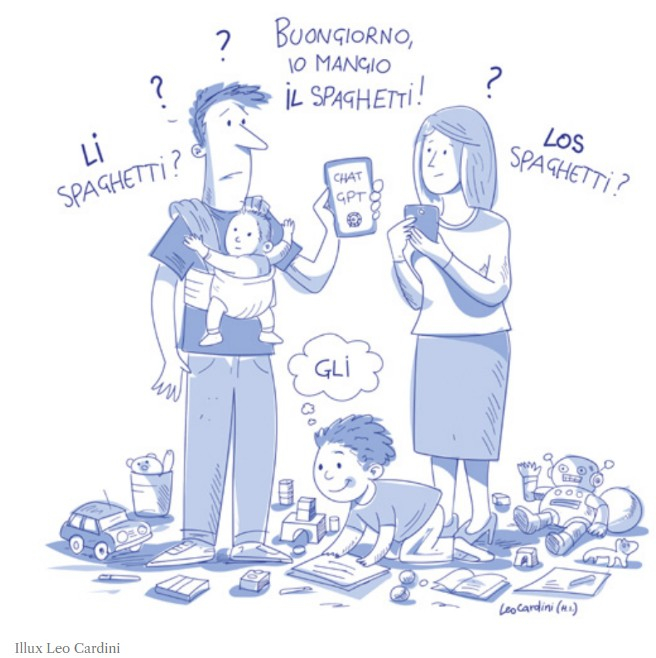
AI chatbots can facilitate language learning, but research suggests that challenge is a necessary component of acquisition.
Published: The Florentine, January 22, 2026
My husband and I are new to Florence and, to our detriment, neither of us speaks Italian fluently. Over the last year, we have attended an in-person Italian class at Monnalisa Language School. But between having a toddler and a baby, life frequently gets in the way of learning. While discussing the need to find more time to practice Italian, my husband said he was going to “chat with an AI bot”. His comment gave me pause. We are guilty of occasionally using ChatGPT for one-off parenting or cooking advice, but we are not people who regularly interact with artificial intelligence.
The question of how long it takes an adult to learn a new language is not an easy one to answer. Researchers say it varies as individuals learn to speak, write, read and listen at different rates. However, most agree that people learning a foreign language are trying to do it as efficiently as possible. As a result, there has been a boom in technology over the last decade aimed at making learning easier, and now AI advancements are taking it to the next level. Today, ChatGPT can act as a personal tutor. A person can go on Talkpal and chat with “characters” to role-play everyday scenarios. But not everyone is convinced that more technology equals better learning.
Thor Sawin, the associate dean of curriculum for Middlebury Language Schools, said he believes there is a place for AI when learning a new language, but that place is small. Hypothetically, chatbots can be used to practice a conversation that a person knows they will have in advance. However, if a person is exclusively learning Italian with an AI chatbot and never transitions to practicing with a real human—or the transition takes too long—it can have negative effects on learning and leave a person feeling “unprepared” for real-world interactions.
Sawin said he likes to think about using AI in terms of “feeding” and “starving” the process of learning a new language. Using AI can feed interactions by making people feel more prepared and more confident, and then there are ways in which using AI can starve a person’s interactions with humans. Among linguists, there’s a term called “transfer appropriate learning”, which means that people want to learn something under the same conditions in which they are going to use it in real life, and he said that can’t happen when practicing with AI chatbots.
Learning a new language as an adult is challenging. It requires a certain level of vulnerability and can make people feel exposed. Researchers recently found that interacting with chatbots can alleviate that anxiety when speaking a second language. But Sawin cautioned that the discomfort people feel when speaking a new language is actually a necessary tool for the brain to learn.
He gave an example of “negotiation”, which is a particular back-and-forth exchange between a language learner and a more advanced speaker. Perhaps the learner says a word incorrectly and the more advanced speaker corrects them, or together they try to figure out what the language learner is saying.
“You’re giving each other examples of how the language should be formed and that kind of back-and-forth interaction really heightens the data that you need to be a language learner,” Sawin said. “It makes it memorable to you.”
Humans can engage in negotiation much better than an AI chatbot.
“AI can’t really negotiate very easily or match your level of performance, where a human, a patient human, who wants to engage with you will do that. You eventually want to do those things in real life and be less awkward, but the only way to get to that is to have it be more awkward at first.”
This is one reason why physical classrooms still matter. Dalila Marassi, an Italian teacher at Hurley Certified Translation in Florence, said she believes AI chatbots can be useful when people do not have time to attend a structured course or have regular lessons with a private teacher, but it shouldn’t be the only way people learn.
“I strongly believe that social interaction with people is key to truly acquiring a language,” Marassi said. “Human interaction offers cultural insight and real-life connections that AI can’t fully replace.”
It’s no secret that the future of learning Italian, or any new language, will include AI. The cat is already out of the bag and the apps are already being made. When I asked in an expat Facebook group if people were using AI to learn Italian, a handful of people said yes. While more people might be leaning on technology to make learning easier, Sawin reminded me that learning a new language is supposed to be hard. There are no shortcuts.
Then, there’s our shared humanity. When someone doesn’t speak a language fluently, it doesn’t mean that person isn’t smart or capable. It’s just that they can’t fully express themselves yet. When a person is learning a new language, it forces them to experience those limitations firsthand, which can be both transformative and humbling.
“We need more experiences where we have that deep humility and where we’re aware of our limitations, and we push through that anyway,” he said. “So we can read everyone else in our lives with that same amount of humility.”