
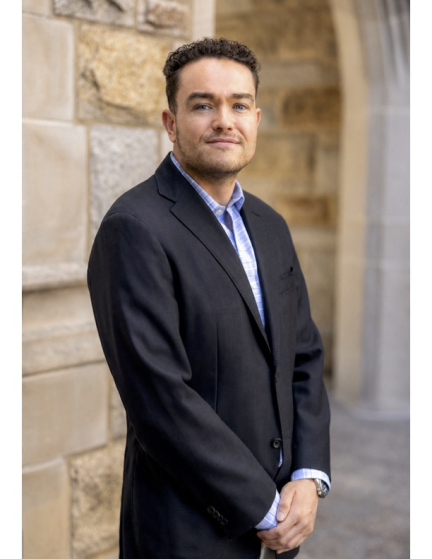
Evan Fernandez
Assistant Professor of History
- Office
- Axinn Center 339
- efernandez@middlebury.edu
- Office Hours
- Fall 2026: Monday 3:30-5:00pm, Wednesday 10:00am-11:30am, and by appointment
Evan Fernandez is a historian of Latin America with a focus on international relations, political economy, and migration.
His first book project, The Promise of the Pacific: Chile, Japan, and Building Nations and Orders with Nitrate, examines evolutions in the international orders of the Americas through the trans-Pacific commerce in Chilean nitrogen from the 1890s to the 1940s. Fernandez has published in the Journal of Global History and Diplomatic History. He received his Ph.D. in History from UC Berkeley in 2024. Fernandez was formerly a Visiting Assistant Professor at Boston College, a Postdoctoral Fellow at Harvard University, and a Visiting Research Fellow at Waseda University in Tokyo, Japan.
Fernandez joined Middlebury College in 2026. He teaches classes about Latin American history from the precolonial period to the present.
Fernandez is also a member of the International Nitrogen Network—a global forum that advises on addressing nitrogen pollution—where he researches and writes for public and policy audiences.
Publications:
- Chile, Japan, Development, and Order in the Pacific, 1890s-1940s,” The Journal of Global History 21 no.1 (March 2026): 60-79
- Bruno Esperante, Evan Fernandez, and Gabriel Coleman, “When Fertilizer Becomes Geopolitics: History’s Lessons for Nitrogen Governance” International Nitrogen Network
- “Pan-Americanism and the Definition of the Peruvian-Chilean Border, 1883-1929,” Diplomatic History 46 no.2 (April 2022): 292-319
Courses Taught
HIST 0105
Current
The Atlantic World, 1492-1900
Course Description
Themes in the Atlantic World, 1492-1900
Linking the Americas with Europe and Africa, the Atlantic has been a major conduit for the movement of peoples, ideas, technology, foods, and customs. This course will explore four themes from the rise of European imperialism and African Slavery to the dawn of national consciousness and minority rights across the Americas. We will study four major themes: (1). Comparative European Colonization and the First Peoples; 2) Comparative Slavery and the Black Experience (3) Decolonization, National Consciousness, and Ideas of Freedom; and (4) Pseudoscience, Migrations and Creolization. We will draw on primary and secondary sources from the Anglophone, Francophone, Lusophone, and Hispanophone worlds to give us a broad comparative perspective. Pre-1800. 2hr/disc. with periodic film screenings.
Terms Taught
Requirements
HIST 0107
Upcoming
Modern Latin America
Course Description
Modern Latin America
In this survey course we will trace the philosophical, economic, political, and cultural developments in Latin American history from independence to the present day. We will place particular emphasis on the formation of nation-states; issues of development, including labor movements and industrialization; national and cultural symbols; and social relations within Latin American societies. We will investigate the broad background of major themes and issues in Latin American societies that include Mexico, Central America, and South America. We will meet twice per week and there are no prerequisites. We will blend lecture with in-class discussion about a variety of primary and secondary readings.
Terms Taught
Requirements
HIST 0219
Current
Latin America in the Cold War
Course Description
Democracy, Dictatorship, and Drug Smuggling: Latin America in the Cold War
The Cold War is often framed as a superpower conflict defined by ideological struggles between Left and Right. This perspective, however, overlooks how the Cold War in the Global South was anything but “cold.” This course highlights Latin America’s experience as a consequential and complex theater of the global conflict. It illustrates how issues seemingly externally imposed were also distinctively Latin American, as a variety of state and non-state actors advanced nuanced rationales for democracy, revolution, and dictatorship. For example, alongside the stories of revolutionaries and diplomats, we will trace the history of drug smugglers who combined tremendous violence with elaborate economic and political projects that profoundly shaped the outcomes of Cold War state-building. While surveying the region broadly, the course is anchored in case studies in Cuba, Guatemala, Colombia, Brazil, Argentina, and Chile, illustrating key patterns from the 1910s through the 1990s.
Terms Taught
Requirements
HIST 0341
Upcoming
The State in Latin America
Course Description
Power, Inequality, and the State in Latin America
The state is the world’s predominant political institution and the primary institution through which people to relate to each other. In Latin America, societal relationships are defined by extreme discrepancies in power and economic well-being. In this discussion-based course, we analyze three episodes of Latin American state formation to illustrate how modern inequities are not necessarily a given: (1) the transition from indigenous empires to colonial states in the sixteenth century, (2) the formation of nation-states in the nineteenth century, and (3) the challenge posed by rogue states in the twentieth century. We will draw on primary and secondary sources to provide examples from Mexico, the Caribbean, and South America.
Terms Taught
Requirements
HIST 0500
Upcoming
Special Research Projects
Course Description
Special research projects may only be taken during the Junior or Senior year, preferable after taking HIST 0600. Approval of department chair and project advisor is required.
Terms Taught
HIST 0700
Upcoming
Senior Independent Study I
Course Description
Senior Independent Study I
The optional History Senior Thesis is written over two terms, with the final grade applying to both terms. Approval is required. Students submit thesis proposals in the spring before the year that they choose to write their thesis. Students generally begin their thesis in the fall and complete it during winter or spring. Approval is required to begin the thesis in winter or spring. All students must attend the Thesis Writer's Workshops in fall and winter semesters and work with a faculty advisor to complete a 55-70 page paper. Please see detailed guidelines under history requirements.
Terms Taught
HIST 0701
Upcoming
Senior Independent Study II
Course Description
Senior Independent Study II
With departmental approval, senior history majors may write a two-term thesis under an advisor in the area of their choosing. The final grade is applied to both terms. Students must submit thesis proposals in the spring before the academic year that they choose to write their thesis. They must attend the Thesis Writers' Workshops held in the fall and winter of the academic year in which they begin the thesis. The department encourages students to write theses during the fall (0700) and winter terms (0701), but with the permission of the chair, fall/spring and winter/spring theses are also acceptable. Under exceptional circumstances, the department may approve a thesis initiated in the spring of an academic year and finished in the fall of the following year. Further information about the thesis is available from the department.
Terms Taught