Benvenuti e bentornati alla scuola italiana!

The 2009 session of the Scuola Italiana is offering a wide range of challenging courses to maintain its reputation and long tradition of commitment to high academic standards. Alongside ten new courses on Italian language, linguistics, and literature, as well as the culture, art and civilization of Italy, this summer we will also launch the MA program in Mediterranean Studies with three new courses that examine the most significant aspects and manifestations of the Mediterranean Culture. The motivation and the effort of the students selected, added to the expertise and the dedication of faculty drawn from European and North American institutions ensure maintenance of the School’s high standards.

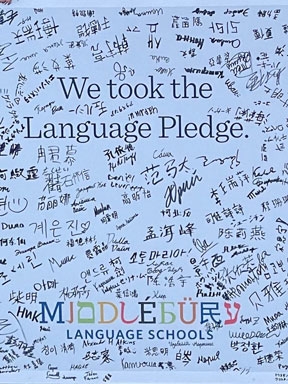
What makes the Middlebury experience so unique is its long-standing observance of the Language Pledge, a commitment made by each student in writing to use exclusively the Italian language for the duration of the summer session. In spite of the considerable demand this formal pledge places on all, generations of students consider it a most valid and effective learning tool. Adherence to this rule is, therefore, strictly enforced at all times.

To be sure, the success of the summer session is due to a great extent to the fact that students and faculty live under the same roof and take part in all the cultural and social activities sponsored by the School: film screenings, lectures, concerts, plays, dinners, parties, club meetings and picnics. All of this contributes to create a cordial and collegial atmosphere that is very conducive to learning and is unlikely to be duplicated elsewhere.

In 2009, the first three levels of language instruction will also emphasize various aspects of the multifaceted Italian culture. A special feature, besides the afternoon conversation sessions, will be a six-week theatrical workshop where students will be assigned parts and experiment with role playing. At the end of the summer session students will perform for the entire school. This special workshop is designed to help undergraduates improve their diction, while learning new idiomatic expressions outside of the traditional classroom setting. Undergraduate students are required to participate in three special writing workshops and are also encouraged to take advantage of the weekly club meetings on traditional Italian masks and costumes and other cultural topics conducted by our specialists Costanza Menghi and Carla Guglielmino.

The two core courses at the graduate level, IT 6502 and IT 6601, will teach grammar and stylistics, emphasizing culture. Advanced culture and civilization courses and graduate literature courses will focus on a wide range of topics through various periods of Italian civilization. They will include courses on the Mafia in Italian Cinema, Contemporary Poetry, Petrarch, the Commedia dell’Arte, a course on Totò, one of Italy’s finest comedians, and a creative writing seminar. Another course will focus on Pier Paolo Pasolini, and seminars will be held on Mediterranean Identity Through Literature-Cinema-Poetry-Theater, Literary Critical Theory, and the parody in Italian literature and Italian opera. This summer’s program will also include three introductory courses on the history of Italian literature and culture. The school is proud to announce that a new course on Italian journalism will be taught by “Il Direttore” Vittorio Zucconi, one of Italy’s more respected and acclaimed journalists.

During the summer of 2009 the Italian School will again supplement its regular six-week graduate program with two intensive three-week sessions designed for teachers and graduate students of Italian, taught by professors of international prominence. There will be a new course on “Being Women and Doing Theater” taught by Italy’s most acclaimed contemporary female writer, Dacia Maraini. Marcel Danesi will return to teach a course on methodology for second language instruction which includes a practicum. Italian-American classical pianist, Julian Gargiulo, will also offer a diction workshop for opera singers and will organize the School Chorus.

The second session will offer a course on “La cucina italiana” to better understand the role that diet and cooking have had through the centuries in shaping Italian culture. Each course meets Monday through Friday for two hours daily, and carries one unit or three semester-hours of graduate credit. Students enrolled in the six-week graduate program are eligible to take one or more of these courses as part of their normal course load of three units (nine semester-hours) of credit for the summer.

A special feature of the 2009 session will be the presence on campus of many professors, writers, and artists as “Special Guests in Residence.” Both students and faculty will certainly benefit greatly from the many contributions that Claudio Bondì, Enrico Bernard, Raffaella Santucci, Vittorio Zucconi, Domenico Scarpa, Gino Tellini, Antonio Nicaso, Marcel Danesi, Julian Gargiulo and all the other instructors and students will bring to the cultural life of the School during their stay at Middlebury. During the second part of the summer session the Italian School will also host writer Ermanno Rea who will be available to interact with students and who will also give two lectures. For the International Film Festival the School will be represented by filmmaker Paolo Sorrentino, who will present his latest film, Il divo. Sorrentino will also give a lecture and interact with students and faculty.

The seven-week session at Middlebury's Vermont campus will be held from June 26 to August 14.

With such an ample variety of academic offerings and the numerous cultural and social activities that are scheduled, I am confident that the 2009 summer school will be a memorable learning experience for all students and professors. I count on all of us to do our best to make this a most successful and fruitful period of study in the Green Mountains of Vermont.

A questa estate e non dimenticate di sfruttare al massimo ogni evento e di parlare sempre e soltanto in italiano!

Antonio Vitti
Director