

Chelsea Maxwell
Portuguese Immersion Program

The application will open on November 2, 2026.
More than 1400 students find success with us each summer. Who enrolls in the Language Schools?
Portuguese Immersion Program

German Immersion Program

Chinese Graduate Program

Italian Immersion Program

French Graduate Program

German for Singers

3-Week Hebrew Immersion Program

Chinese Immersion Program

Spanish Graduate Program

Korean Immersion Program

German Graduate Program

Russian Immersion Program

French Immersion Program

Arabic Immersion Program
Our dedicated faculty are some of the world’s leading academic professionals, and our students graduate with some of the highest levels of proficiency. Here’s why:
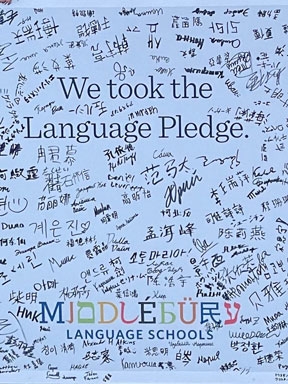
We Take the Language Pledge®
Only Middlebury offers the Language Pledge®, in which you pledge to communicate only in language while here. In a community of motivated learners and supportive faculty, this creates a 24/7 immersion environment.

We Live in Language
You’ll exponentially grow your language skills in whichever program you choose. And you’ll put your language skills to work outside of the classroom as well, participating in all kinds of cocurricular activities.

We Share a Commitment
Each summer, we welcome students from all walks of life and all parts of the world, ages 18 to 80+. One thing they all have in common is the potential and the desire to succeed.
Since 1915, Middlebury Language Schools has been one of the nation’s preeminent language learning institutions featuring programs in 12 languages in Vermont. Together we create one of the most effective language-learning environments each summer.
Find more videos on our YouTube channel. You can also follow us on our Blog, LinkedIn, Facebook, or Instagram.
Nǐ hǎo, wǒ jiào Jason. I am South African. I am just about to start the program here at Middlebury. The 8-week Chinese summer program. I’m really excited. I can’t speak any Chinese further than what I told you and I’m hoping to use Mandarin within engineering for a long term goal.
8 Weeks Later
Hello. My name is Jason. I am South African. I am currently studying Chinese at Middlebury’s Chinese summer school. I think Middlebury’s teachers are excellent and very professional. Also, I think Middlebury is beautiful. But I really think the Middlebury advantage is that teachers spend a lot of time helping students practice speaking Chinese.

