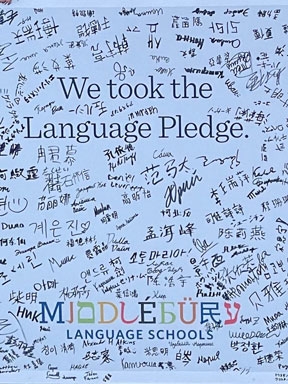
The Russian School had a great summer in 2003. After students arrived and took their placement test, the director of the Russian School formally opened the school and led the students in taking the language pledge. Classes in the 9-week language program started the next day, with students placed in seven different levels of instruction. At the end of the first week, we held a field day in which courses competed against one another in silly races (egg & spoon, three-legged, sack races), volleyball, and tug-of-war. That evening courses held parties to celebrate the end of the first week of our intensive work together


Two weeks later students participating in the 6-week graduate program arrived and joined our community to take courses in Russian language, history, film, literature and culture. We celebrated their arrival with a school-wide picnic at Lake Dunmore


The cultural program this summer was, as always, rich and exciting. We had two special guests, both filmmakers. Marina Goldovskaia, documentary filmmaker, came for a few days during which time we saw four of her films including the award-winning documentary, Solovki Power. The discussions that ensued were terrific. Everywhere Marina Evseevna went, she took her camera with her and filmed: we might see a documentary about the Middlebury Russian School some day! Aleksandr Mitta, feature filmmaker, came for a week during which time we watched six films. One of the films featured the Russian School's own Anna Rodionova in a leading role; another featured Veniamin Smekhov. Not only did students enjoy the films and discussions, but they also had the rare opportunity to make a pair of short films with Aleksandr Naumovich. They are available for download as quicktime movies:

"Language Barrier" (German/Russian, 1 minute 17 seconds, 7MB, completed under Mitta's direction).

"The Letter Y" (Russian, 2 minutes 45 seconds, 16MB, editing by 2003 Film Club)


Other highlights of our summer program this year included karaoke night, charades night, and our fabulous talent show (featuring comic skits, serious musical performances, and dance). We saw countless films in three film festivals: contemporary Russian films on Saturdays, cult films (the most popular films of their time) on Wednesdays, and late night on Saturdays, an insomniac film series dedicated to the serial "The Brigade." We also saw two silent films with live accompaniment this summer, one of which was part of our celebration of the departure of our outgoing director, Ben Rifkin

We enjoyed special lectures and discussions about Vladimir Vysotsky (by famous Russian actor and director Veniamin Smekhov), of the situation in Chechnya and regional elections in Russia in the past year or so (by Aleksandr Logunov), and the history of the Russian theater (by Sergei Kokovkin) as well as roundtables on practical issues related to graduate studies in Russian-related disciplines and job possibilities in Russia and with Russian. Of course we had dances (with great Russian dance music), picnics at lakes and waterfalls, and some of us even went on some mushroom-hunting expeditions. We had tea salons twice a week for students and faculty to gather, drink tea, and talk about everything from films we had just seen to the latest news on Russian television or internet news sites


Our soccer teams and volleyball teams both had terrific seasons, and our chess team remains undefeated. (Well, actually, unchallenged, but that means that it's undefeated!) Members of our yoga club met weekly and showed everyone that they were the most flexible members of our community. Our radio club put on weekly broadcasts with music, interviews and call-in shows, while our newspaper club put out two issues of our school newspaper, Nepravda ("Untruth"). The cooking club met weekly to make delicious dishes, some of which were eaten up by members of the chess club (who just happened to meet at the same time right near the kitchen!) Students participating in our special lexicon workshop learned to understand the terminology used in discussion of organized crime, especially important for students interested in law enforcement issues. Students in the folk art club painted wooden boxes and boards in Russian folk style


This year's literary symposium was dedicated to St. Petersburg in conjunction with the 300th anniversary of the founding of that wonderful city; our play this year, directed by Sergei Kokovkin and Anna Rodionova, also focused on St. Petersburg. Vivat Peterburg was a huge hit: approximately 30 students participated in this play, based on works about St. Petersburg by Pushkin and Gogol. The scenery, by Olga Solovova, was stunning


The choir this year was directed by Zolotoi Plios: Sergei Gratchev, Elena Sadina, and Aleksandr Solovov. The choir concert this year was a performance of a traditional Russian folk wedding, complete with matchmakers, betrothal, bridesmaids' songs, bachelors' songs, liturgical music and chastushki (funny rhyming couplets) as well as elements of dance and theater. Students sang, danced and played instruments to the delight of an audience of close to 300 people


Our students improved their Russian tremendously with all their hard work in courses and in the cocurricular program, as demonstrated by the results on their exit testing (see
examresults


This year the Russian School said goodbye and thank you to director Benjamin Rifkin of the University of Wisconsin-Madison after five summers of service to Middlebury; we welcome our new director, Karen Evans-Romaine of Ohio University and look forward to the summer of 2004 with great anticipation


This page was last updated on August 16, 2003