
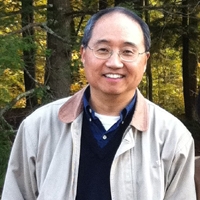
Wei He Xu
Professor of Chinese
- Office
- Voter Hall 104
- Tel
- (802) 443-3430
- wxu@middlebury.edu
First studied English language and literature at Nanjing Normal University in Nanjing, China; then came to the States to study English/American literature and Chinese/comparative literature at Washington University in St. Louis.
Has taught various courses at Middlebury College since 2000, but regularly first-year Chinese drill classes, Classical Chinese, senior seminar on modern Chinese fiction in Chinese, traditional Chinese novels, love and sexuality in traditional Chinese literature, sometimes Chinese literary tradition in translation. Once or twice in a while taught humor in traditional Chinese literature or courses in world literature.
Has done research in vernacular fiction of late imperial China, especially the 18th-century novelistic masterpiece Hónglóumèng 紅樓夢/红楼梦 (Red Chamber Dream; also known in English as the Story of the Stone). Also interested in humor as a field of study, particularly in humor theories, literary humor, Confucian and Greco-Roman ethics and etiquettes of humor, etc. Recently wrote a little entry on Confucianism for Encyclopedia of Humor Studies (SAGE, 2014).
Enjoys all kinds of jokes including such olden Chinese humor as follows:
Hearing Confucius say that he wanted to go and live among the barbarians, someone warned him, “Think about their crudity. What are you going to do about that?” Confucius replied, “You see, once a gentleman lives among them, what crudity will there be?” From Chey and Davis, Humour in Chinese Life and Letters, p. 61
Confucius was reading a book when Laozi paid him a visit and asked: “What book is this?” “It is about ritual. You see, even a sage will read that sort of book.” Laozi replied: “Fair enough! A sage will read it. But why are you reading it?” From Christoph Harbsmeier, “Confucius Ridens,” p. 139
Post-humorously, sometimes does such killjoy things as wondering, often fruitlessly, about meanings of jokes. E.g., maybe the self-important Confucius above violates the Daoist virtue of loving oneself without exalting or being full of oneself; hence the dig from the visiting Laozi, the father of Daoism and Confucius’s teacher (lǎoshī 老師/老师) of ritual as tradition has it.
Courses Taught
CHNS 0101
Beginning Chinese
Course Description
Beginning Chinese
This course is an introduction to Mandarin (guoyu or putonghua). The course begins with simple words and phrases, the pronunciation and cadences of Mandarin, romanization, Chinese characters, and simple vocabulary items, all taught in the context of practical communication. Sentence patterns and other fundamentals of speaking, reading, and writing will be taught, including both traditional characters (used everywhere before the 1950s and still used in Taiwan and Hong Kong) and simplified characters (used in China). Students should have achieved active command of more than 600 Chinese characters and more than 800 compounds by the end of the sequence CHNS 0101, CHNS 0102, and CHNS 0103. 5 hrs. lect., 1 hr. drill
Terms Taught
Requirements
CHNS 0102
Continued Beginning Chinese
Course Description
Beginning Chinese
An intensive continuation of CHNS 0101, this course is required of those wishing to take CHNS 0103 in the spring. Students may anticipate learning a significant amount of new vocabulary, sentence patterns and idiomatic expressions. Skits, oral presentations, writing assignments, and cultural activities are also part of this course. (CHNS 0101)
Terms Taught
Requirements
CHNS 0331
Love & Sex in Trad Chinese Lit
Course Description
Clouds and Rain: Love and Sexuality in Traditional Chinese Literature (in translation)
This seminar explores a spectrum of traditional attitudes toward romantic love, sexualities, men and women seen through the prism of classical Chinese literature. Fiction and drama will be the main focus with due attention to poetry. Texts to be analyzed include, e.g., pre-6th-century B.C. and subsequent poems; 3rd and 4th-century and later stories of strange romances; the remarkable 7th-century tale of the Dwelling of Playful Goddesses and early 9th-century love story of “Yingying”; the marvelous late 16th-century romantic drama, the Peony Pavilion; the hilarious late 17th-century erotic novella, the Carnal Prayer Mat; and selected chapters from novelistic masterworks such as the late 16th-century and early 17th-century, Jin Ping Mei, and the 18th-century, The Story of the Stone (also known as Dream of the Red Chamber). (National/Transnational Feminisms) 3 hrs. lect./disc.
Terms Taught
Requirements
CHNS 0411
Classical Chinese I
Course Description
Classical Chinese I (in Chinese)
This course is an introduction to wenyan, the written language of traditional China. In this course we will emphasize comprehension of the literal and metaphorical meanings of short wenyan texts. Our approach will include grammatical analysis and baihua translation (i.e., from the Classical Chinese into modern Chinese); discussion will be conducted entirely in baihua. This course begins the two-semester sequence of Classical Chinese, which not only introduces students to wenyan but also provides a vital learning experience for any student seeking to attain a high level of linguistic and cultural proficiency in Chinese, including modern written discourse. (CHNS 0302 or the equivalent) 3 hrs. lect.
Terms Taught
Requirements
CHNS 0500
Independent Project
Course Description
Senior Essay
(Approval Required)
Terms Taught
CHNS 0700
Senior Essay
Course Description
Senior Thesis
(Approval required)
Terms Taught
CHNS 0701
Senior Thesis Research
Course Description
Senior Thesis Proposal
(Approval Required)
Terms Taught
CHNS 0702
Senior Thesis
Course Description
Senior Thesis
(Approval required).
Terms Taught
Requirements
Areas of Interest
Vernacular fiction of the Ming-Qing period (1368-1911)
Humor