
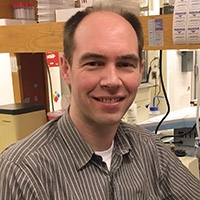
Michael French
Visiting Assistant Professor of Chemistry/Biochemistry
- Office
- McCardell Bicentennial Hall
- Tel
- (802) 443-3094
- mfrench@middlebury.edu
- Office Hours
- Spring 2022: Tues. and Thurs. from 12:30-2 p.m. and by appointment
My research group focuses on the molecular mechanisms of protein degradation, with an emphasis on understanding the biochemistry of how ubiquitin ligases work. In eukaryotic organisms, proteins that are damaged, misfolded, or no longer needed are degraded through a specialized pathway known as the ubiquitin-proteasome system. In this system, the small protein modifier ubiquitin is covalently attached to a protein substrate, usually in the form of a polyubiquitin chain, by a series of enzymes. The ubiquitinated protein, marked for destruction, is then shuttled to a large, multi-subunit complex known as the proteasome, which unfolds the protein substrate and cleaves it into pieces. Current work in my group is focused on understanding how ubiquitin ligases, the key regulatory enzymes in this cascade, modify their substrates with different types of polyubiquitin chains. We are specifically interested in understanding how the Nedd4 family of ubiquitin ligases, which consists of nine different members in humans, builds polyubiquitin chains on its substrates. Recent work suggests a two-phase mechanism that imparts these enzymes with the ability to synthesize two distinct types of polyubiquitin signals, the functions of which have yet to be fully defined (French et al., JBC 2017; Ohtake et al., PNAS, 2018). Using the tools of biochemistry and proteomics, we seek to understand the general relevance and functional importance of this mechanism for ubiquitin ligases within the Nedd4 family.
Courses Taught
CHEM 0500
Independent Study
Course Description
Independent Study Project
Individual study for qualified students. (Approval required)
Terms Taught
CHEM 0700
Senior Research
Course Description
Senior Research
In this course students complete individual projects involving laboratory research on a topic chosen by the student and a faculty advisor. Prior to registering for CHEM 0700, a student must have discussed and agreed upon a project topic with a faculty member in the Chemistry and Biochemistry Department. Attendance at all Chemistry and Biochemistry Department seminars is expected. (Approval required; open only to seniors)
Terms Taught
CHEM 0701
Senior Thesis
Course Description
Senior Thesis
Students who have initiated research projects in CHEM 0400 and who plan to complete a senior thesis should register for CHEM 0701. Students are required to write a thesis, give a public presentation, and defend their thesis before a committee of at least three faculty members. The final grade will be determined by the department. Attendance at all Chemistry and Biochemistry Department seminars is expected. (CHEM 0400; approval required)
Terms Taught
MBBC 0700
Senior Independent Research
Course Description
Senior Independent Research
Seniors conducting independent research in Molecular Biology and Biochemistry under the guidance of a faculty mentor should register for MBBC 0700 unless they are completing a thesis project (in which case they should register for MBBC 0701). Additional requirements include attendance at all MBBC-sponsored seminars and seminars sponsored by the faculty mentor’s department, and participation in any scheduled meetings and disciplinary sub-groups and lab groups. (Approval required).
Terms Taught
NSCI 0700
Senior Research
Course Description
Senior Research
This course is for senior NSCI majors who plan to conduct one or more semesters of independent research, or who plan to complete preparatory work toward a senior thesis, such as researching and writing a thesis proposal as well as, if appropriate, collecting data that will form the basis for a senior thesis. Senior NSCI majors who plan to complete a senior thesis should register initially for NSCI 0700. Additional requirements may include participation in weekly meetings with advisors and/or lab groups and attending neuroscience seminars. (Approval required, open to seniors only)
Terms Taught
NSCI 0701
Senior Thesis
Course Description
Senior Thesis
Senior NSCI majors who have completed one or more terms of NSCI 0700, who have a GPA of 3.3 in their major courses, and who plan to complete a senior thesis should register for NSCI 0701 for the final semester of the senior thesis process. Students enrolled in NSCI 0701 write a thesis, give a public presentation of their research, and present an oral defense of the thesis before a committee of at least three faculty members, two of which must be affiliates of the Neuroscience Program. Faculty may recommend High honors in Neuroscience after considering the quality of these components of a student’s thesis and the student’s GPA in major courses. Additional requirements may include participation in weekly meetings with advisors and/or lab groups and attending neuroscience seminars. (NSCI 0700, Approval required)
Terms Taught
Academic Degrees
B.S./M.S., Biochemistry/Cell Biology, Bucknell University
Ph.D., Biochemistry and Molecular Biology, Northwestern University
Postdoctoral Fellowship, The Scripps Research Institute and The Salk Institute
Publications
French, M.E., Koehler, C.*, and Hunter T. Emerging functions of branched ubiquitin chains. Cell Discov., 7(1):6, 2021. *C. Koehler is a former undergraduate student at Grinnell College
French, M.E., Klosowiak, J.L., Aslanian, A., Reed, S.I., Yates, J.R. III and Hunter, T. Mechanism of ubiquitin chain synthesis employed by a HECT domain ubiquitin ligase. J. Biol. Chem. 292:10398-10413, 2017.
Klosowiak, J.L., Park, S.N., Smith, K.P., French, M.E., Focia, P.J., Freymann, D.M. and Rice, S.E. Structural insights into Parkin substrate lysine targeting from minimal Miro substrates. Sci. Rep. 6:33019, 2016.
French, M.E., Kretzmann, B.R.* and Hicke, L. Regulation of the Rsp5 ubiquitin ligase by an intrinsic ubiquitin-binding site. J. Biol. Chem. 284:12071-12079, 2009. *B.R. Kretzmann is a former undergraduate student advisee at Northwestern University
Stamenova, S.D., French, M.E., He, Y., Francis, S., Kramer, Z.* and Hicke, L. Ubiquitin binds to and regulates a subset of SH3 domains. Mol. Cell 25:273-284, 2007. *Z. Kramer is a former undergraduate student advisee at Northwestern University
French, M.E., Swanson, K., Shih, S., Radhakrishnan, I. and Hicke, L. Identification and characterization of modular domains that bind ubiquitin. Methods Enzymol. 399:135-157, 2005.
Zhou, L., Thompson, R., Reamer, R.A., Lin, Z., French, M., Ellison, D. and Wyvratt, J. Mechanistic study of the enantiomeric recognition of a basic compound with negatively charged single isomer gamma-cyclodextrin derivatives using capillary electrophoresis, nuclear magnetic resonance spectroscopy, and infrared spectroscopy. Electrophoresis 24:2448-2455, 2003.
Zhou, L.,Thompson, R., French, M., Ellison, D. and Wyvratt, J. Simultaneous enantioseparation of a basic drug compound and its acidic intermediate by capillary electrophoresis. J. Sep. Sci. 25:1183-1189, 2002.