
Master of Arts in Teaching (MAT) with a Secondary Teaching License (Modern Languages)

Founded in 2025, the Middlebury Language Schools’ MAT program offers a secondary (7–12) teaching license in modern languages valid for teaching in the U.S. public school systems. With a nationwide shortage of K–12 world language teachers, our program is uniquely positioned to help fill this critical gap.
Format
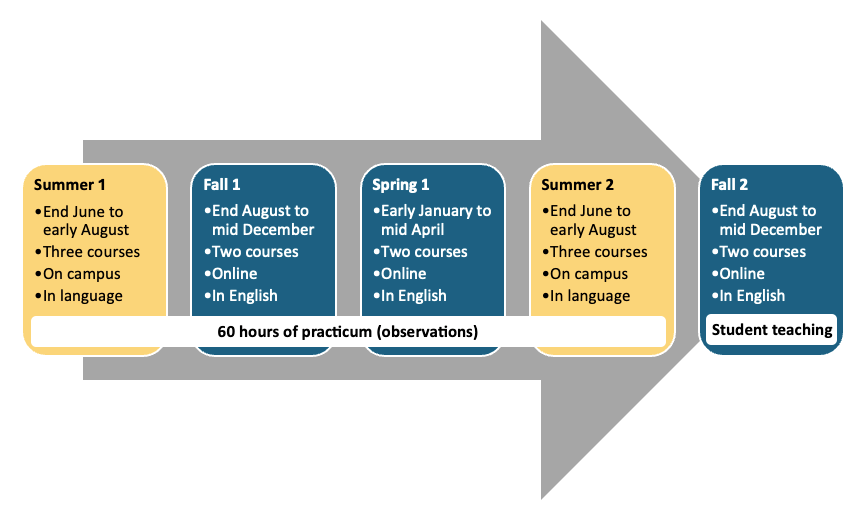
The 18-month Middlebury MAT program begins with a summer on campus, where candidates take three courses in their target language in a fully immersive setting. During the academic year between summers, candidates complete four asynchronous online courses, each lasting seven weeks. A second summer on campus follows, again with a three-course load. In the final semester, candidates complete a 13-week student teaching placement while enrolling in two 15-week asynchronous online courses designed to support reflective practice and the development of the Vermont Licensure Portfolio.
Languages
The MAT is offered in Arabic, Chinese, French, German, Hebrew, Italian, Japanese, Korean, and Spanish. All programs are located on the Middlebury campus.
Why the Middlebury MAT?
- Teaching license plus a master’s in one program: Earn both a teaching license and a Master of Arts in Teaching in a single, integrated program designed to prepare you for immediate success in secondary world language classrooms.
- Flexible course design for working professionals: Complete coursework during the academic year through an asynchronous online format that allows you to balance your studies with professional and personal commitments.
- Adaptable student teaching placements: Do your practice teaching in any U.S. state, in accordance with your living situation and career aspirations.
- Unique immersive environment: Experience Middlebury’s distinctive full immersion environment during the summers, where you live, study, and participate in activities entirely in your target language, accelerating both your linguistic proficiency and cultural understanding.
- Generous financial aid: Take advantage of robust financial aid packages, with the potential to cover up to 100% of demonstrated financial need, making the program more accessible and affordable.
- World-class learning experiences: Strengthen your language skills, cultural competence, and teaching expertise under the guidance of a distinguished, internationally diverse faculty with deep experience in language education.
Dates and Fees
| Dates | Cost of Attendance | |
| First Semester (tuition, on-campus housing and food)* | June 26 - August 7, 2026 | $12,225 |
| Second Semester (Online) | Aug. 31 - Oct. 18, 2026 & Oct. 26 - Dec. 13, 2026 | $5,490 |
| Third Semester (Online) | Jan. 4 - Feb. 21, 2027 & Mar. 1 - Apr. 18, 2027 | $5,490 |
| Fourth Semester (tuition, on-campus housing and food)* | Summer 2027 (TBD) | TBD** |
| Final Semester (Practicum) | Fall | TBD** |
*Tuition ($8,235) and on-campus housing/food ($3,990) are included in the total bill. Cost of attendance does not include transportation, books and supplies, health insurance, and personal living expenses. Students are required to live on campus and have meals together in dining halls, organized by language. The MAT will involve additional fees ($300 - $900) depending on the state you transfer the license to and the language you are seeking to get licensed to teach.
**Cost of attendance typically increases about 4.5% each academic year.
Funding
Middlebury may meet up to 100% (tuition, on-campus housing and food) of your demonstrated need. This means that if you qualify, you will attend the Language Schools at little to no costs.
Within a few days of submitting your application, you will receive an email with the subject “Middlebury Financial Aid Information” that includes instructions for applying to need-based financial aid from the Middlebury Financial Aid Portal. You will also receive a second email with links to apply to fellowships and scholarships.
Eligibility
The MAT program is designed for candidates who already have graduate-level proficiency in their teaching language, typically demonstrated by four or more years of study or native ability. Applicants must hold a bachelor’s degree (or equivalent) with a minimum 3.0 GPA from a regionally accredited institution. At this time, the program is open only to U.S. citizens and permanent residents. Curious how these eligibility criteria look in practice? Read about a current student in the program.
Licensure
Upon successful completion of required coursework, the student teaching placement, and the Vermont Licensure Portfolio, Middlebury Language Schools will recommend candidates for licensure to the Vermont State Agency of Education. Candidates may then choose to transfer their license to a different state. Rules and protocols for transferring a Vermont teaching license to another state vary widely, but Vermont has some form of reciprocity with most other states. MAT program staff are available to help candidates navigate the steps toward applying for other states’ licensure. It is the candidate’s responsibility to complete required steps to obtain an additional state’s license.
Application Materials
- Middlebury Language Schools Graduate Application
- New Applicants (including if you have attended Language Schools previously as an Immersion or Graduate Student): Select ‘Graduate Level - New Applicants (MA or DML)’, your language, and ‘Master of Arts in Teaching (MAT) with a Secondary Teaching License’ on the application.
- Transcripts
- Application fee
- Contact information for recommenders
- Answers to additional application questions
- Have you ever been a teacher before? (age, subject, type of school)
- Have you ever held any kind of teaching license?
- In what state(s) would you want to teach after completing this program?
- Are there additional languages you are interested in adding to your licensure via proficiency testing?
- What is your formal and informal experience with the language, including teaching, work, travel, study, or residence abroad.
- Proof of basic skills for non-native speakers of English (see FAQs below for more information; proof of basic skills is ultimately required of all MAT students prior to recommendation for licensure)
Deadline
Applications to the MAT program are due by May 15. See Application Deadlines for Graduate Programs for further information.
Questions?
Please email mateaching@middlebury.edu.
Contact

Jason Martel
Director, Master of Arts in Teaching (MAT)
Email:
jmartel@middlebury.edu
Tel:
(831) 647-3547
Frequently Asked Questions
How and when can I fulfill Vermont’s basic skills testing requirement for licensure?
The state of Vermont requires a passing score on the Praxis Basic Skills Test (formerly Praxis I) or an authorized equivalent test in order to be licensed. Passing scores are required before your license can be awarded, and we recommend that you take the tests prior to the start of coursework. You’ll need to score a minimum of 156 on the Praxis reading test (5713), 162 on the writing test (5723) AND 146 on the mathematics test (5733). You could also take a single combined test (5752) which covers reading, writing, and math. You can waive the Praxis requirement by using an equivalent way of demonstrating basic skills, such as ACT, SAT, GRE, or ASVAB: see Agency of Education Testing Requirements for a detailed list of what Vermont will accept. Basic skills tests for other states also count as equivalent to the Praxis.
How and when can I fulfill Vermont’s subject area testing requirement for licensure?
The state of Vermont requires a passing score on the Praxis Subject Test (formerly Praxis II) or authorized equivalent proficiency test in order to be licensed. Passing scores are required before your license can be awarded, and we recommend that you take the tests prior to the start of coursework. For candidates aiming to teach in Arizona, California, Florida, Georgia, Illinois, Massachusetts, Michigan, Minnesota, Missouri, New York, Ohio, Oregon, Texas, and Washington, those states’ Praxis equivalents may be used instead of the Praxis tests.
In addition to the state’s Praxis equivalent, candidates aiming to teach in Ohio, Washington and Wisconsin will be required to take the ACTFL Oral Proficiency Interview and Written Proficiency Exam to transfer their license. Arabic, Hebrew, Italian, and Korean, have no Praxis Subject Assessment, therefore an equivalent ACTFL Oral Proficiency Exam AND Written Proficiency Exam (or equivalent assessments aligned to the CEFR scale) will be required. Scores for Italian should be equivalent to ACTFL Advanced-Mid, and scores for Arabic, Hebrew, and Korean should be equivalent to ACTFL Advanced-Low.
What’s the practicum (observations) requirement?
Students in the program are required to complete 60 practicum hours of observation and/or (co-)teaching before beginning their student teaching placements in the second fall semester. Practicum hours will vary depending on specific students’ needs and situations, but may include observation of classes during the summer session on campus at Middlebury, observation or substitute teaching in local 7–12 schools during the academic year, and/or structured collaboration with other language education organizations. Practicum hours will be aligned with program courses where possible and supervised by the Program Director. Students are ultimately responsible for ensuring that their required practicum observation hours are complete by the end of the second summer.
What happens during the student teaching placement?
Candidates are encouraged to find their own student teaching placement in the community where they plan to teach. In this process, Middlebury MAT staff will assist candidates in finding appropriate placements either in Vermont or in the candidate’s preferred state. Ultimately, the candidate is responsible for securing a student teaching site. Candidates who are currently world language teachers of record can complete their student teaching in their own classrooms; however, they will need to identify a licensed teacher to serve as their cooperating teacher.
What’s the Vermont Licensure Portfolio?
During the first summer session, candidates will meet with the Program Director to review the process for creating and submitting the Vermont Licensure Portfolio. This portfolio is required by the state and ensures candidates are proficient in the Core Teaching Standards for Vermont Educators. Students will collect ideas and create artifacts throughout their program that can be included in the portfolio. Upon completion of student teaching, candidates will submit the portfolio to the MAT program administration for review.
Can I add an endorsement in an additional language after receiving licensure?
In Vermont, candidates can add a language to their modern language endorsement by passing a proficiency exam. Other states may vary as to whether they will recognize endorsements achieved through proficiency only. Candidates who wish to obtain licensure to teach more than one language can consult with MAT program staff to determine when and how to apply for an additional endorsement.
How do I transfer my license from Vermont to another state?
Rules and protocols for transferring a Vermont teaching license to another state vary widely, but the state has some form of reciprocity with most other states and jurisdictions. MAT program staff are available to help candidates navigate the steps toward applying for other states’ licensure. It is the candidate’s responsibility to complete required steps to obtain an additional state’s license.
I’m an international student. Is this program right for me?
The MAT program is only open to U.S. citizens and permanent residents because, as a 50% online program, we are not eligible to issue visas for the professional semester (that is, the second fall semester). Furthermore, receiving a teaching license through the program will not automatically qualify you for a work visa in the United States.
Any authorization to teach in the United States through an H1b or J1 visa would have to be handled through a potential employer and sponsor organizations; this is easiest done by earning a teaching license in your other country of residence and then applying to have that license recognized by the U.S. state in which you desire to teach directly. Most U.S. jurisdictions have a pathway for recognizing teaching licenses from other countries if candidates have taught for several years on that license.
If I’m recommended for licensure to the State of Vermont, how long do I have to apply?
Upon successful completion of the MAT program, and if you provide evidence of passing scores on the basic skills and subject areas tests, we will recommend you for licensure to the State of Vermont. You will then need to apply to the state for licensure. There is no expiration date on a recommendation for licensure. However, if the recommendation is held for more than 10 years without applying, you would need to adhere to the requirements of Policy F2 Recency of Study as listed in the VSBPE Manual of Policies and Procedures.