Conflict Transformation Program
The Middlebury Schools Abroad are proud to support the work of the Kathryn Wasserman Davis Collaborative in Conflict Transformation.
Through language education and immersive learning, our students are challenged to transcend their own knowledge and habits. The skills of intercultural communication and curious listening help our students positively contribute to the conflicts they encounter around the world. Read more about the role of Conflict Transformation (CT) in international education here.
Through research, instruction, internships, and deep community engagement, Middlebury Schools Abroad CT projects provide our students with a more nuanced understanding of the root causes and social structures that lead to conflict. Our CT projects also allow students to practice skills that build open-mindedness and self-awareness, promote compassionate intercultural interactions, and increase their independence, confidence, and resilience.
2025-2026 Academic Year Projects
Argentina and Uruguay
As part of their Writing & Culture class since 2024, students from the Middlebury Schools in Argentina and Uruguay travel together to Neuquén, Argentina at the northern end of Patagonia. Through preparatory coursework and site visits in Neuquén, students examine the historical tensions between indigenous Mapuche communities and the Argentine state, focusing on case studies that highlight both ongoing struggles and transformative initiatives. Last fall, at the Raguiñ Kien intercultural hospital, students examined an innovative collaboration between Mapuche and Western medicine. And at a local teacher-training center, students heard from guest speakers on how transformational approaches to pedagogy can allow for institutional change. Each visit emphasized sustained relationship-building and trust with local communities as essential to meaningful intercultural dialogue and long-term collaboration. Click here for information on CT projects from previous semesters.
Argentina
Community Engagement
As part of their Writing & Culture class, students at the School in Argentina visited three different Buenos Aires museums related to the country’s military dictatorship between the 1970s and 80s. At the Memory Park and Museum, students met with artist Javier Olmo who shared the symbolism behind his memorial and guided an interactive art activity. At the ESMA Museum, a former concentration camp and extermination site, local activists from HIJOS (‘Sons and Daughters of the Disappeared’) and Abuelas de Plaza de Mayo spoke on the history of violence and disappearance. And lastly, Professor of History and Criminologist Liz Santesteban lectured on the pedagogy of memory in educational institutions. In an Argentinian political context that increasingly negates historical facts and past violence, students learned about the power of preserving history and transmitting knowledge to future generations.
Cameroon
CT Courses
The Middlebury School in Cameroon once again offered the CT Course The Roles and Experiences of Women in Transforming Conflict in Post-Colonial Cameroon. This course explored the role of Cameroonian women as changemakers. Using the case study of internally displaced women from the ongoing conflict in the Northwest and Southwest regions of Cameroon, students identified and analyzed transformative approaches to political conflicts and learned from women changemakers and their community-based efforts to transform those conflicts. Conflict was discussed across numerous themes including environment, education, food and water, the economy, displacement, and public health. Through academic writings on CT and field-based experiences with local and international NGOs, students observed, learned, and described how women negotiate freedom, re-integration, stability and reemergence for themselves, their families, and their communities in periods of conflict.
Students also participated in a class entitled “Intercultural Theories and Practice” where they learned theories of intercultural communication (ICC) and reflected on their experiences. One ICC theory crucial to the course was the cultural adjustment W curve, which can help students frame shifting cultural understandings and interactions with their host community. Through lectures, class discussions, written reflective papers, and community experiences, students became more aware of the inter and intrapersonal conflicts that arise in new cultural environments. They then developed strategies for negotiating respectful and meaningful cultural integration, which included identifying conflicts, looking to peers for support, drawing context from ethnographic interviews, and practicing deep observation. As a result of the course, students gained confidence during their time abroad, understanding of their host culture, the ability to further their immersion, and the tools to transform intercultural conflicts into personal growth and deeper relationships.
Research Assistantships
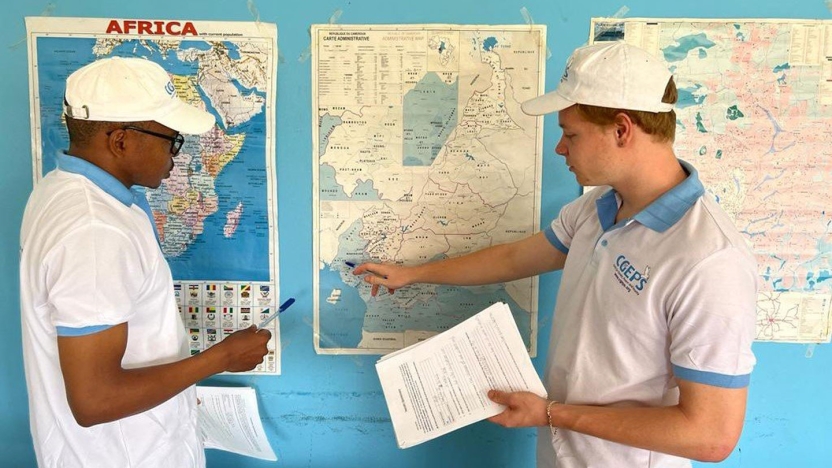
During the spring semester, the School in Cameroon also offers students the opportunity to work alongside Professor Erik Fofack at the Yaoundé-based Center for Gender, Peace and Security (CGPS) as Junior Researchers, supporting his research on women’s representation in Cameroonian media. Students investigate gender representation in local media, monitoring media outlets, and exploring newspaper and magazine archives. The position allows students to apply their French language skills to a semi-professional setting and gain a nuanced understanding of the Cameroonian social, political, and cultural environment. For more information on how to apply for this funded opportunity click here.
Chile
Community Engagement
Students from the School in Chile’s Santiago and Valparaíso–Viña del Mar campuses, joined local Santiago high-schoolers at the Museum of Memory and Human Rights. Together they examined the conflicts and social impact of the Pinochet dictatorship. The sessions—“Sound Archives and Dissidences,” “Women in Dictatorship: Challenging Power and Sustaining Life,” “Where Does Memory Dwell?,” and “Patio 29: A Process for Identifying Disappeared People”—were led by researchers and victims of the conflict, allowing students to hear testimony on the role of memory, resistance, gender, and human rights in Chilean history and community building. The museum visit was complemented by CT coursework where students discussed the role of activism and collective resilience in local and national political conflicts.
Research Assistantships
CT-funded research projects continue at the School in Chile. Students work with local faculty to address socio-ecological conflicts, investigating the value of biocultural memory and analyzing conflicts from the local community’s perspective. Students engage in individual and group reflections that deepened their understanding of conflict transformation processes and connect theory with practice. Activities include theoretical readings, conflict mapping, interviews with key informants, and a community presentation of findings. This project not only strengthens conflict transformation skills but also fosters an interdisciplinary and intercultural understanding of socio-ecological conflicts.
France
CT Courses
During the spring semester, two CT courses are offered at the School in France: Taking to the Streets: Revolts and Social Movements in France and The EU, an Unprecedented Experiment in the Socialization of Conflicts. Students in the Taking to the Streets courselearn about the history and role of social and political conflict in France while also gaining a foundation in conflict transformation. Students analyze actors and causes of conflict, the role of conflict in shaping French governance, and visit sites including the Conseil économique, social & environmental and the National Museum of the History of Immigration. Students taking The EU, an Unprecedented Experiment in the Socialization of Conflicts analyze the EU through the lens of conflict transformation, learning about the institutionalization of conflict management, deliberation, and dialogue at both the national and regional level. The course includes a guided tour of the European Parliament in Strasbourg.
Internships & Intercultural Learning
EUSA is an educational organization that works with the School in France to place and guide students through faculty-led, intercultural, and linguistically immersive internship programs in Paris. EUSA in France has integrated CT into their curriculum so that students can harness the conflict inherent to intercultural, intergenerational workplace relationships as a tool for deeper self-understanding, more effective working relationships, and stronger intercultural communication. Students participating in an EUSA internship learn basic concepts in a CT-informed EUSA orientation, practice transformative approaches by applying the CT framework to workplace conflicts, reflect on their engagement with conflict in weekly journal entries, and plan for future CT development in a final report.
Morocco
Community Engagement
Over a semester-long arc, which includes pre- and post-trip sessions and on-site CT modules, the School in Morocco leverages local experiential excursions to create a powerful platform for learning. Grounded in the core themes of conflict transformation, well-known Moroccan landscapes become transformative classrooms. On both the Sahara Desert and Ouled Ali, Middle Atlas trips, students reframe intercultural misunderstandings as opportunities for transformation rather than tension and reflect on the structural, cultural, and relational dimensions of conflict.
Research Assistantships
During the spring semester, two students at the School in Morocco work as research assistants under the guidance of Professor Hassan Belhiah. Their independently conducted research projects cover cultural-linguistic challenges facing modern Morocco. Students have focused on topics such as the modern reintegration movements of Moroccan Jews, looking at the historical roles of this religious minority and dispelling antisemitic misconceptions promulgated by the Moroccan government. They have also explored the marginalization of language and culture as factors influencing economic disparities, drawing on historical analysis of Arab conflicts past and present to identify how language and conflict interact. Students document linguistic revitalization efforts, educational policies and equity in Moroccan civilian life. Through statistical analysis, historical research, and first-hand accounts, students immerse themselves in Morocco’s history. Their research shows how language can serve as both an instigator and a tool for transformation in conflicts both past and present. For more information on how to apply for this funded opportunity click here.
Spain
The School in Spain integrates CT into their orientation programs every year. “Stolpersteine: aquí vivió”, an interactive tour of Madrid, invites students to learn about chapters of Spanish history often forgotten, overlooked, or even contested by Spanish society: the thousands of Spaniards deported to Nazi concentration camps following the Spanish Civil War and the history of colonialism and enslavement in Spain. Students visited Stolpersteine, the 1992 work of German artist Gunter Demnig that composes the world’s largest decentralized memorial, where they reflected on the restorative nature of history reclamation and discussed how best to repair the harm done to Spain’s Jewish populations, past and present. After the tour, students participated in a guided discussion with Middlebury staff and guest speakers whose family members were victims of Nazi terror.
Taiwan
Students participate in local retreats that focus on cross-cultural conflicts between Chinese and Western cultural norms. Through guided meditation, movement and voice exercises, and a closing sharing circle, students develop self-awareness and empathy, exploring how internal responses shape their approaches to conflicts. As a culminating activity, students create reflective works, including personal letters and strategies to address cross-cultural and internal conflicts. They note the vulnerability, empathy and active listening skills required of the conflicts they face as cultural outsiders and language learners.These activities equip students to navigate and transform cultural tensions during their study abroad experience.
United Kingdom
The Middlebury-CMRS Oxford Humanities Program (M-CMRS) regularly holds a CT-themed symposium focused on the Northern Ireland peace prociess. Speakers have included Professor Ian McBride, Foster Professor of Irish History at the University of Oxford; Lord John Alderdice, the former leader of the Alliance Party in Northern Ireland; and Sir Jonathan Phillips, who has been both Warden of Keble College and Permanent Secretary of the UK’s Northern Ireland Office. Speakers and students engage in discussions that consider if and how the lessons of the Northern Ireland peace process can apply to other conflicts.
Uruguay
Uruguay has historically had lower poverty levels than many Latin American countries thanks to social policies, education and healthcare, but inequality persists. Part of the School in Uruguay’s Conflict & Writing Course includes hands-on activities with local social impact organizations that complement classroom learning on institutionalized inequalities. In the fall of 2025, students worked alongside volunteers from TECHO, a local organization addressing poverty in informal settlements by building emergency housing. In groups, they reflected on the impact of social network capacity building in the fight against poverty and inequality. Click here for information on CT projects from previous semesters.