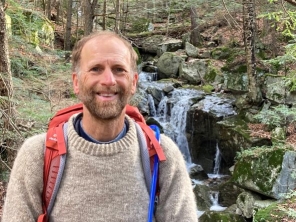
Michael J. Sheridan
Associate Professor of Anthropology
Email: msherida@middlebury.edu
Phone: work802.443.5582
Office Hours: Spring Term: Mondays and Wednesdays 10:00-11:00 and Fridays 9:00-10:00
Download Contact Information
My interest in anthropology began at Harvard in 1984. I decided to major in anthropology with an archaeological focus because it was about as far as I could get from the suburban lifestyle I had known until then. I did a lot of work on the reconstruction of symbolic systems from the archaeological record of mute stones and bones. After I graduated in 1988, I joined the Peace Corps as a water technician (based largely on my experiences in student theatre as a set designer). Just three weeks after commencement, a Peace Corps jeep dropped me and a backpack at my homestay in the village of Kinungi, Kenya. I adjusted to my new home with the Macharia family over that first weekend by learning to cook chapattis and to milk a cow without getting the Vaseline on my hands into the milk. I didn’t speak any Swahili yet, and my family didn’t speak much English. It was a pretty steep learning curve for all of us.
Peace Corps posted me to the town of Wundanyi, in the Taita Hills of southeastern Kenya. It was a beautiful place – 8000’ high rocky peaks with shrouds of cloud and rainforest, waterfalls everywhere, and miles of dirt roads that I got to know very well. My job was helping village water project committees to design and get funding for water pipelines. I taught myself enough hydraulics and survey techniques to do my job, and by the time I left in 1990 I had 11 designs finished and 2 projects funded and built. Peace Corps was an amazing experience that didn’t fit easily into the dichotomy of good and bad. All of the high points were exhilarating; all of the low points were devastating. It made me more intensely alive than I had ever been, and it thoroughly transformed me. But there was a problem – the two pipelines I had finished fell apart within a year after I left, because too many people installed illegal taps in the main pipeline. Water pressure fell, and the management committee fell apart. After I received letters about this from my friends in Taita, my innate stubbornness pushed me to understand why. What is ‘environmental management,’ anyway? How do African ideas of management differ from those of development planners? These questions sent me to grad school to pursue a Ph.D. in anthropology. I started working toward my degree in 1992, got married and moved to Vermont in 1995, did field research in Tanzania in 1997-1998, and finished my Ph.D. in 2001.
My interest in resource management expanded into a theoretical interest in how localized relationships between the cultural and biophysical worlds become transformed by their incorporation into the global economic and political system. This topic requires interdisciplinary approaches because environmental change lies at the intersection of symbolic and material processes. African agriculture, for example, often merges mundane issues like soil moisture and crop yields with metaphysical concerns about gender relations and cosmology. Understanding the causes and consequences of environmental change therefore demands a methodological holism that can draw on perspectives from the social and the natural sciences. When combined, sociocultural anthropology, environmental history, biogeography, and political ecology can bridge the artificial dichotomy of nature and culture to reveal the instability and complexity of human-land relationships. By conceptualizing human ecology as a historical process characterized more by change than equilibrium, this perspective on global environmental change can explore international relations, regional political economies, and local understandings of land use in the same intellectual framework. All of these levels of analysis are linked by nested social relations of power.
I have engaged these issues through fieldwork on agriculture, community development, and land management in the North Pare Mountains of Tanzania in 1997-1998, 2004, and 2006. My work has focused on development agency efforts to manage resources, and how those forms and meanings of conservation interact with, and often contradict, indigenous ways of doing things. I have explored this topic through irrigation management and soil and water conservation practices, but most of my recent work has involved theory-building for understanding the social and ecological contexts of sacred groves in Africa. My current work concerns the thorny issue of how the key concept of power varies cross-culturally. I argue that a more anthropological political ecology must explore how environmental management in the tropics typically leads to conflict because of contradictory assumptions about power at personal, institutional, and symbolic levels of social action.
My wife Kristina Simmons and I live in Cornwall with our daughter Gaia, son Kieran, and various critters.
Courses
Courses offered in the past four years.
▲ indicates offered in the current term
▹ indicates offered in the upcoming term[s]
ENVS 0500 - Independent Study
Independent Study
A one- or two-semester research project on a topic that relates to the relationship between humans and the environment. The project, carried out under the supervision of a faculty member with related expertise, must involve a significant amount of independent research and analysis. Students may enroll in ENVS 0500 no more than twice for a given project. (Approval only)
Winter 2010, Winter 2011, Winter 2012, Winter 2013
ENVS 0700 - ES Senior Honors Work
Senior Honors Work
The final semester of a multi-semester research project on a topic pertinent to the relationship between humans and the environment. Students may enroll in ENVS 0700 only once. (Previous work would have been conducted as one or two semesters of an ENVS 0500 Independent Study project.) The project, carried out under the supervision of a faculty member, will result in a substantial piece of writing, and will be presented to other ENVS faculty and students in a public forum. (Senior standing; ENVS 0112, ENVS 0211, ENVS 0215, GEOG 0120, and ENVS 0500; Approval only)
Winter 2011, Winter 2012, Winter 2013
IGST 0503 - African Studies Ind. Project
INTL 0503 - African Studies Ind Project
African Studies Independent Project
(Approval Required)
Winter 2010, Winter 2011, Spring 2011, Winter 2012
SOAN 0211 - Human Ecology ▲
Human Ecology
Environmental issues are also cultural and political conflicts, between competing social groups, economic interests and cultural paradigms. This course introduces students to human ecology, the study of how our adaptations to the environment are mediated by cultural differences and political economy. Topics include: how ecological anthropology has evolved as a subdiscipline, with a focus on systems theory and political ecology; how ritually regulated societies manage resources; how rural communities deal with environmental deterioration; and how contradictions between environmental protection, economic development, and cultural values complicate so many ecological issues. Limited places available for students to satisfy the College writing requirement. (SOAN 0103 or ENVS 0112 or ENVS 0211 or ENVS 0215 or BIOL 0140) 2 hrs. lect., 1 hr. disc. (Anthropology)
Spring 2010, Spring 2011, Spring 2012, Spring 2013, Fall 2013
SOAN 0232 / SOAN 0332 - Anthro of Continuity & Change ▲
Anthropology of Continuity and Change in sub-Saharan Africa
Africa has long represented primitive mysteries for Europeans and North Americans who perceived it as a "Dark Continent" full of exotic people and animals. Even now, many Americans learn little about Africa and Africans except for ‘thin’ media reports of political, economic, and ecological upheaval or persistent poverty, disease, and despair. This course provides a ‘thick’ description and analysis of contemporary African conditions using ethnographies, films, and literature. Our focus will be on understanding both continuity and change, cultural diversity, and commonality. (Not open to students who have taken SOAN 0332) 3 hrs. lect./disc. (Anthropology)/
Fall 2009, Fall 2010, Fall 2011, Fall 2012, Fall 2013
SOAN 0306 - Topics Anthropology Theory
Topics in Anthropological Theory
This course gives an introduction to some important themes in the development of anthropological thought, primarily in the past century in anglophone and francophone traditions. It emphasizes close comparative reading of selections from influential texts by authors who have shaped recent discourse within the social sciences. (SOAN 0103 or SOAN 0105) 3 hrs. lect./disc. (Anthropology)
Spring 2010, Spring 2011, Spring 2012, Spring 2013
SOAN 0359 / SOAN 0459 - Language and Power
Language and Power
This course is an introduction to both linguistic anthropology and political anthropology. Communication patterns are always mediated by cultural processes, social inequality, and power, so in this course we will investigate cross-cultural examples of how language, discourse, and representation relate to inequality, power, and resistance. Topics will include sociolinguistics, ethnolinguistics, gendered language practices, political discourse, and theoretical approaches to power (Marx, Foucault, and Bourdieu) (SOAN 0103 or SOAN 0105 or LNGT 0102) 3hrs. lect./disc. (Anthropology)
Fall 2009, Fall 2011
SOAN 0491 / FYSE 1323 - Anthro of Climate Change
Anthropology and Climate Change
Climate change has become one of the most pressing issues of the 21st century, and much of the discussion about its causes and consequences is based on the biophysical sciences and is strongly influenced by political and economic interests. Anthropology widens our perspectives on climate change. In this seminar we will examine cross-cultural case studies of past and present responses to climate change. We will look at how technological, economic, social, political, and spiritual dynamics shape the way people understand and react to climate change. Key themes will include gender and vulnerability, social-ecological resilience, climate ideologies, development policy, social scale, and ethnometeorology. (Not open to students who have taken FYSE 1323) (SOAN 0103 or ENVS 0112 or ENVS 0211 or ENVS 0215 or BIOL 0140) (Anthropology)
Fall 2010, Fall 2012
SOAN 0500 - Advanced Individual Study ▲ ▹
Prior to registering for SOAN 0500, a student must enlist the support of a faculty advisor from the Department of Sociology/Anthropology. (Open to Majors only) (Approval Required) (Sociology or Anthropology)
Fall 2009, Winter 2010, Spring 2010, Fall 2010, Winter 2011, Spring 2011, Fall 2011, Winter 2012, Spring 2012, Fall 2012, Winter 2013, Spring 2013, Fall 2013, Spring 2014
SOAN 0700 - One-Semester Senior Project ▲ ▹
One-Semester Senior Project
Under the guidance of a faculty member, a student will carry out an independent, one-semester research project, often based on original data. The student must also participate in a senior seminar that begins the first week of fall semester and meets as necessary during the rest of the year. The final product must be presented in a written report of 25-40 pages, due the last day of classes. (Sociology or Anthropology)
Fall 2009, Spring 2010, Fall 2010, Spring 2011, Fall 2011, Spring 2012, Fall 2012, Winter 2013, Spring 2013, Fall 2013, Spring 2014
SOAN 0710 - Multi-Semester Senior Project ▲ ▹
Multi-Semester Senior Project
Under the guidance of a faculty member, a senior will carry out an independent multi-semester research project, often based on original data. The student must also participate in a senior seminar that begins the first week of fall semester and meets as necessary during the rest of the year. The final product must be presented in a written report of 60-100 pages, due either at the end of the Winter Term or the Friday after spring break. (Sociology or Anthropology)
Fall 2009, Winter 2010, Spring 2010, Winter 2011, Spring 2011, Fall 2011, Winter 2012, Spring 2012, Fall 2012, Winter 2013, Spring 2013, Fall 2013, Spring 2014
SOAN 1070 / INTL 1070 - Introduction to Swahili
Introduction to Swahili and East African Culture
This course introduces students to Swahili, the lingua franca of East Africa. Students will acquire a foundation for speaking, reading, and writing Swahili, and will learn how to use it appropriately in East African culture. The use of English in the classroom will be kept to a minimum after the first meeting. Students will also be introduced to the geography, history, politics, and lifestyles of East Africa. This course is particularly useful for students who intend to do study abroad programs or tourism in East Africa because its linguistic and cross-cultural training will give them the resources to maximize such an experience. This course counts as elective credit towards the Sociology/Anthropology major. (Anthropology)
Winter 2010, Winter 2012