• J-Term 2026: Global Courses Across Three Continents

    Where Classrooms Meet the World — January Global Courses Across Three Continents

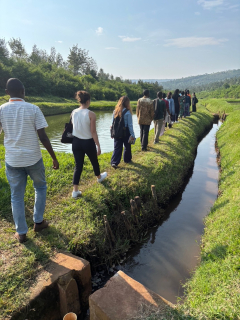
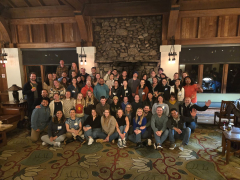
    Each January, Middlebury Institute (MIIS) students step beyond Monterey’s classrooms into immersive global courses that translate theory into lived experience. Supported by the Davis Collaborative in Conflict Transformation and MIIS Experiential Learning Funds, the 2026 Winter Term brought nearly forty students to South Africa, Czechia/Austria, and Bhutan — three distinct contexts united by a shared pedagogical model: experiential learning grounded in partnership, practice, and reflection.

  • News Stories

    How Hamas Monetized the Gaza War

    | by Amir Tadros

    The merged challenge of terrorist financing and reputational laundering is difficult terrain for governments and the private sector to navigate. Amir Tadros’s (CTEC Graduate Researcher) paper confronts that gap head-on, arguing that Hamas’s wartime narrative production functions not as atmospheric context but as core raise-phase infrastructure within the terrorist financing lifecycle. It is an original and overdue contribution, and Tadros traces how a deliberately engineered information environment activates donor networks, legitimizes sham charities, and normalizes aid diversion—all before a single dollar enters the formal financial system where existing tools can reach it.

    Hamas has been designated as a Foreign Terrorist Organization (FTO) by the U.S. Department of State since 1997. Yet, efforts to truly counter the group’s financing only began in a robust way after its deadly October 7, 2023 attack. Much work remains in countering Hamas’s manipulation, and Tadros’s paper provides a partial roadmap to do so. 

    Jason Blazakis - CTEC Executive Director

  • News Stories

    The Charities of Hamas – Designations History and Policy Recommendations

    | by Jason M. Blazakis

    It has now been more than two years since Hamas’s deadly attack in Israel. As someone who worked for more than a decade in the United States Government (USG) as head of the State Department’s Counterterrorism Bureau’s Office of Counterterrorism Finance and Designations CT/CTFD, I wanted to reflect on the financial methods, with a specific examination of charities1, that Hamas has used to finance itself.

  • A Darker Strain of Environmentalism

    | by Olivia Kilborn

    As Executive Director of CTEC, I am proud to share this Michael Donnelly Research Fellowship report—part of a tradition of rigorous, student-led analysis that reflects the very best of our Institute. Like the Donnelly Fellow reports that came before it, this paper is published in honor of Michael Donnelly, a late friend and colleague whose legacy lives on through this fellowship supporting underrepresented MIIS students.

    This report was written by Olivia Kilborn, a CTEC Michael Donnelly Research Fellow and an M.A. candidate in Nonproliferation and Terrorism Studies at MIIS. In A Darker Strain of Environmentalism, Kilborn examines the resurgence of ecofascist rhetoric in the context of the climate crisis and asks a timely question: how do online eco-fascist subcultures and far-right European political parties draw on ecofascist ideology—where do their rhetorical strategies converge, and where do they diverge? By comparing narratives across mainstream political arenas and extremist digital spaces, the report helps clarify how climate anxiety, migration politics, and identity-based grievance can be braided into exclusionary—and potentially violent—worldviews.

    — Jason M. Blazakis, CTEC Executive Director 

  • Seeds of Extremism: Ecofascism and Militant Accelerationism in a Warming World

    | by Isabela Bernardo

    As Executive Director of Center on Terrorism, Extremism, and Counterterrorism (CTEC), I’m pleased to share Seeds of Extremism: Ecofascism and Militant Accelerationism in a Warming World—a timely, rigorously researched analysis of how climate stress can be exploited by violent extremist movements, and how ecofascist narratives increasingly fuse with accelerationist tactics to produce a more dangerous hybrid threat. Grounded in a clear framework and strengthened by detailed case studies (including the 2019 El Paso shooting and an examination of the “Pine Tree Party” network), the report equips policymakers, practitioners, and researchers with the conceptual tools to recognize early warning signals, understand online radicalization 

    This research paper—written by CTEC Senior Research Analyst Isabela Bernardo—is a must-read for anyone concerned about the rise of ecofascism and its intersection with violent extremist ideologies. I also want to express my sincere gratitude to the Kathryn Wasserman Davis Collaborative in Conflict Transformation for its generous support; without it, this paper and CTEC’s work examining the dangerous edges of accelerationist culture would not be possible.

    — Jason M. Blazakis, CTEC Executive Director