
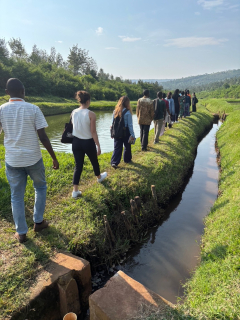
2024-2026 Experiential Learning and Research Impact Report Released
Join us in celebrating the professional and research accomplishments of Middlebury Institute students documented in our 2024-2026 annual Experiential Learning Impact Report.
1926 Items
Join us in celebrating the professional and research accomplishments of Middlebury Institute students documented in our 2024-2026 annual Experiential Learning Impact Report.

| by Jon Reidel
The sale is expected to close in September, establishing the Monterey Institute of International Studies at Soka University of America.
Noor Flanagan Almusahwi served as the 2026 Donnelly Spring Fellow at the Center on Terrorism, Extremism, and Counterterrorism. His paper argues that two decades of Western counterterrorism failure in Iraq and Afghanistan cannot be explained by thin intelligence or absent political will alone. The deeper problem was interpretive. Policymakers built legitimacy out of paperwork while the populations they governed built it out of honor, obligation, and memory. Noor calls this semiotic misalignment, and he traces it through the language of liberation in Iraq and the social cost of foreign partnership in Afghanistan. His critique of the follow-the-money orthodoxy is the sharpest section. Tracking a transfer tells you how value moved. It tells you nothing about the duty that moved it. That gap is where insurgents recruit, and Noor writes about it with the authority of someone who has lived through the conditions he analyzes.
– Jason Blazakis, CTEC Executive Director
| by Brittany West
From Monterey to the global stage, Middlebury Institute students are putting their skills to work this summer. Through applied research and practicum courses, our students are collaborating with organizations making a tangible difference worldwide while finishing their degrees.
| by Jason Warburg
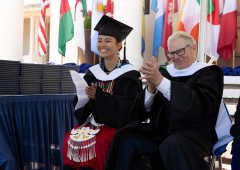
In a ceremony honoring 222 Middlebury Institute graduates from 27 countries, speakers highlighted the global community embodied by the “MIIS family” of students, alumni, faculty and staff.

| by Mikayla Parson
Three Middlebury Institute students have been named Fulbright finalists for the 2026–27 award cycle, earning opportunities to conduct research and teach abroad in Indonesia, Romania, and Panama. Their projects span climate resilience, language education, and information integrity, reflecting the global impact of MIIS students and alumni through international exchange and cross-cultural engagement.
| by Mikayla Parson
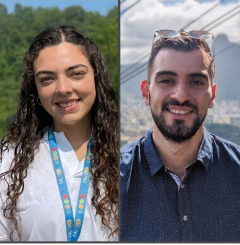
The Critical Language Scholarship (CLS) Program is a fully funded, 8–10 week summer study abroad initiative for U.S. undergraduate and graduate students, sponsored by the U.S. Department of State. It offers intensive language instruction and cultural immersion in 13+ critical languages essential for U.S. national security and economic prosperity.
| by Mikayla Parson
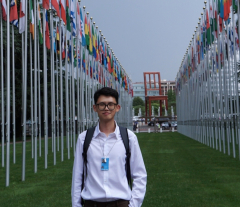
Every year one Middlebury Institute graduate students is selected for a 10k Projects for Peace Award for work completed over the summer with a local partner.

From Beijing to Tokyo, Middlebury researchers analyze the security, trade, and cultural historical tensions shaping the future of East Asian relations.
| by Amir Tadros
The merged challenge of terrorist financing and reputational laundering is difficult terrain for governments and the private sector to navigate. Amir Tadros’s (CTEC Graduate Researcher) paper confronts that gap head-on, arguing that Hamas’s wartime narrative production functions not as atmospheric context but as core raise-phase infrastructure within the terrorist financing lifecycle. It is an original and overdue contribution, and Tadros traces how a deliberately engineered information environment activates donor networks, legitimizes sham charities, and normalizes aid diversion—all before a single dollar enters the formal financial system where existing tools can reach it.
Hamas has been designated as a Foreign Terrorist Organization (FTO) by the U.S. Department of State since 1997. Yet, efforts to truly counter the group’s financing only began in a robust way after its deadly October 7, 2023 attack. Much work remains in countering Hamas’s manipulation, and Tadros’s paper provides a partial roadmap to do so.
Jason Blazakis - CTEC Executive Director