
US preparing to send hundreds of troops to Saudi Arabia amid Iran tensions
Analyzing new images from Planet Labs, Dr. Jeffrey Lewis suggests to CNN that the US is preparing to deploy troops and and stealth jets to Saudi Arabia.
494 Items
Analyzing new images from Planet Labs, Dr. Jeffrey Lewis suggests to CNN that the US is preparing to deploy troops and and stealth jets to Saudi Arabia.
“My concern is that the next step states could take is that they take it upon themselves to start designating groups [as terrorists] the federal government hasn’t,” says Jason Blazakis, director of the Center on Terrorism, Extremism, and Counterterrorism. He is quoted in a Center for Public Integrity investigative report exploring bills supported by various groups and lawmakers aimed at protecting Americans from Islamic extremism and terrorism.
“Any conclusion that this is a paradigm shift in Pakistan’s larger treatment of Lashkar is grossly naive,” Middlebury Institute Professor Jason Blazakis, director of the Institute’s Center on Terrorism, Extremism, and Counterterrorism tells ProPublica as news broke that Pakistan had yet again arrested and released militant leader Hafiz Saeed.
States can close North Korea’s “back door to luxury” by adopting the Model Law Prohibiting Luxe Goods Transfers drafted by CNS experts Leonard Spector and Catherine Dill MANPTS ‘13, as reported by the Financial Times.
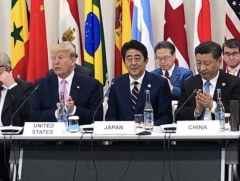
Professor Akaha shared his thoughts on Japanese Prime Minister Abe’s approach to President Trump in the East Asia Forum.
Slator, Barry Slaughter Olsen
Recently, the Pentagon released the Doctrine for joint Nuclear Operation, a 60-page paper giving the Pentagon’s insights on nuclear weapons and when to use them. The document has been taken off of the Joint Chiefs of Staff’s website, but it was archived by the Federation of American Scientists (FAS), a group that studies national and international security threats. In this Vice article, Jeffrey Lewis, director of the East Asia Nonproliferation Project, gives his thoughts on the document.
Controversy has arisen on whether a drone that was shot down was flying over Iranian territory or international waters. In a press conference, Lieutenant General Joseph Guastella said statements about the aircraft being shot down over Iran are false. However, both the U.S. and Iran will release their own versions of where the takedown occurred. On NPR’s All Things Considered, Jeffrey Lewis, director of the East Asia Nonproliferation Project, gave his two cents on the situation, stating that things can easily get out of hand when military forces are involved.
In recent years, far-right groups have been on the rise in the U.S. and around the world, with the number of violent acts committed by domestic groups on U.S. soil increasing as those by Islamist jihadists have declined. However, the U.S. does not yet have a way of addressing homegrown terrorism. If the State Department could place foreign far-right groups—those not currently designated as terrorist organizations—on the foreign terror list, the U.S. government could prosecute domestic extremist groups with ties to them. Jason Blazakis, who heads the Center on Terrorism, Extremism, and Counterterrorism at the Middlebury Institute of International Studies at Monterey was quoted in a Vice article as saying it would be positive for the State Department to use its placement tool to look at as many different groups as possible.
Washington Post, Sarah Bidgood
According to the Washington Post’s recent article on national security, U.S. military intelligence has stepped up accusations against Russia over nuclear testing. The James Martin Center for Nonproliferation Studies, located at the Middlebury Institute of International Studies in Monterey, CA, regularly monitors Russia’s Novaya Zemlya test site. According to East Asia Program Director Jeffrey Lewis, who teaches courses on arms control in the MA in Nonproliferation and Terrorism Studies program, no alarming activity has been detected.