
Learning in Crisis: A Global Pandemic in the Classroom
Middlebury Institute faculty have adjusted syllabi and teaching methods as a response to the global pandemic, at times incorporating the crisis directly into lesson plans.
| by Netta Avineri, Gabriel Guillen, and Thor Sawin
Middlebury Institute faculty members Netta Avineri, Gabriel Guillén, and Thor Sawin share their experiences cultivating mobile mindsets in Intercultural Competence (ICC) courses designed to rely heavily on personal interactions, local and global partnerships, and travel that had to be reimagined due to Covid-19. This peer-reviewed article was previously published by the World Council on Intercultural and Global Competence.
How can students respectfully engage with other cultures when they are learning from home? This article focuses on three ICC courses at the Middlebury Institute of International Studies (MIIS) that entailed travel and working with global and local partners, and were redesigned due to COVID19. We explore how faculty, students, and other stakeholders navigated global and local realities by cultivating mobile mindsets while sheltering in place. The sudden (im)mobility of learners and the design of technological platforms afforded new conversations about power and privilege, using ICC lenses. The breakdown of conceptual barriers between local and global helped learners contend with what it means to know a community and how communicating in digitally-mediated third spaces can lower the “curtain” between community and classroom. The discussion of these courses demonstrates how students can develop both nested interculturality (Avineri, 2019) and contact zone competence (Canagarajah, 2014) through ICC engagement in remote courses. “Nested interculturality” is a collective of dispositions (enduring attitudes that guide behavior) and practices (behaviors and action that embody those dispositions) for ethical engagement in intercultural interactions (Avineri, 2019, p. 37); this model foregrounds the role of tensions at micro, meso, and macro levels. “Contact zone competence” reflects skills necessary for diverse individuals to negotiate time-and-place-bound spaces of mutual attention and mutual intention, transcending (perceived) boundaries between languages and groups.
Service Learning: Domestic & International Community Partnerships
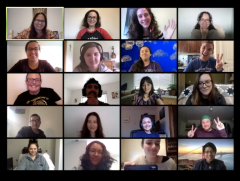
Critical service-learning (Mitchell, 2008) fosters students’ civic engagement through integrating ethical community interactions, classroom components, critical reflection, a social change orientation, working to redistribute power, and developing authentic relationships/partnerships. The sixteen students in this Spring 2020 course worked with six local partner organizations (Census 2020, higher education institution, homeless service provider, nonprofit organization, middle school, high school) and one U.S.-based minority language organization, each of which served their communities in diverse ways. Due to COVID-19, the need for service and connection intensified for many individuals and groups throughout our communities. In the course, all the critical service-learning components were flattened into online experiences. In some cases it was possible to build off relationships that had been cultivated before going online. In addition, the students and partner organizations explored the following tensions, each of which provided meaningful opportunities for critical reflection, dialogue, learning, and engagement:
Students were challenged to interact with communities in innovative and flexible ways, moving away from mobility and face-to-face communication. Through service while “sheltering in place”, students learned to strike their own balance between challenge/ risk taking and safety/comfort, a central dichotomy in the “nested interculturality” model.
Language & Peacebuilding in the Balkans
This course was designed around meeting activists in four Balkan countries to reflect on language’s role in the manufacture, perpetuation, and deconstruction of nationalism in the aftermath of regional conflicts in 1990-2000. Drawing on Oxford (2013), learners explored language in every step of enemy-creation – from othering to genocide – in the Balkans context, and hypothesized how lingua franca English and globalization might facilitate contact zones transcending ethnolinguistic, religious, migrational and generational identities.
Cancelled the day before our planned departure, our disrupted travel plans made real the dislocations experienced by survivors of the 1990’s conflicts. Passports became irrelevant. As American society rapidly shifted to paramount focus on survival, learners lived in real-time experiences of characters from the books and films assigned for the course. Before, our mobility as international graduate students seemed a form of privilege. Discussion re-centered on immobility as privilege – sheltering safely in place (in contrast to “essential workers”), not needing to flee.
With the mobility aspect of the course removed, we implemented Oxford’s peacebuilding practices into our jointly re-created one-week intensive course and our Zoom communication. Although spontaneous/emergent ICC encounters abroad were lost, participants nevertheless durably processed course content, more integrated into learners’ career plans. Learners situated the theoretical ICC concepts about language choices facilitating enemy creation and reconciliation in their own workplaces or hometowns via white papers, artwork, and digital narratives. This permanently-available collection prominently features concepts and practices from Balkan war-era conflict and inter-ethnic peacebuilding being “mobilized” to challenge the invisible curtain which separates two mobilities in our local California community – privileged international graduate students versus marginalized agricultural migrants.
Spanish in the Community
Any class seeking to blend language learning and critical language awareness should ask painful but necessary questions (Bruzos, 2017). For our Spanish in the Community course, the transition from physically taking weekly trips to Salinas for tandem learning with English speakers to virtual language exchanges required negotiating new platforms and acknowledging course participants’ differing degrees of digital access and digital fluency. Zoom alone was insufficient,and each negotiated space for remote collaboration (Whatsapp, Zoom, and phone calls) involved new asymmetries, affordances, and social engagements beyond curricular constraints.
Indeed, our transition to a collection of remote spaces allowed our learners to identify clear asymmetries, such as that some of our English learners could not shelter in place, being essential agricultural workers. Working and learning from home is a privilege and, through the semester, participants were able to exchange very different perspectives on how the pandemic affected them, their families, and their communities. In these new remote spaces, language learning was the ostensible motivation for our encounters, and yet, instructors and participants seemed to seek something else, the continuation of the social bond established in the physical world.
From a nested interculturality perspective (Avineri, 2019), these virtual encounters reflected a layered tension between partners and individuals, instructors and learners, academic and personal needs. Instructors had to recreate a community of sustained inquiry and emotional sheltering, ensuring participants could and would participate in the new format. Tasks and instructions had to be redefined, which opened the doors for more agency, relevance, and collective reflections through Whatsapp, Zoom, and GoogleDocs, among other digital spaces.
Implications
The process of reframing and reflecting on these three courses during the pandemic allowed us to draw pedagogical implications for ICC development using digital spaces. Among them:
Platforms such as Zoom can foster critical empathy and other ICC dispositions, as sketched in Table 1.
References
Avineri, N. (2019). “Nested interculturality”: Dispositions and practices for navigating tensions in immersion experiences. In D. Martin & E. Smolcic (Eds.), Redefining teaching competence through immersive programs (pp. 37–64). Basingstoke: Palgrave Macmillan.
Bruzos, A. (2017). “De camareros a profesores” de ELE: La mercantilización del español y de su enseñanza como lengua extranjera. Spanish in Context, 14, 2, pp. 230–249.
Canagarajah, S. (2014). Theorizing a competence for translingual practice at the contact zone. In S. May (Ed.), The Multilingual Turn: Implications for SLA, TESOL and Bilingual Education (pp. 78–102). New York: Routledge.
Mitchell, T. (2008). Traditional vs. Critical Service-Learning: Engaging the Literature to Differentiate Two Models. Michigan Journal of Community Service Learning, Spring, pp. 50-65.
Oxford, R. (2013). The language of peace: Communicating to create harmony. Charlotte, NC: Information Age.
Eva Gudbergsdottir
eva@middlebury.edu
831.647.6606
Middlebury Institute faculty have adjusted syllabi and teaching methods as a response to the global pandemic, at times incorporating the crisis directly into lesson plans.

Middlebury Institute Professor Pushpa Iyer shares how, as a response to the Covid pandemic, she recreated an intense storytelling course with personal connections between faculty and students at its heart, to fit the new reality of remote learning.
Middlebury Institute Professor Rana Issa recently hosted an improvised cooking lesson in Arabic, celebrating Lebanese culture and cuisine with students and their families, utilizing WhatsApp, colored pens, and pantry staples.